

In the refined landscape of 2026, a condo assignment is no longer a simple paper flip; it's a sophisticated portfolio transition that requires architectural precision and a visionary approach. You likely recognize that the GTA market has evolved, and the casual strategies of the past won't suffice in a climate defined by stricter tax enforcement and shifting valuations. Mastering toronto condo assignment sales is now the hallmark of the discerning investor who values substance, clarity, and professional excellence.
We understand the hesitation that comes with complex HST rebate eligibility or the fear of a builder refusing consent at a critical juncture. This guide promises to demystify those hurdles, offering you a clear roadmap to navigate builder restrictions and secure financing with absolute precision. We'll explore the essential payment structures between original deposits and assignment profits while identifying the specialized brokerage expertise required for these niche transactions. Prepare to unlock exclusive opportunities and handle your next milestone with the grace and confidence your modern ambitions deserve.
Key Takeaways
- Understand the legal distinction between selling a physical asset and assigning the "right to purchase" to navigate your real estate transition with precision.
- Master the two-tiered financial structure of toronto condo assignment sales to accurately calculate deposit recovery and projected profit margins in the 2026 market.
- Learn to identify and negotiate the "Right to Assign" clause within your original agreement to ensure a seamless exit strategy that secures builder consent.
- Gain clarity on the 2026 tax landscape, including HST rebate eligibility and federal anti-flipping rules, to protect your investment's net returns.
- Discover how a visionary partner utilizes meticulous contract management to bridge the gap between pre-construction and final closing with absolute confidence.
Understanding the Mechanics of Toronto Condo Assignment Sales
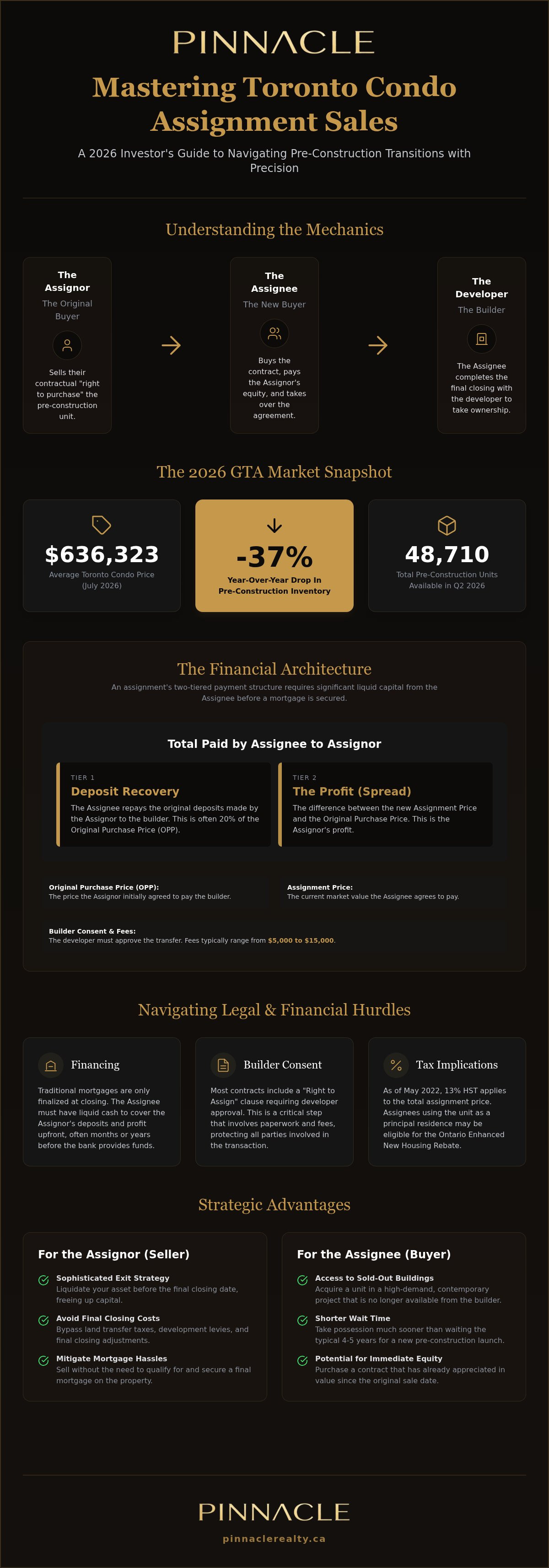
A condo assignment is the transfer of a contractual right to purchase a property, rather than the sale of the physical property itself. This distinction is the cornerstone of the legal principle of assignment, where the original purchaser, known as the Assignor, sells their interest in a pre-construction contract to a new buyer, the Assignee. Unlike a traditional resale transaction where title transfers on closing day, toronto condo assignment sales involve a two-stage process. The Assignee first pays the Assignor for their equity and profit; later, they complete the final closing with the developer to take ownership of the unit.
In 2026, this market has reached a pivotal juncture. While the broader Toronto condo market has softened with an average price of $636,323 as of July 2026, pre-construction inventory has tightened significantly. Inventory levels dropped by 37% year-over-year to 48,710 units in Q2 2026. This scarcity makes assignments a primary vehicle for investors seeking contemporary assets without the four-year wait typical of new builds. For the Assignor, it represents a sophisticated exit strategy; for the Assignee, it's an opportunity to secure a modern residence in a maturing market.
The Life Cycle of an Assignment Contract
The "Assignment Window" typically opens once a building reaches a specific construction milestone, often after the structure is topped off. A critical phase in this cycle is Interim Occupancy, where the Assignee may move into the unit and pay occupancy fees to the builder before the building is officially registered. Timing is the architect of your ROI. Selling too early might leave profit on the table, while waiting until the final closing eliminates the assignment advantage entirely. You can view current opportunities on our listings page to understand how timing influences market positioning.
Key Terminology for the Modern Investor
Success in this niche requires a meticulous grasp of contract language. The "Original Purchase Price" (OPP) is what the Assignor initially agreed to pay the builder, while the "Assignment Price" reflects the current market value. The gap between these figures, plus the original deposits, constitutes the payment required from the Assignee to the Assignor. Most contracts include a "Builder Consent" clause, which gives the developer the final authority to approve the transfer. These consent fees generally range from $5,000 to $15,000, and understanding who bears this cost is a vital part of the negotiation process. Clarity in these covenants ensures a transition handled with the precision your portfolio demands.
The Financial Architecture: Deposits, Profits, and HST
The financial architecture of toronto condo assignment sales is built on a distinct, two-tiered payment structure. Unlike a standard resale where the down payment is held in trust until closing, an assignment requires the Assignee to provide liquid capital much earlier in the process. The first tier is the recovery of the Assignor’s original deposits, which often total 20% of the Original Purchase Price (OPP). The second tier is the "spread," representing the difference between that initial price and the current market value. This profit is typically paid to the Assignor upon receiving builder consent or at another contractually agreed milestone, creating a substantial upfront capital requirement for the buyer.
Traditional mortgages present a unique challenge in this niche. Lenders generally don't advance funds to cover the assignment profit or the deposit recovery at the time of the contract transfer. Instead, a mortgage is only finalized at the final closing when the title is officially transferred from the builder to the Assignee. This means the Assignee must have the cash or alternative liquidity to secure the Assignor’s equity months or even years before the bank steps in. It's a high-stakes transition that demands meticulous financial planning and a clear understanding of your liquid position.
HST Rebates and Tax Implications
The tax landscape in 2026 is rigorous and requires a visionary approach to compliance. Since May 2022, the 13% HST has applied to the total assignment price, and the CRA meticulously scrutinizes the "intent" of the transaction. If you're an Assignee planning to use the unit as a principal residence, you may qualify for the Ontario Enhanced New Housing Rebate. For agreements entered into between April 1, 2026, and March 31, 2027, this offers a 100% GST rebate for homes valued up to $1 million. However, if the CRA determines the intent was speculative, particularly for contracts held less than 365 days, the profit is treated as 100% business income under federal anti-flipping rules. This can lead to a top marginal tax rate of 53.53% for high earners in Ontario.
Closing Costs and Hidden Levies
Beyond the purchase price, investors must account for builder-specific costs that often remain hidden to the untrained eye. Builder consent fees typically range from $5,000 to $15,000; negotiating which party absorbs this cost is a standard element of our bespoke listing services. Additionally, the Assignee inherits the responsibility for development charges, education levies, and parkland dedications at final closing. Because these levies can escalate, having a specialized real estate lawyer review the original agreement to ensure these costs are capped is essential for capital preservation. These legal fees generally range from $1,200 to $2,500, reflecting the complexity of the assignment paperwork compared to a standard home sale.
Navigating Legal Hurdles and Builder Restrictions
The legal framework of toronto condo assignment sales is defined by the developer’s terms, not the open market’s rules. Most Agreements of Purchase and Sale (APS) include a "Right to Assign" clause that is conditional, not absolute. You must secure written consent from the builder before any marketing begins. Developers often impose strict moratoriums on assignments until a certain percentage of the building is sold or construction reaches a specific milestone. A sophisticated guide understands these nuances, ensuring your exit strategy aligns with the builder’s timeline and requirements with absolute clarity.
One of the most significant hurdles is the "No MLS" restriction. Builders typically prohibit public advertising on the Multiple Listing Service to prevent assignment units from competing with their remaining inventory. This creates a need for an exclusive, off-market approach to toronto condo assignment sales. Success depends on a brokerage with a robust private network and a refined marketing aesthetic that reaches qualified investors without violating the original contract terms. Managing these delicate builder relations requires a discerning partner who values professional composure over aggressive tactics.
The Builder Consent Process
To obtain consent, the builder requires the Assignee to provide a mortgage pre-approval letter and proof of funds. This ensures the new buyer is as financially capable as the original purchaser. It's vital to recognize that the Assignor often retains lingering liability. Under the Homeowner Protection Act, 2024, the original buyer may remain responsible if the Assignee defaults before final closing. Navigating this risk requires meticulous vetting of potential buyers to protect your long-term success and ensure a smooth transition of the contract.
Documenting the Transition
The formal transfer is executed using OREA Form 150, alongside bespoke builder-specific amendments that override standard terms. These documents must explicitly state that all original upgrades, decor credits, and developer incentives, such as capped levies, transfer to the Assignee. Our Residential Listing Services focus on documenting the exact state of the contract to ensure no value is lost during the transition. By managing these communications with precision, we transform a complex legal process into a significant life milestone handled with grace.
Strategic Advantages for Buyers and Sellers in the GTA
The decision to engage in toronto condo assignment sales is often a calculated move toward financial agility. For sellers, an assignment offers a sophisticated exit strategy that preserves capital and provides liquidity before the final closing. If your personal goals or financial circumstances have shifted since the initial purchase, assigning the contract allows you to realize gains and transition into your next chapter without the carrying costs of a final mortgage. It's a refined way to manage a real estate portfolio with grace and precision.
Buyers find equal value in this niche, primarily through the gift of time. In a market where pre-construction projects often face four-year lead times, an assignment allows you to acquire a brand-new, contemporary unit that is nearing completion. You're effectively bypassing the uncertainty of early-stage construction while still benefiting from a property that has never been occupied. By leveraging our Buyer Agency Services, investors can identify off-market opportunities that aren't visible to the general public, securing a competitive edge in a tightening market.
Why Investors Target Assignments
The primary allure for the modern investor is the ability to capitalize on the time lag of construction. You're often buying at a price point established months or years prior, effectively avoiding the "Sales Centre" premium that developers charge for new releases in 2026. Because these units are new, they carry full Tarion warranty protection, offering a level of security that traditional resale properties lack. This combination of historical pricing and modern aesthetic standards creates a compelling case for those with ambitious growth targets. It's a discerning way to build equity while ensuring your assets meet the highest contemporary standards.
The Peel Region Expansion
While the downtown core remains a staple, the visionary investor is looking toward Brampton’s high-density growth corridors. The Peel Region is undergoing a significant transition, driven by massive transit infrastructure projects like the Hazel McCallion LRT. These developments are fueling demand for toronto condo assignment sales in suburban hubs where value and growth potential intersect. With the GTA benchmark home price sitting at $934,600 as of July 2026, Brampton offers a strategic entry point for those seeking architectural prominence at a more accessible valuation. Pinnacle Realty’s deep regional expertise allows us to identify these emerging clusters before they reach peak market saturation.
Ready to secure your place in the GTA's most exclusive developments? Explore our exclusive off-market listings to find your next milestone investment.
Executing a Seamless Assignment with Pinnacle Realty
Executing toronto condo assignment sales requires more than a simple listing; it demands a visionary orchestration of contract law, builder relations, and bespoke marketing. At Pinnacle Realty, we don't just facilitate transactions. We manage transitions. Our approach is grounded in the belief that every assignment is a significant life milestone that deserves a polished, professional demeanor. By focusing on clarity over chaos, we navigate the intricate web of builder consents and financial settlements with a precision that instills absolute confidence in our clients.
Success in this niche market depends on an exclusive network. Because many developers prohibit public MLS advertising, we utilize a sophisticated off-market strategy to connect assignors with qualified investors. This ensures your unit maintains its architectural prominence and perceived value without violating original purchase agreements. We handle the delicate communication with developers, ensuring that every requirement for consent is met promptly and professionally. It's a discerning process that values lifestyle alignment as much as the immediate result.
The Pinnacle Difference
Our ability to navigate these complexities stems from our rigorous Real Estate Sales Training. This program ensures our agents are not just salespeople but sophisticated guides who master the nuances of contract law and regional expertise. We maintain a consistent emphasis on contemporary aesthetic standards, ensuring that every property presentation reflects the high-end luxury our clients expect. Our process is intentional and highly organized, mirroring the seamless service experience we promise to every partner in the metropolitan market.
Your Next Chapter Starts Here
The transition from a pre-construction contract to a realized investment begins with a meticulous valuation. We analyze current market trends, such as the tightening inventory in the GTA, to position your assignment for maximum ROI. Our network includes specialized real estate lawyers and mortgage brokers who understand the unique requirements of assignment closers. This comprehensive support system allows you to move forward with your modern ambitions while we handle the technical substance of the deal.
If you're ready to transition your portfolio with grace and precision, contact Pinnacle Realty today. We're committed to your long-term success and provide the clarity needed to navigate the competitive landscape of 2026. Let us help you realize the full potential of your GTA real estate opportunities with the confidence your investment deserves.
Securing Your Future in the GTA Market
Mastering the intricate landscape of 2026 requires a discerning perspective and a commitment to architectural precision. We've explored the sophisticated mechanics of toronto condo assignment sales, from the two-tiered financial structures to the vital importance of securing builder consent. Success in this niche isn't just about the transaction; it's about managing a significant life transition with absolute confidence and grace. By understanding the spread and the evolving tax landscape, you're now positioned to unlock exclusive opportunities that others might overlook.
As GTA pre-construction specialists with deep Brampton-based local expertise, Pinnacle Realty is your partner in progress. We provide sophisticated contract negotiation and a visionary approach to off-market listings, ensuring every detail of your portfolio is handled with meticulous care. Your modern ambitions deserve a professional guide who values clarity over chaos and substance over surface-level promises. We invite you to Discover Exclusive Toronto Condo Assignments with Pinnacle Realty and take the next step in your investment journey. The path to your next milestone starts with a partner who is as invested in your long-term success as you are. We look forward to realizing your vision together.
Frequently Asked Questions
Can I list my Toronto condo assignment on MLS?
No, most builders prohibit public MLS advertising for toronto condo assignment sales to protect their remaining inventory from competition. You must typically rely on a brokerage’s exclusive network and off-market marketing strategies to reach qualified investors discreetly. Violating this "No MLS" rule can lead to the builder revoking your right to assign or even terminating the original purchase agreement. Success requires a partner who excels in private, high-end property presentations.
How much are the builder consent fees for assignments in 2026?
Builder consent fees in 2026 typically range from $5,000 to $15,000, depending on the developer and the specific project covenants. These fees cover the administrative and legal costs the builder incurs to process the contract transfer. During the negotiation phase, the Assignor and Assignee must decide which party absorbs this cost. It's a critical financial detail that we ensure is documented with absolute clarity to protect your investment's net returns.
Is the Assignee eligible for the HST New Housing Rebate?
Yes, the Assignee may be eligible for the HST rebate if they intend to use the unit as their primary residence. In 2026, the Ontario Enhanced New Housing Rebate offers a 100% GST rebate for homes valued up to $1 million for agreements entered into by March 31, 2027. If the property is intended as a rental, the Assignee must typically pay the HST upfront and apply for the rebate afterward as a landlord.
What happens to the original deposit when a condo is assigned?
The Assignee reimburses the Assignor for the original deposits paid to the builder as part of the total assignment price. This payment usually occurs when the builder provides written consent to the transfer or at another contractually agreed milestone. This structure allows the Assignor to recover their initial capital and realize their profit, while the Assignee takes over the deposit obligations and the eventual responsibility for the final balance at closing.
Can I get a mortgage for a condo assignment purchase?
You cannot obtain a traditional mortgage for the assignment contract itself; financing is only finalized at the final closing. Lenders don't advance funds to cover the "spread" or the deposit reimbursement paid to the Assignor. Assignees must have the liquid capital available to pay the Assignor upfront. This is a common hurdle in toronto condo assignment sales that requires a sophisticated financial plan and early consultation with specialized mortgage professionals.
Why do builders restrict assignment sales until a certain percentage is sold?
Builders restrict assignments to prevent early purchasers from competing with the developer’s own unsold units. By requiring a specific sales milestone, builders ensure their financial targets are met without price undercutting from individual assignors. This policy maintains the project’s market value and overall stability. Once the milestone is reached, the "Assignment Window" opens, allowing investors to transition their contracts with the builder’s formal approval and a visionary exit strategy.
What is the difference between an assignment and a "flip"?
An assignment is the transfer of a contract before the building is finished, whereas a "flip" usually involves selling a physical property shortly after taking title. Assignments happen during the pre-construction phase and involve the right to purchase, not the deed. In 2026, both are subject to strict anti-flipping rules if the contract is held for less than 365 days, which treats the profit as 100% business income rather than capital gains.
Is the Assignor still liable if the Assignee fails to close with the builder?
Yes, the Assignor generally remains legally liable if the Assignee fails to complete the final closing with the builder. Unless the developer provides a formal release of liability, the original purchaser acts as the financial backstop for the contract. The 2024 Homeowner Protection Act emphasizes this lingering obligation, making it vital to meticulously vet the Assignee’s financial capability. A professional guide ensures all parties are qualified to protect the Assignor’s long-term interests.


