

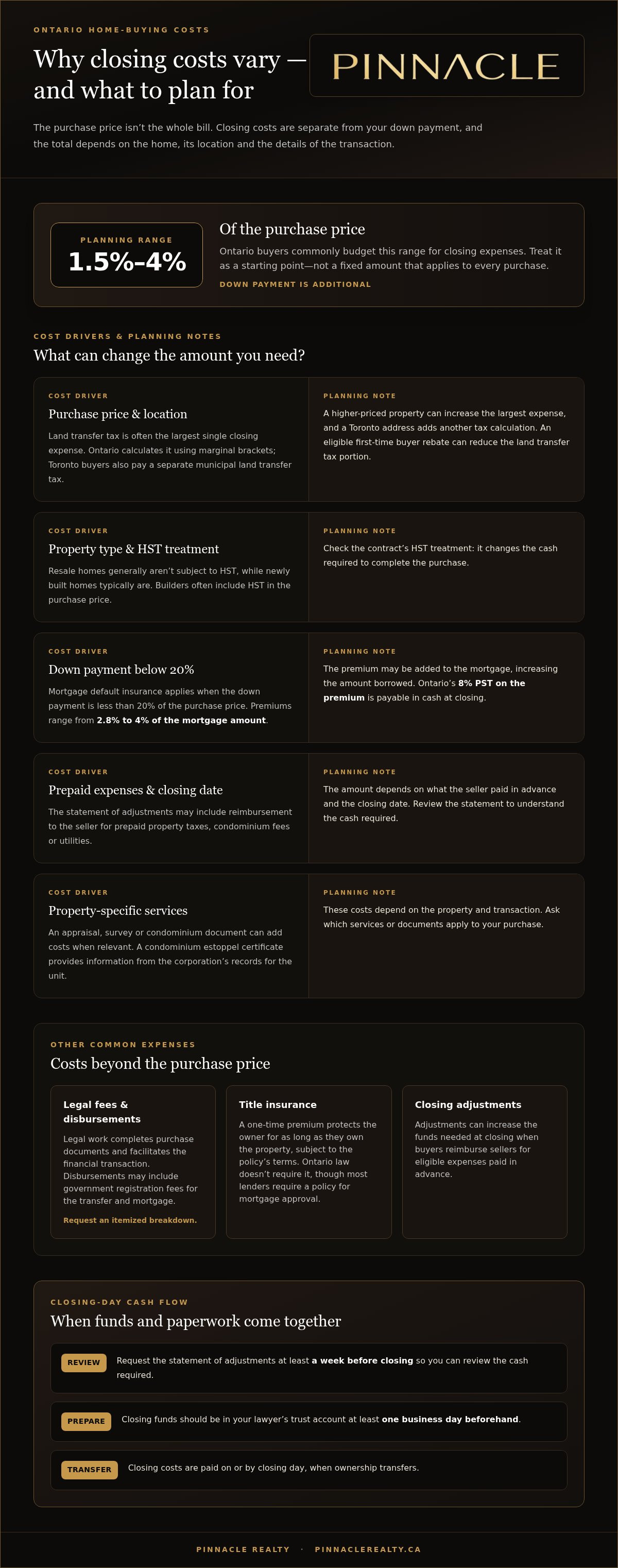
The purchase price isn’t the whole bill. Closing costs when buying a house in Ontario are generally estimated at 1.5% to 4% of the purchase price, on top of your down payment. Land transfer tax can make up the largest share, with legal work, title insurance and closing adjustments adding to the total due by closing day.
It’s easy to focus on the down payment and overlook the other funds needed to complete a purchase. Understanding what closing costs cover, how Ontario land transfer tax is calculated and which details can change the total helps you plan with greater clarity.
This guide breaks down the main expenses, explains how Toronto’s municipal land transfer tax is added to the provincial tax, and outlines the factors that shape your final bill. You’ll have a clearer picture of the cash to set aside as you prepare for your move.
Key Takeaways
- Understand how legal work and closing adjustments can change the funds you need on closing day.
- See how title insurance fits into a purchase and what protection it provides over the time you own the home.
- Compare the factors that can shift your total, including property type, appraisal needs and prepaid expenses.
- Learn how Ontario and Toronto first-time buyer rebates may reduce land transfer tax, and what eligibility involves.
What is the biggest closing cost when buying a home in Ontario?
Land transfer tax is often the largest single closing expense, especially in Toronto, where municipal tax also applies. Legal fees, title insurance, registration charges and closing adjustments add to the purchase price.
Lawyer Fees and Disbursements
Real estate legal fees cover a lawyer’s work completing purchase documents and facilitating the financial transaction. Disbursements are separate expenses incurred during the file, and may include government registration fees for registering the transfer and mortgage on title.
Ask for an itemized breakdown so you can distinguish legal fees from disbursements. A quoted legal fee may not represent the full amount due to the lawyer. Discuss the fee and its scope with your lawyer; land transfer tax, by contrast, is calculated using tax brackets, not negotiated.
Additional Fees Beyond the Purchase Price
Title insurance is a one-time premium that protects the owner for as long as they own the property, subject to the policy’s terms. Ontario law doesn’t require it, although most lenders require a policy as a condition of mortgage approval.
A condominium estoppel certificate provides information from the condominium corporation’s records for the unit. Its cost is separate from the purchase price and mortgage.
Closing adjustments can increase the funds you need. In the statement of adjustments, buyers may reimburse sellers for prepaid property taxes, condominium fees or utilities. The amount depends on what the seller paid in advance and the closing date.
Closing costs are paid on or by closing day, when ownership transfers. Your lawyer completes the transaction, and closing funds should be in the lawyer’s trust account at least one business day beforehand. Request the statement of adjustments at least a week before closing so you can review the cash required.
Is CMHC mortgage insurance a closing cost in Ontario?
CMHC mortgage default insurance applies when an Ontario buyer’s down payment is less than 20% of the purchase price. The premium is calculated as a portion of the mortgage amount, so the buyer’s down payment and loan size affect the amount. This insurance protects the lender if the borrower defaults; it doesn’t insure the home or replace title insurance.
Mortgage default insurance premiums range from 2.8% to 4% of the mortgage amount. Buyers can add the premium to the mortgage rather than pay it all upfront. That increases the amount borrowed, and interest applies to the added balance over the mortgage term. The premium is therefore a purchase expense even when it isn’t paid as a separate closing-day amount.
Ontario also charges 8% PST on CMHC mortgage insurance premiums. Unlike a premium added to the mortgage, this PST is payable in cash at closing. For example, a buyer financing a home with less than a 20% down payment must account for both the insurance premium and its tax when planning funds for the closing date.
Title insurance serves a different purpose from a title search. A lawyer searches the property’s registered title to identify ownership information and registrations that may affect the purchase. The policy is a one-time premium that protects the owner for as long as they own the property, subject to its terms. A title search examines records; title insurance covers certain title-related risks. They are related, but not interchangeable.
In Toronto and elsewhere in Canada, title insurance doesn’t pay off the seller’s mortgage or cover ordinary home repairs. It also doesn’t replace a home inspection. Lenders commonly require a policy as a condition of mortgage approval, while Ontario law doesn’t require buyers to purchase one. Reviewing the title search and insurance coverage alongside the mortgage paperwork helps clarify which risks each addresses.
Typical closing-cost range and factors affecting the total
Ontario buyers commonly budget 1.5% to 4% of the purchase price for closing expenses, separate from the down payment. A useful starting point for estimating closing costs when buying a house in Ontario is to apply that range, then account for the property’s location, type and rebate eligibility.
Estimating a Closing-Cost Budget
Closing costs are the funds reserved for expenses involved in transferring ownership, beyond the purchase price and down payment.
The range reflects the combined effect of provincial land transfer tax, Toronto’s additional municipal tax and other transaction expenses. Treat it as a planning range, not a fixed percentage that applies identically to every purchase. An eligible first-time buyer rebate can reduce the land transfer tax portion.
Factors Affecting the Total
The final amount depends first on the purchase price and location. Ontario land transfer tax uses marginal brackets, while Toronto buyers also pay municipal land transfer tax. A higher-priced property can increase the largest expense, and a Toronto address adds a separate tax calculation.
Property type also matters. Resale homes generally aren’t subject to HST, while newly built homes typically are; builders often include HST in the purchase price. The contract’s HST treatment changes the cash required. A down payment below 20% can also mean mortgage default insurance, with Ontario PST on its premium payable at closing.
Property tax and utility adjustments depend on prepaid expenses and the closing date. An appraisal, survey or condominium document can add costs when relevant. To refine your estimate of closing costs when buying a house in Ontario, consider the property’s price, location and type, as well as rebate eligibility and financing. These details explain why buyers purchasing at the same price may need different amounts to close and take ownership.
How is land transfer tax calculated in Toronto and Ontario?
Ontario land transfer tax is calculated on the property’s value using marginal brackets. Each rate applies only to the portion of the price within its bracket, rather than one rate applying to the full purchase price.
The provincial rates are 0.5% on the first C$55,000, 1% on amounts from C$55,000 to C$250,000, and 1.5% from C$250,000 to C$400,000. The rate is 2% from C$400,000 to C$2,000,000, then 2.5% above C$2,000,000. Toronto buyers also pay municipal land transfer tax, calculated in addition to the provincial tax.
For perspective, the combined provincial and Toronto tax on a C$500,000 home is C$12,950 before rebates. The exact estimate depends on the purchase price and whether the property is in Toronto.
First-Time Buyer Rebates
Eligible first-time buyers can reduce the provincial tax by up to C$4,000. In Toronto, the municipal rebate can reach C$4,475, making the maximum combined rebate C$8,475. These are rebates against land transfer tax, not a general payment toward the down payment or mortgage premium.
For the Ontario provincial rebate, buyers must be at least 18 years old, have never owned a home anywhere in the world, and intend to occupy the property as their principal residence. The rebate can fully cover provincial tax on a home purchased for up to C$368,333. Above that price, an eligible buyer may still receive the maximum rebate, but tax can remain payable.
A real estate lawyer typically applies any eligible rebate when calculating land transfer tax during the purchase process. Share the purchase details and your first-time buyer eligibility with the lawyer so the closing estimate reflects the rebate. Ontario’s rebate and Toronto’s municipal rebate have separate limits, so a buyer in Toronto may qualify for both.
Planning a purchase? Explore buyer representation as you assess the property and its purchase costs.
Pinnacle Realty: Residential Listing Services
Pinnacle Realty provides Residential Listing Services for homeowners preparing to bring a property to market. Understanding the likely costs of a purchase can also help sellers plan their next move, compare timing and consider how a sale may fit into a future home purchase.
For buyers, Pinnacle Realty’s Buyer Agency Services provide representation as they assess homes, compare property types and plan a purchase. The brokerage also handles Condominium Sales and Pre-Construction Property Sales, with options for different stages and styles of homeownership. The right next step depends on whether you’re buying, selling or coordinating both sides of a move.
Contact Pinnacle Realty to discuss your real estate plans and find support for your next transition.
Make your next move with a clear plan
A home purchase is more than a transaction. It’s a shift in how you live, where you spend your time and what you want from the years ahead. Planning for closing costs when buying a house in Ontario is one part of that decision; choosing a property that fits your priorities is another.
As you move from research to a decision, consider how location, property type and timing fit together with your broader plans. A focused conversation about your purchase can help you weigh the options and approach the next stage with greater clarity. Pinnacle Realty offers local insight and guidance to support your plans and the move ahead in Brampton.
Contact Pinnacle Realty to discuss your purchase. Take the next step with confidence and make room for the possibilities ahead.
Frequently Asked Questions
What are Closing Costs?
Closing costs are expenses involved in completing a home purchase and transferring ownership, separate from the down payment. Some arise before closing, such as a home inspection or appraisal; others are settled through the lawyer’s closing statement. For example, a buyer may need funds for legal work, tax, insurance and adjustments, even after arranging the mortgage and down payment.
How much should you budget overall?
Budget about 1.5% to 4% of the purchase price for closing costs, in addition to your down payment. The range is broad because land transfer tax, location, property type and financing affect the total. Use the higher end when planning cash until you have a detailed closing estimate.
What are the line items you'll actually pay?
Common line items include land transfer tax, legal fees, lawyer disbursements, title insurance and registration charges. Depending on the home, you may also pay for an inspection, appraisal or condominium estoppel certificate. The lawyer’s statement may include adjustments for property taxes, utilities or condominium fees prepaid by the seller. For a newly built home, HST treatment can also affect the final amount.
What rebates and savings can a first-time buyer claim?
Eligible first-time buyers can receive Ontario’s land transfer tax rebate, and Toronto purchasers may also qualify for the municipal rebate. The two rebates have separate eligibility rules and maximums, so an eligible buyer in Toronto may claim both. These reduce land transfer tax, not legal fees, insurance or other closing expenses. Ask your real estate lawyer to account for applicable rebates when calculating the amount due.
What closing costs should home buyers budget for in Ontario?
Plan for the down payment separately, then set aside funds for taxes, legal expenses, title insurance and purchase-related adjustments. A home inspection and appraisal may be additional costs, while a condominium purchase can involve its own documents and fees. New construction can bring HST considerations. Buyers with less than 20% down should also account for mortgage default insurance and Ontario PST on its premium.
How much is Ontario land transfer tax, and how is it calculated?
Ontario calculates provincial land transfer tax using marginal brackets, applying each rate only to the price portion within that bracket. Rates begin at 0.5% on the first C$55,000 and rise to 2.5% on amounts above C$2,000,000. For example, provincial tax on a C$750,000 purchase is C$11,475 before rebates. Toronto buyers pay a separate municipal land transfer tax as well.


