

What if the defining moment of your career isn't the day you receive your licence, but the moment you decide to move beyond the status quo? It's natural to feel a sense of hesitation when looking at the multi-phase educational requirements or the evolving landscape of the Trust in Real Estate Services Act. Learning how to become a real estate agent in Ontario often feels like a complex puzzle of registration fees, insurance premiums, and technical milestones. You want clarity, you want a plan, and you want to ensure your investment leads to a life of architectural prominence and professional drive.
This guide serves as your visionary partner, distilling the journey into a definitive roadmap designed for the modern professional who values both prestige and progress. We've mastered the step-by-step transition from aspiring student to licensed Ontario REALTOR® so you can focus on your long-term success. You'll find a chronological checklist for 2026, a transparent breakdown of your first-year investment, and the strategic advantage of aligning with a mentorship-focused brokerage like Pinnacle Realty. It's time to replace uncertainty with absolute confidence and begin your ascent in the competitive metropolitan market.
Key Takeaways
- Master the mandatory educational phases through providers like Humber Polytechnic to transition seamlessly from academic theory to professional application.
- Follow a definitive, chronological roadmap on how to become a real estate agent in Ontario, ensuring you meet every regulatory milestone with absolute confidence.
- Develop a precise 2026 budget that accounts for tuition, RECO registration fees, and the essential insurance premiums required to launch your career.
- Learn to evaluate brokerage models to find a partner like Pinnacle Realty that offers the specialized sales training and regional expertise necessary for the competitive GTA market.
- Establish a sophisticated foundation for your first year by mastering the CRM systems and lead generation strategies used by top-tier real estate professionals.
Prerequisites and the Regulatory Framework in Ontario
Launching a career in the GTA requires more than just ambition; it demands an alignment with a rigorous regulatory framework that ensures the highest standards of professional excellence. Understanding how to become a real estate agent in Ontario begins with recognizing that our province maintains one of the most prestigious and consumer-centric markets in the world. This structure isn't just a hurdle. It's a hallmark of quality that protects both the professional and the client during significant life milestones.
Understanding the RECO Mandate
The Real Estate Council of Ontario (RECO) serves as the administrative authority that protects the public interest and enhances consumer confidence across the province. Since the implementation of the Trust in Real Estate Services Act (TRESA), the industry has shifted toward even greater transparency and accountability. As a registrant, you'll be expected to uphold a code of ethics that prioritizes integrity over high-pressure tactics. This regulatory environment transforms the profession into a refined service, moving away from simple transactions toward a model of sophisticated, visionary partnership.
Within this framework, you'll start your journey as a Real Estate Salesperson. While both Salespersons and Brokers are registered to trade in real estate, a Broker has completed additional courses and has been registered as a Salesperson for at least 24 of the 36 months preceding their application. This distinction signals a deeper level of academic commitment and a mastery of the local landscape, positioning the Broker as a leader within a brokerage environment.
Minimum Entry Requirements
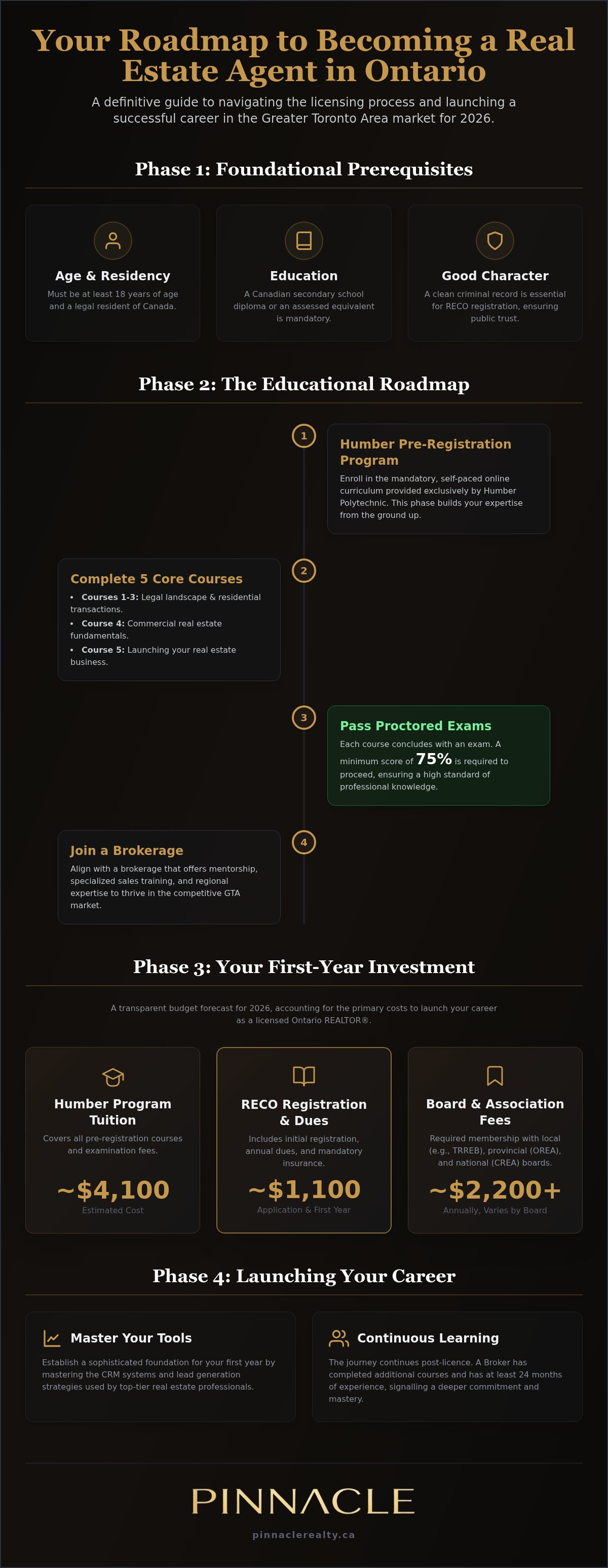
Before enrolling in the mandatory educational programs, you must meet several foundational criteria to ensure you are prepared for the professional drive required in this industry. The baseline for entry is clear and non-negotiable: you must be at least 18 years of age and a legal resident of Canada. Academic prerequisites require a Canadian secondary school diploma or an equivalent assessment to ensure all candidates possess the literacy and analytical skills necessary for complex contract navigation.
- Age and Residency: You must be 18 or older and have a valid Canadian residency status.
- Educational Background: A high school diploma is the minimum requirement, though many successful agents bring diverse post-secondary experience.
- Criminal Record Check: A clean record is essential for the mandatory RECO registration process.
The 'Good Character' requirement ensures that every registrant possesses the honesty, integrity, and financial responsibility necessary to manage client assets with absolute precision. This assessment is a vital component of the application, as public trust remains the cornerstone of the Ontario market. By meeting these prerequisites, you signal your readiness to transition into a role that demands meticulous attention to detail and a global standard of service.
The Educational Roadmap: The Humber Real Estate Program
The transition from an aspiring professional to a registered practitioner begins with a rigorous academic commitment. Mastering how to become a real estate agent in Ontario requires a deep dive into the technicalities of the market, the complexities of contract law, and the nuances of client representation. The Humber Real Estate Program is the exclusive gateway for this journey, offering a self-paced, online curriculum that balances theoretical knowledge with practical simulation.
Breaking Down the Pre-Registration Phase
The Pre-Registration phase is a structured sequence of five courses designed to build your expertise from the ground up. You'll progress from the fundamentals of real estate essentials into the detailed mechanics of residential and commercial transactions. Each course concludes with a proctored exam, requiring a minimum score of 75% to proceed. This high standard ensures that every registrant enters the market with a polished, professional foundation.
- Courses 1 to 3: Focus on the legal landscape, residential property types, and the intricacies of the listing process.
- Course 4: Expands your portfolio into commercial real estate, covering complex leasing and investment scenarios.
- Course 5: Prepares you for the practicalities of launching your business within a brokerage environment.
The Simulation Sessions act as a pivotal bridge between theory and reality. In these controlled, real-world scenarios, you'll practice drafting agreements and navigating client negotiations. It's here that you begin to develop the calm, composed demeanor necessary for high-stakes metropolitan markets. If you're looking for a partner to help translate this theory into a thriving career, consider exploring real estate sales training opportunities that complement your studies.
Timeline for Completion
Establishing a clear timeline for how to become a real estate agent in Ontario is essential for maintaining your momentum. While the Pre-Registration phase has a maximum 24-month limit, most driven candidates complete the journey within 6 to 12 months. Success in a self-paced environment requires meticulous time management and a visionary mindset. Balancing the curriculum with a full-time career is entirely achievable if you treat your study hours with the same discipline you'll eventually apply to your listings.
Once you've completed this phase, you have one year to register with RECO and begin your Post-Registration education. This second phase must be finished within your first two years of practice, focusing on specialized topics that further refine your regional expertise. This continuous growth ensures you remain a discerning partner for your clients, capable of handling every transaction with grace and precision.
Calculating the Investment: Fees, Dues, and Startup Costs
A successful transition into the Ontario market requires more than academic excellence. It demands a realistic financial strategy. While the allure of high-density listings and modern metropolitan growth is significant, your first year involves a series of intentional investments. Understanding how to become a real estate agent in Ontario means budgeting for the initial hurdles that pave the way for a premium career path.
Mandatory Regulatory and Educational Fees
The foundation of your investment lies within the educational program. When calculating how to become a real estate agent in Ontario, the minimum cost for the Pre-Registration Phase at Humber College is approximately C$4,140. When you include the post-registration requirements, the total educational outlay typically ranges between C$4,795 and C$5,800. These figures cover your primary courses and initial exams; however, you should set aside C$100 to C$150 for any necessary exam rewrites.
Once your studies are complete, the Real Estate Council of Ontario (RECO) requires an initial application fee of C$590. This is accompanied by a mandatory professional liability insurance premium, which generally costs between C$400 and C$500 annually. RECO insurance acts as a critical safeguard that protects your professional reputation and personal assets against errors or omissions during complex transactions.
Joining Organized Real Estate
To access the tools of the trade, you must join what is known as organized real estate. This is a "three-way agreement" involving the Canadian Real Estate Association (CREA), the Ontario Real Estate Association (OREA), and your local board. For many in the GTA, this means joining the Toronto Regional Real Estate Board (TRREB). This membership is essential. It provides the keys to the Multiple Listing Service (MLS®), which is the lifeblood of property data and market exposure.
- Initiation Fees: Expect a one-time entrance fee of C$460 for TRREB and approximately C$400 for OREA/CREA.
- Annual Dues: Combined annual membership dues for these organizations total roughly C$1,760.
- Operational Capital: Budget C$2,000 to C$4,000 for professional photography, CRM software, and high-end marketing materials.
Your total startup costs for the first year will likely fall between C$7,000 and C$10,000. This capital isn't just a cost. It's the fuel for your new business. It allows you to present a polished aesthetic and maintain the contemporary standards that discerning clients expect in a competitive landscape. By planning for these expenses early, you replace financial anxiety with a sense of absolute confidence in your new venture.
Choosing Your Brokerage and Completing RECO Registration
Securing your educational credentials is a significant milestone; however, it is merely the prologue to your professional narrative. In the Ontario market, your licence remains inactive until you align with a registered brokerage. This legal requirement for sponsorship is the bridge between academic theory and active practice. Understanding how to become a real estate agent in Ontario involves recognizing that your choice of brokerage will define your trajectory, culture, and long-term success.
The Brokerage Search: Finding Your Professional Home
Choosing a brokerage is a decision that should be handled with the same precision you apply to a high-end listing. You must decide between the expansive reach of traditional firms, the lean structure of virtual models, or the curated excellence of a boutique environment. For those with modern ambitions, a boutique brokerage often provides the lifestyle alignment and detail-oriented support that larger corporations lack. It is essential to ask about lead generation systems, administrative support, and the availability of seasoned mentors who understand the local landscape.
The most critical differentiator for a new registrant is the quality of in-house real estate sales training. While Humber teaches you the law, your brokerage teaches you the craft. You should carefully weigh commission splits against desk fees. A beginner often benefits more from a split model that includes robust marketing support and mentorship than a high-percentage split that leaves them isolated. If you are ready to master the GTA market with a visionary partner, explore our career opportunities at Pinnacle Realty and see how our structured approach accelerates your growth.
Finalizing Your RECO Status
Once you have found your professional home, you must move quickly. You have exactly 12 months from the date of your final exam to submit your registration application to RECO. This process is completed through the RECO MyWeb portal, where you will provide your background check results and educational transcripts. Your Broker of Record plays a central role here, as they must officially confirm their intent to employ you before RECO will process the application.
This final step transitions your status from 'Inactive' to 'Active.' It is the moment you gain the legal authority to represent clients and trade in real estate. The transition is smooth and intentional when you have a detail-oriented brokerage guiding the paperwork. Once the registrar approves your application, you are no longer just a student; you are a registered professional ready to navigate the prestigious markets of the Peel Region and beyond.
Beyond the Licence: Building a Successful Career in the GTA
Mastering how to become a real estate agent in Ontario is a technicality; building a legacy is an art. The first 90 days of your career act as the foundation for your future trajectory. It is the period where you move from a student mindset to a business owner's perspective. You must implement a sophisticated CRM, establish lead generation systems, and cultivate a network of trusted professionals. Success in the competitive metropolitan market requires more than a licence. It requires a commitment to excellence and a visionary approach to service.
Mastering the Local GTA Landscape
Authority in the real estate world is built through regional mastery. Instead of attempting to cover the entire province, the most successful agents focus their energy on specific pockets where they can offer unparalleled insight. Focusing on neighbourhoods like Dorset Park or Mount Pleasant allows you to become the go-to resource for local market conditions. Utilizing Pinnacle Realty’s listings provides a real-time data set to analyze shifts in pricing, inventory, and buyer demand with absolute precision.
Your professional network is your greatest asset. Beyond finding clients, you must build a collaborative circle of mortgage brokers, home inspectors, and legal experts. These partnerships ensure that every transaction you handle is executed with grace and technical accuracy. By positioning yourself as a deeply knowledgeable guide, you instill a sense of confidence in your clients that high-pressure tactics can never replicate.
The Pinnacle Advantage: Training for Excellence
The transition from a newly registered agent to a top-tier producer is rarely a solo journey. It requires a partnership with a brokerage that values your long-term growth as much as your immediate results. Our structured training programs are designed to bridge the gap between the theoretical knowledge gained through Humber and the practical realities of your first sale. We focus on contemporary aesthetic standards, sophisticated marketing, and the meticulous navigation of high-density pre-construction and luxury listings.
Continuous growth is the hallmark of a true professional. Whether you are mastering the nuances of commercial leasing or refining your presentation for elite residential listings, the right support system makes the difference. Ready to begin your journey? Explore career opportunities with Pinnacle Realty and align your modern ambitions with a brand that understands the future of the GTA market.
Your Ascent in the Ontario Real Estate Market
The journey from an aspiring student to a registered practitioner is a significant life milestone handled with grace and precision. You've now mastered the technical roadmap of how to become a real estate agent in Ontario, from the initial Humber educational phases to the final RECO registration. This path requires absolute confidence, meticulous financial planning, and a visionary mindset. Success isn't found in the licence alone, but in the professional drive you bring to the competitive metropolitan landscape.
Obtaining your credentials is only the beginning of your professional transition. True success in the GTA depends on the strategic partnership you build after graduation. At Pinnacle Realty, we provide bespoke real estate sales training for new agents, deep expertise in the Brampton residential market, and sophisticated marketing support for every listing. We bridge the gap between academic theory and high-end market growth, positioning you as a premier partner for modern clients.
Join the Pinnacle Realty Team: Start Your Real Estate Career Today
Your future in the Ontario market is bright. Take the first step with a partner that's invested in your long-term excellence and professional prestige.
Frequently Asked Questions
How long does it take to become a real estate agent in Ontario in 2026?
Most candidates complete the Pre-Registration Phase within six to twelve months. While you have a maximum window of 24 months to finish the initial five courses, your personal drive and schedule will dictate the pace. Understanding how to become a real estate agent in Ontario involves managing this timeline effectively. Once you pass your final exam, you have one year to register with a brokerage and begin your professional practice.
What is the total cost to get a real estate licence in Ontario?
You should budget between C$7,000 and C$10,000 for your first year of practice. This investment covers the Humber College tuition of approximately C$4,140, RECO registration fees, and mandatory professional liability insurance. It also includes initiation dues for organized real estate boards like TRREB. Planning for these costs ensures you launch your business with absolute confidence, allowing you to focus on high-end listings rather than unexpected financial hurdles.
Can I complete the Humber Real Estate Program while working a full-time job?
Yes, the program is designed for the modern professional seeking a significant life milestone without sacrificing their current income. The curriculum is delivered through a self-paced, online environment, allowing you to study during evenings or weekends. Many successful agents at Pinnacle Realty began their journey this way, balancing their existing roles with the academic commitment required to master the local landscape before transitioning into a full-time career in the GTA.
What is the difference between a real estate salesperson and a broker?
A Real Estate Salesperson is a registrant authorized to trade in real estate under a brokerage's supervision. In contrast, a Broker has completed additional advanced education and has been registered as a salesperson for at least 24 of the previous 36 months. This distinction signals a deeper level of academic mastery and professional drive. Brokers often take on leadership roles, such as a Broker of Record, guiding the firm's regulatory compliance and strategic growth.
Do I need a university degree to become a real estate agent in Ontario?
A university degree isn't a mandatory prerequisite for registration. The baseline requirement is a Canadian secondary school diploma or an equivalent assessment. However, a background in business, marketing, or architecture can provide a sophisticated foundation for your career. What matters most is your ability to navigate complex contracts with precision and your commitment to providing a global standard of service to clients in competitive metropolitan markets like Brampton and the wider Peel Region.
How do I choose the best brokerage to join as a new agent in Brampton?
Seek a brokerage that offers a visionary approach to mentorship and structured real estate sales training. As a new agent in Brampton, you need a partner with deep regional expertise and a polished aesthetic. Ask about their in-house marketing support, lead generation systems, and whether they specialize in high-density pre-construction or residential listings. Aligning with a firm like Pinnacle Realty ensures you have the support needed to turn modern ambitions into tangible success.
What happens if I fail one of the Humber real estate exams?
If you don't achieve the required 75% score, you're permitted to book an exam rewrite. These sessions typically cost between C$100 and C$150. While a setback can feel discouraging, it's a natural part of the learning curve in a prestigious industry. Use the opportunity to refine your understanding of complex market technicalities. This dedication to excellence ensures that when you finally register, you possess the absolute confidence required to represent your clients effectively.
Is the Ontario real estate market still a good career choice in 2026?
Real estate remains a premier career choice for those with a professional drive and a passion for lifestyle alignment. With average home prices in Ontario exceeding C$802,000 as of early 2026, the potential for significant growth is substantial. Learning how to become a real estate agent in Ontario prepares you for a market that rewards clarity and substance. For a dedicated professional, the GTA market offers a rewarding path of continuous growth and prestige.


