

Interest rates can shape what buyers can afford, but they’re only one influence on Brampton home values. In 2026, mortgage interest rates in Brampton were around 5-6%, while the Bank of Canada Prime Rate cited for the market was 4.45%. Lower borrowing costs can increase buyers’ spending capacity and put upward pressure on local prices.
That connection matters, but it is only one part of the picture. If you’re asking what increases property value in Brampton, consider your home’s condition and features alongside recent comparable sales, neighbourhood demand and location.
These factors work together to shape a home’s market position. Renovations do not necessarily add their full cost to the sale price, and nearby sales are useful only when the homes are genuinely comparable. Access to schools, parks, shops and transit can also influence buyer interest. Understanding these drivers gives you a more grounded basis for your next property decision.
Key Takeaways
- Interest rates influence buyers’ borrowing capacity, which can affect how much demand, and price pressure, a Brampton home attracts.
- Prioritize updates that improve everyday function and appeal, such as refreshed kitchens, efficient systems and usable finished space.
- Compare your home with recent nearby sales, accounting for property type, size, condition and features rather than relying on a broad citywide figure.
- Consider how local inventory and buyer demand shape negotiating conditions, and how those conditions can change over time.
- Access to schools, parks, shops and transit can strengthen a location’s appeal, so weigh neighbourhood amenities alongside the home itself.
Q1: How do interest rates affect my home’s value in Brampton?
Interest rates affect buyers’ budgets, which can influence demand and put pressure on home value. Lower mortgage rates can make monthly borrowing more manageable, allowing some buyers to consider a higher purchase price. In 2026, mortgage interest rates in Brampton were around 5-6%, while the Bank of Canada Prime Rate cited for the market was 4.45%. These rates shape purchasing power, but they don’t set an individual property’s sale price.
Transit and infrastructure can shape buyer interest, too. Convenient connections to Brampton transit routes, regional services and Toronto may suit commuters and buyers who value access to amenities. New or improved connections can make an area more accessible, but their effect depends on the home’s precise location, travel patterns and competing properties. Buyers consider the actual journey, not just a transit line on a map.
Property sales transactions show how these forces meet in the market. Brampton recorded 404 buy-or-sell transactions across all property types in September 2026. The average sold price fell 3.7% month over month and 8.0% year over year that month. Those figures show why a lower rate alone doesn’t guarantee a higher sale price: available homes, buyer activity and the features of recent sales also matter.
Renovations, additions and basement apartments must also meet Brampton’s zoning and permit requirements. The applicable rules depend on the property and proposed work, including its intended use and design. Before treating converted or added space as a value-enhancing feature, identify the relevant City of Brampton approvals and building requirements.
If you’re selling, compare recent sales of similar homes and assess how your property’s location and transit access set it apart. Convenient connections may appeal to buyers who value commuting options, while a longer or less practical route may carry less weight. The same transit improvement can affect nearby homes differently, depending on access, noise, parking and property type.
Interest rates are one part of a larger valuation picture. The Bank of Canada Prime Rate and mortgage rates affect affordability; transit connections and infrastructure affect convenience; completed transactions show what buyers have paid. Consider these factors together rather than estimating value from a headline rate or planned transit improvement alone. Recent comparable sales provide context, while condition, layout and location help explain a home’s position in Brampton’s market.
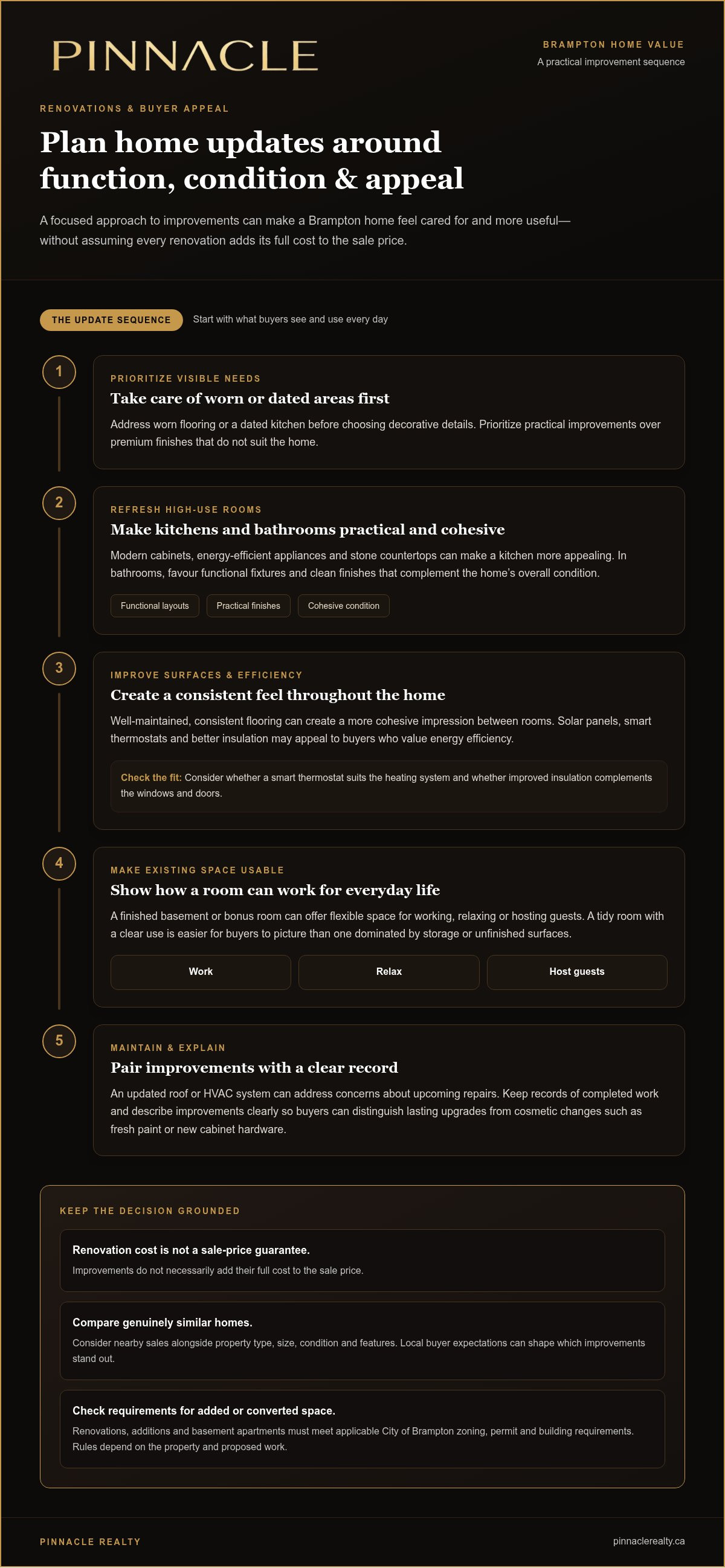
Kitchen, bathroom, flooring, and energy-efficiency upgrades
Targeted improvements can refresh a Brampton home’s appearance and everyday function. Their value depends on the property, buyer expectations and comparable homes in the area.
Kitchen and Bathroom Upgrades
Kitchen and bathroom upgrades modernize high-use rooms through practical finishes and functional layouts. In Brampton, modern cabinets, energy-efficient appliances and stone countertops can make a kitchen more appealing to buyers. A spacious kitchen with an open-concept design may also attract stronger offers and help a home sell faster. In bathrooms, prioritize a clean, cohesive finish and functional fixtures that complement the home’s overall condition.
Flooring and Energy-Efficient Upgrades
Flooring upgrades renew surfaces buyers see and use throughout the home, while energy-efficient improvements can support comfort and operating needs. Consistent, well-maintained flooring creates a more cohesive impression between rooms. Solar panels, smart thermostats and better insulation may appeal to buyers who value energy efficiency. Make the purpose and condition of these features clear during a viewing.
Finished basements and bonus rooms can add usable space for activities such as working, relaxing or hosting guests. A finished basement, for example, can give a Brampton household a separate recreation area without changing the main-floor layout. Buyers can more readily picture using a tidy, flexible room than one dominated by storage or unfinished surfaces.
Maintenance matters as much as visual upgrades. An updated roof or HVAC system can address concerns about upcoming repairs, while neglected systems may distract from a renovated kitchen. Keep records of completed work and describe improvements clearly in the home’s presentation. This helps buyers distinguish lasting upgrades from cosmetic changes such as fresh paint or new cabinet hardware.
To decide which project may support your home’s value, compare its features with similar properties in your part of Ontario. A refreshed kitchen may stand out where nearby homes have dated finishes; a finished basement may matter more when buyers need flexible living space. Consider condition, layout and buyer appeal together. Choose improvements that suit the home, not simply the latest trend.
Prioritize visible needs before premium finishes. Address worn flooring or a dated kitchen before choosing decorative details. Consider whether a smart thermostat suits the home’s heating system and whether improved insulation complements its windows and doors. A balanced plan can make the property feel cared for, efficient and coherent without relying on one standout feature.
Reviewing current Brampton property listings can help you compare layouts and finishes buyers see in the local market.
Market demand, inventory, and seasonal trends
Brampton’s real estate market responds to buyer demand, available homes and recent sales. In September 2026, the city recorded 404 buy-or-sell transactions across all property types. Over the same month, the average sold price fell 3.7% month over month and 8.0% year over year. Understanding what increases property value in Brampton means reading these market signals alongside the features of an individual home.
Inventory affects how buyers and sellers negotiate. When fewer suitable homes are available, several interested buyers may compete for one property. When inventory rises, buyers can compare more options, and sellers may need sharper pricing or presentation. Brampton’s market had higher inventory, moderated prices and longer average time on market than during the 2021-2022 peak. Current local comparisons offer a clearer guide than expectations shaped by that boom.
Seasonal timing can affect when listings and buyer activity appear. Sellers often prepare homes for market in spring, while buyers may be weighing school, work and moving plans. For a specific Brampton property, the result depends on competing listings and active buyers. A well-presented home with a realistic asking price can stand out among similar options in any season.
A comparative market analysis estimates a home’s likely market position by examining recent sales of similar nearby properties. An appraisal is a formal valuation prepared for a specific purpose, such as mortgage lending. Sellers can use a comparative market analysis to understand competing listings and completed transactions. For a useful comparison, match property type, location, condition, size and sale timing.
These measures are not interchangeable. The average reflects recorded sale prices, the median identifies the middle sale, and the benchmark represents a typical home using MLS HPI methodology. Detached homes and condominiums may differ substantially from any citywide measure.
For sellers considering what increases property value in Brampton, these figures offer context, not a price for a particular home. Focus on the property’s segment and nearby competition. If similar homes attract offers while comparable listings remain unsold, demand and pricing may be diverging. Track completed sales, active inventory and time on market together. These signals help show whether buyers respond to the asking price, the home’s features or the alternatives nearby.
Recent prices have softened: the average sold price fell month over month and year over year, amid higher inventory and longer time on market. The available market figures do not identify which property types appreciated most.
Property type and comparable neighbourhood sales
Recent Brampton prices vary by property type and neighbourhood. Detached homes typically command more than condos or townhouses because they offer more space and privacy.
Property Types and Neighbourhood Differences
Property type describes a home’s form, such as detached, townhouse or condominium; neighbourhood provides its local context. Both matter because buyers compare homes with similar space, features and surroundings. A detached home’s larger lot may set it apart from a condo, while nearby services and local demand influence each area’s appeal. Price level and appreciation are different measures: a higher-priced type has not necessarily risen faster.
For Brampton, neighbourhood ranges illustrate why a citywide estimate can be misleading. These ranges represent the 25th-75th percentile of recent sales.
Property type also changes the comparison. These figures describe different segments, not interchangeable listings.
Comparable Neighbourhood Sales
Comparable sales are completed transactions for nearby homes with relevant similarities. They help estimate value more accurately than a broad neighbourhood average because size, condition, lot and property type shape buyer comparisons. Match the home with similar sales, then account for meaningful differences. Compare a condo with similar units, not detached houses.
Recent Brampton examples show how this works. The closest matches provide context for a listing’s position.
Neighbourhood coverage matters, too: Springdale, Northwest Brampton and Bram East have distinct price bands. Use the range for orientation, then examine recent sales that match the home’s type, size and condition. Market trends are more useful when comparisons reflect the same local segment.
Location and proximity to amenities and school districts
In Brampton, nearby schools, parks, shops and transit can strengthen a home’s appeal. Buyers consider how these amenities fit their daily routines and travel needs.
Proximity to Amenities
Proximity to amenities describes how conveniently residents can reach everyday services and recreation. In Brampton, access to shops, parks and transit can make a neighbourhood more appealing to buyers. A home near transit may suit someone commuting to Toronto, while a nearby park may appeal to households seeking outdoor space. These advantages shape buyer interest alongside the home’s condition and layout.
Assess the location from a buyer’s perspective. Consider the route from the front door to a shop, park or transit stop, not just the distance on a map. A Brampton home close to transit may still feel less convenient if the route is difficult to use. A detached property near useful amenities can appeal to buyers seeking both private space and everyday access.
Convenience also involves trade-offs. A home beside a busy route may offer straightforward transit access but experience more traffic activity. Compare the immediate surroundings with nearby streets, noting differences in access, noise and privacy. These distinctions help explain why two Brampton homes with similar layouts may attract different levels of interest.
School District Proximity
School district proximity describes how a home relates to nearby schools and the routes residents use to reach them. In Brampton, access to good schools can contribute to neighbourhood appeal and home value. Buyers may consider a school’s location, the daily journey and how well the area fits their household’s needs. These preferences can influence demand for homes nearby.
For a useful comparison, identify the schools and routes relevant to a Brampton address. A nearby school may be convenient for one household, while another buyer may prioritize transit or park access. When selling, describe the location accurately and connect its features to practical routines rather than making broad claims about every buyer’s priorities.
Neighbourhood appeal also reflects how comfortable residents feel using nearby streets and public spaces. Lower crime rates can make an area more desirable and increase home value. Consider this alongside access to shops, parks, transit and schools; no single amenity defines a location. A balanced view helps explain the setting to buyers and compare nearby properties fairly.
To see how location features appear across available homes, compare Brampton property listings.
Pinnacle Realty: Residential Listing Services
Pinnacle Realty provides Residential Listing Services for Brampton homeowners preparing to sell. If you’re weighing renovations, comparable sales and neighbourhood demand, a considered listing approach can position your property around its features and current market context. The goal is to present a clear picture of the home to prospective buyers.
If you’re buying, Pinnacle Realty’s Buyer Agency Services can support your search and evaluation. The brokerage also offers Condominium Sales and Pre-Construction Property Sales for buyers considering those property types. Your next step depends on whether you’re selling, buying or exploring a new home.
For a conversation about your Brampton property plans, contact Pinnacle Realty or visit pinnaclerealty.ca.
Plan Your Property’s Next Move
Your next decision can connect today’s home improvements with what you want from your property in the future. Before committing time and effort, consider how each choice supports your plans, whether you’re preparing to sell, looking for a home that better fits your needs or exploring a condominium. Understanding what increases property value in Brampton can help you weigh your options, alongside your priorities and timing.
Pinnacle Realty offers Residential Listing Services, Buyer Agency Services and Condominium Sales to support different stages of that transition. A focused conversation can help you consider your next property decision in the context of the market.
Contact Pinnacle Realty today to discuss your plans. A thoughtful next step can bring your goals and your property journey into sharper focus.
Frequently Asked Questions
Q2: Should I renovate before selling my home?
Renovate before selling only when the work addresses a visible drawback or buyer concern. For example, repair damaged flooring, fix a leaking tap or refresh worn paint before considering a major remodel. Compare your home’s condition with similar Brampton listings and recent sales. A focused repair plan can improve presentation without committing to upgrades that buyers might not value at the same level.
Which home renovations add the most resale value in Brampton, Ontario?
Functional, broadly appealing improvements are strong candidates, including kitchen updates, finished basements and roof or HVAC improvements. The best choice depends on what comparable Brampton homes offer and what your property lacks. A dated kitchen may stand out beside updated listings, while a basement renovation offers less practical appeal if the space is awkward or poorly finished.
What is the average cost and return on investment for kitchen and bathroom renovations in Brampton?
Renovation costs and resale returns depend on project scope, materials, existing condition and the home’s position in the local market. Replacing cabinet hardware and fixtures differs substantially from changing layouts, plumbing or major finishes. Estimate the work by separating essential repairs from design choices, then compare the planned result with similar Brampton homes. Buyers assess the finished space, not your renovation receipts.
How much value do finished basements and legal basement apartments add to Brampton homes?
A finished basement can add useful living or recreation space, while a legal basement apartment may appeal to buyers seeking a separate suite. Value depends on layout, finish quality, access and comparable sales. For an apartment, zoning and building requirements matter: represent the suite’s approvals and permitted use accurately in the sale. Do not present unfinished or unapproved space as a legal rental unit.
How do Brampton neighbourhood, transit access, schools, and amenities affect property values?
Neighbourhood features influence which buyers consider a home and how it fits their routines. A Brampton address near transit, schools, parks or shops may appeal to buyers who prioritize those connections. Assess the actual route and immediate surroundings, not just a map pin. A busy road, limited pedestrian access or distance from everyday services can affect how buyers weigh an otherwise similar property.
How do lot size, home type, bedrooms, bathrooms, and parking affect Brampton resale prices?
These features shape usable space and the pool of potential buyers. MPAC considers lot size, square footage, bedrooms and bathrooms when assessing Brampton homes; buyers also compare parking and property type when evaluating sale prices. A larger lot or extra bathroom matters most when similar nearby homes offer less. Compare like with like, since detached homes, townhouses and condos attract different buyer expectations.
How do energy-efficiency upgrades and curb appeal affect a Brampton home's value?
Energy-efficiency features may appeal to buyers concerned with comfort and household energy use. Better insulation, a smart thermostat or solar panels can signal an efficiency-minded home. Curb appeal shapes the first impression: tidy landscaping, a clean entrance and maintained exterior surfaces make the property easier to assess. Present upgrades clearly, with relevant product and maintenance records available for review.
Which renovations may not pay off when selling a home in Brampton?
Highly personalized finishes, luxury features that exceed nearby homes and layout changes that reduce useful space can be difficult to recover through a sale. Elaborate built-ins, for example, may not suit buyers who prefer flexible rooms. Compare proposed work with recent sales and competing Brampton listings before starting. Prioritize safety, function and visible maintenance needs over design choices that serve only one household’s preferences.


