

The strongest move isn’t simply to join a real estate team in Brampton; it’s to choose a structure that supports the career you want to build. Apply directly to teams or brokerages, then compare expectations, commission arrangements, training, lead support and day-to-day culture before deciding.
It’s natural to focus on potential earnings, especially when weighing the costs and uncertainty of building a business. But the right fit also depends on how a team shares opportunities, develops agents and sets expectations around availability and collaboration. These details can shape your growth and work-life balance.
This guide explains how to prepare an application, compare teams or offices, and understand how commission structures affect take-home earnings. You’ll also find practical ways to assess mentorship, team culture and career development, helping you make a considered choice about your next professional step.
Key Takeaways
- Prepare a focused application that outlines your licensing status, experience, strengths and goals.
- Compare teams by the support they provide, how they share leads and what career paths they make possible.
- Read commission terms closely, including how splits, expenses and lead sources affect your earnings.
- Look beyond an office’s location: consider its training, collaboration style and expectations for availability.
- Assess whether the team’s culture and working rhythm align with the kind of long-term career you want to build.
Application instructions
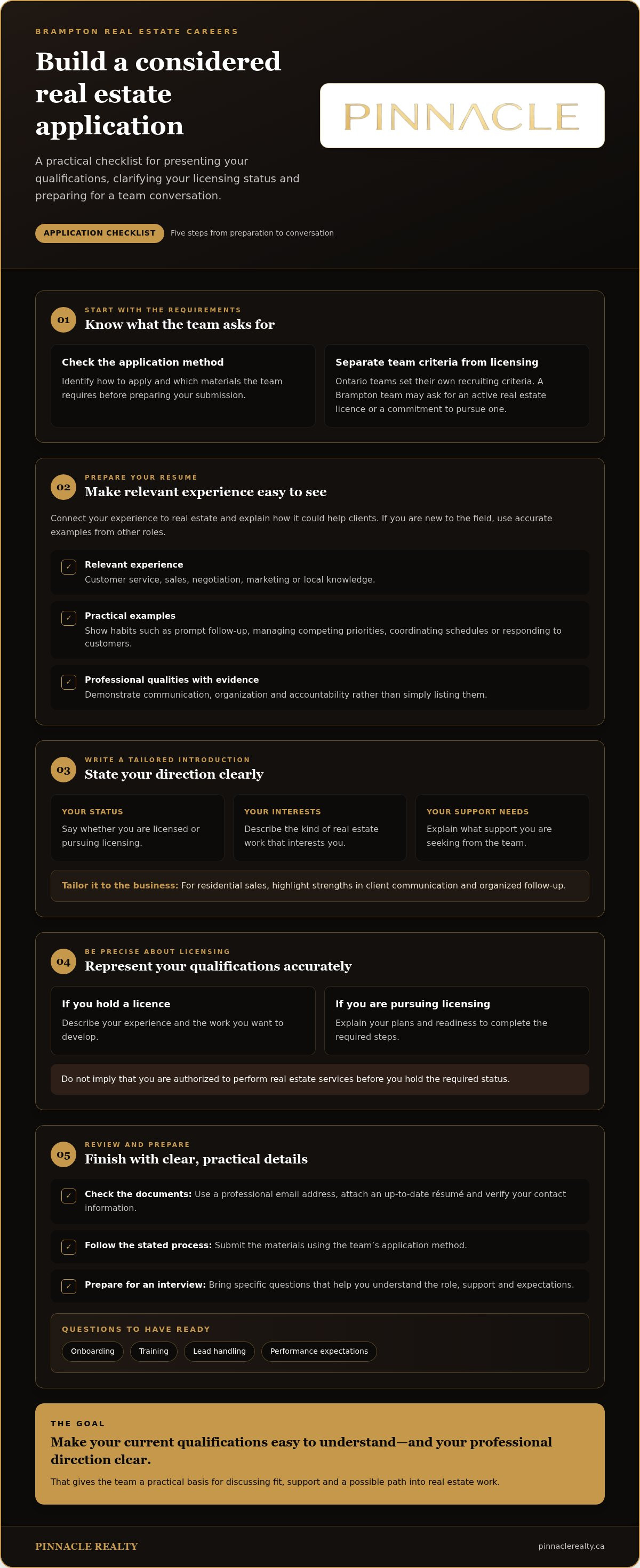
To apply, prepare a concise profile, explain your goals and show how you would serve clients. A Brampton team may require an active real estate licence or a commitment to pursue one.
Preparing an Application
Start with a focused résumé that connects your experience to real estate. Include customer service, sales, negotiation, marketing or local knowledge, then explain how each skill could help a client. If you’re new to the field, draw on examples from other roles, such as following up promptly or managing competing priorities.
Next, prepare a short introduction for the team lead or brokerage. State whether you’re licensed or pursuing licensing, what kind of work interests you and what support you’re seeking. Tailor the message to the team’s business. For example, if you’re interested in residential sales, highlight your strengths in client communication and organized follow-up.
Before sending your application, review the practical details. Use a professional email address, attach an up-to-date résumé and check that your contact information is accurate. If the team requests an interview, prepare specific questions about onboarding, training, lead handling and performance expectations. Clear questions help you understand the role rather than rely on broad promises.
Qualifications and Licensing
Ontario real estate teams can set their own recruiting criteria, so distinguish a team’s hiring requirements from the profession’s licensing process. For a Brampton team application, the entry requirement may be an active real estate licence or a commitment to pursue one. Decide which route reflects your situation, then explain it clearly in your application.
If you already hold a licence, describe your experience and the work you want to develop. If you’re pursuing licensing, be clear about your plans and readiness to complete the required steps. Don’t imply that you’re authorized to perform real estate services before you hold the required status. A clear account of your qualifications helps the team assess your potential contribution and onboarding needs.
Teams may also value professional qualities that support reliable client service. Give examples of communication, organization and accountability instead of simply listing these traits. A past role coordinating schedules, responding to customers or tracking sales leads can demonstrate relevant habits. Keep your examples accurate and concise.
Use this sequence to submit a considered application:
- Identify the team’s application method and required materials.
- Prepare a résumé and tailored introduction that state your licensing status.
- Connect your experience to the team’s clients and business focus.
- Review your documents, then follow the team’s stated submission process.
- Prepare for a conversation about training, expectations and next steps.
A strong application makes your current qualifications easy to understand and your professional direction clear. It gives the team a practical basis for discussing fit, support and a possible path into real estate work.
Career growth paths
A real estate team can offer more than a first step into sales. It can help you develop client service, market knowledge and business habits. Map out the skills you want to build, then connect each to a responsibility you could take on. For example, an agent focused on residential buyers can strengthen skills in assessing needs, researching properties and preparing offers.
Start by finding out how advancement works within the team. Some roles focus on direct client relationships; others develop expertise in listing preparation, lead follow-up or transaction coordination. Ask how agents take on more responsibility, receive feedback and access training. A clear progression links practical milestones to skills, such as independently handling client meetings or confidently explaining local market conditions.
Specialization can also shape a long-term path. An agent might focus on residential sales, condominiums, pre-construction properties or commercial real estate. Each area calls for distinct knowledge and an approach suited to its clients. For instance, commercial real estate sales involves understanding business objectives and property requirements, while residential work often centres on household needs and moving decisions.
Consider these development steps when comparing a team’s growth opportunities:
- Build core practice: Improve client communication, follow-up and market research through supervised work and regular feedback.
- Choose a focus: Match your interests to a property type or client group, then deepen relevant expertise.
- Expand responsibility: Take on more complex client conversations and contribute to team processes as your skills grow.
- Develop leadership: Look for opportunities to mentor colleagues, share knowledge or support team planning.
Brampton’s professional network is also changing. Brampton Real Estate Board members voted to join the Toronto Regional Real Estate Board, an integration bringing 2,500 BREB members into TRREB. TRREB serves almost 70,000 licensed real estate brokers and salespersons in and around the Greater Toronto Area. For an agent, a broader professional environment can make relationship-building, collaboration and local knowledge valuable parts of career development.
Growth takes more than a title. Track progress through concrete examples: a client conversation handled confidently, stronger knowledge of a neighbourhood, or a referral earned through attentive service. Team training can build these skills, while peer feedback can show where to improve. Ask how learning connects to daily work and whether development includes observation, practice and constructive review.
Before choosing a path, write down your preferred work, learning priorities and next professional milestone. Then discuss how the team’s responsibilities and training align with those aims. A considered plan helps you build a career around the clients you serve, the expertise you develop and the contribution you want to make.
Commission structure
Team commission terms determine how earnings are divided and which costs or services affect your share. In Ontario, the written team agreement should explain how leads, existing clients, pending transactions and earned commission are handled if an agent leaves. The wording matters; there is no single arrangement for every team.
Start by identifying the commission model. A team may divide commission between the agent and team, or use different terms for team-generated leads and clients the agent brings independently. For example, a client referred by the team could be treated differently from a past client who contacts you directly. The agreement should explain the method that applies to each source.
Next, trace the path from a completed transaction to your net earnings. Read how the team share is calculated, when commission becomes payable and whether additional deductions apply. A clear written example can show the sequence: the transaction closes, commission is received, agreed deductions are applied, and the remainder is allocated. Don’t compare offers using the headline split alone.
- Lead source: Identify whether the client came through team marketing, a referral or your own network.
- Included support: Clarify which services the split covers, such as lead assignment, marketing resources or transaction support.
- Expenses: Look for any separate charges, how they are calculated and when they are deducted.
- Payment timing: Understand what event triggers payment and how pending deals are treated.
- Changes to terms: Review how amendments are communicated and recorded.
Leaving requires particular care. The agreement should define who may continue serving team-generated clients, how personal contacts are treated and how commission is allocated on pending transactions. For example, a buyer who made an offer before an agent leaves may be treated differently from a new lead assigned afterward. Read the departure terms alongside the lead and commission clauses.
Before signing, flag each clause that affects money, client relationships or future work. Ask for unclear wording to be explained in writing, then compare the same terms across team offers. A useful comparison records the lead source, deductions, payment timing and departure rules in separate columns. This makes differences clear without relying on verbal summaries.
Keep a copy of the signed agreement and any written amendments. If the team discusses a special arrangement for a particular client, transaction or referral, ensure the final terms are documented through the proper agreement process. Clear records help everyone understand how commission works before a transaction begins, not after a disagreement arises.
Searching by team or office
Choose your search based on the work you want, then compare teams and brokerages using the same criteria. As a Brampton applicant, distinguish the team’s day-to-day structure from the brokerage’s oversight, location and professional environment.
Begin with a focused search for Brampton teams and offices. Use terms tied to your intended work, such as residential sales, commercial property or buyer representation. Review each team’s website and public profiles for its stated services, recruiting process and office location. Marketing can introduce a team’s focus, but direct conversations reveal how responsibilities and support work in practice.
Check registration through the Real Estate Council of Ontario (RECO). Search RECO’s public register using the brokerage’s legal name and the individual agent’s name. Compare the listed brokerage affiliation with the name on the team’s materials and application documents. This helps distinguish a branded team from the registered brokerage associated with its agents.
Build a comparison sheet before arranging conversations. Record specific details rather than impressions, including:
- Business focus: Note whether the team works mainly in residential, condominium, pre-construction or commercial real estate.
- Office arrangement: Compare the location, meeting format and how agents work together.
- Development support: Record the training, coaching and feedback described for new team members.
- Work expectations: Note how the team describes lead follow-up, client communication and availability.
- Application route: Save the required documents, submission method and contact role.
Ask the same questions in each team conversation. For example, find out how a new agent moves from observing a client meeting to managing one independently. Ask who reviews work, how team leads are assigned and what happens when several agents could serve a client. Specific scenarios make differences between offices easier to compare.
Location matters when it supports your routine and client relationships. Consider whether an office is practical for team meetings, training and serving clients across Brampton. A central address alone says little about mentorship or collaboration, so compare the actual working arrangement with your preferred schedule and business focus.
Finally, check that names match across records. If a team uses a brand name, look for the associated legal brokerage name and compare it with RECO’s records. Note any differences between a public profile, application form and registration listing. Resolve discrepancies before deciding, then weigh the confirmed details alongside the team’s culture and growth opportunities.
Team culture and work-life balance
A Brampton real estate team can provide shared expertise, peer support and structured collaboration. The trade-off may be less control over lead allocation, schedules or team processes than an independent agent has.
Team culture shows in everyday moments: how colleagues share information, respond to questions and handle busy periods. For example, clear client handoffs can reduce confusion when an agent is unavailable. A solo agent has more control over these decisions, but must organize client coverage independently.
Work-life balance depends on how the team handles availability, follow-up and shared responsibilities. Ask what happens when a client sends an evening message or a showing request conflicts with a personal commitment. A practical answer explains who responds, how urgent requests are managed and whether the arrangement works both ways.
Before joining, ask the team lead direct questions about its working norms:
- Communication: How are team updates shared, and which matters require an immediate response?
- Client coverage: Who assists when an agent is unavailable, and how are handoffs explained to clients?
- Collaboration: How are disagreements about client service or responsibilities resolved?
- Learning: What does feedback look like after a client meeting or transaction?
- Boundaries: How does the team plan for evenings, weekends and planned time away?
Use specific scenarios to understand the answers. If you’re attending a family event and a client needs a timely response, ask who covers the conversation and how the client relationship stays clear. If a colleague helps with a showing, ask how responsibilities and follow-up are coordinated afterward.
For an agent working solo, independence can mean choosing personal systems and setting a preferred pace. It also means arranging coverage, managing every inquiry and building professional support without a team structure. A team can make collaboration and shared learning part of the routine, while unclear expectations can cause friction around clients, time and credit.
Compare the team’s stated values with its behaviour during your conversations. Notice whether the lead listens carefully, explains expectations clearly and describes how colleagues work together. Ask how the team handled a recent challenge, such as a scheduling conflict or client handoff. A real example can reveal its habits more clearly than a slogan.
Write down your priorities before deciding: mentorship, autonomy, predictable routines or shared client coverage. Rank them, then assess each team against the same list. If professional development is central to your goals, explore real estate career opportunities as you consider your next step.
Pinnacle Realty: Residential Listing Services
Pinnacle Realty provides Residential Listing Services for Brampton homeowners preparing to sell. If you’re planning to list a property, the service offers professional representation through the transition. The brokerage also provides Buyer Agency Services, Condominium Sales and Pre-Construction Property Sales for different property needs across the market.
For aspiring agents, the career comparisons in this guide can clarify what matters in a team environment. For homeowners, the next step is different: consider your property goals, timing and preferred approach to selling. Pinnacle Realty can discuss Residential Listing Services in relation to your plans, without making the conversation a commitment.
Contact Pinnacle Realty to discuss Residential Listing Services or your real estate plans.
Shape your next professional move
Choosing to join a real estate team in Brampton is also a decision about the work and relationships you want to build. Let your next step reflect the clients you hope to serve, the strengths you want to develop and the professional environment where you can do your best work. A clear direction can make a career move a considered transition.
For real estate guidance connected to a move or property decision, Pinnacle Realty offers Residential Listing Services, Buyer Agency Services and Condominium Sales. These services support clients at different stages, from preparing to sell a home to exploring a condominium purchase. Understanding the client perspective can also help you define the service standards you want to bring to your career.
Whether you’re planning your next move or exploring a real estate opportunity, take a deliberate first step. Contact Pinnacle Realty to discuss your real estate needs. Your next chapter can begin with a thoughtful conversation and a clear sense of direction.
Frequently Asked Questions
How do I join a real estate team in Brampton, Ontario?
To join a real estate team in Brampton, identify teams that match your preferred client work, then follow each team’s application process. Prepare a résumé that connects your experience to real estate and clearly states your licensing status or plans. Before accepting an offer, review the written agreement and ask how onboarding, client responsibilities and transaction support work. This helps you understand the role beyond the initial interview.
Which real estate teams in Brampton are recruiting agents?
Pinnacle Realty is actively recruiting real estate professionals and provides specialized real estate sales training. Recruitment needs and role expectations can change, so focus on what each opportunity involves rather than relying on a general team listing. Consider whether the team’s client focus and learning environment suit your goals. For example, an agent building foundational sales skills may value structured training alongside opportunities to develop client relationships.
What are the typical commission splits and fees for Brampton real estate teams?
There isn’t one split or fee amount that applies to every Brampton team. The written agreement sets out how commission is divided and whether separate charges apply. Compare the full arrangement, not just the split: a higher share may come with different support or expense responsibilities. For a useful comparison, see how each agreement treats a team-generated client, your own referral and a transaction requiring additional support.
Do Brampton real estate teams charge desk fees, marketing fees, or monthly fees?
Some team agreements may include desk, marketing or recurring fees, while others handle expenses differently. Read each cost clause to see what triggers the charge, how often it applies and which services it covers. For instance, distinguish a marketing expense tied to a specific listing from a recurring office charge. Compare these terms alongside commission provisions to understand the full financial arrangement.
What should I compare when choosing a real estate team in Brampton?
Compare each team’s working style with the client experience you want to provide. Consider a realistic scenario, such as a client needing an update while you’re at a showing: who responds, and how is the next step coordinated? Also assess whether the team’s property focus matches your interests, its training addresses skills you want to develop, and its communication norms suit your working rhythm.


