

The highest brokerage split can still leave you with less in your pocket. To have real estate brokerage commission splits explained clearly, look beyond the headline percentage and follow the money from a completed transaction to your final earnings.
It’s understandable to focus on the share you keep. But gross commission isn’t the same as take-home income. Fees, transaction terms, and the support included in an agreement can all affect its value. In Ontario, commission arrangements are negotiable, so comparing them takes more than a quick look at one number.
This guide explains how commission moves from a transaction through the brokerage split, what can affect your net earnings, and how percentage, graduated, capped, and flat-fee models differ. You’ll also find a practical framework for weighing costs against guidance, training, and professional development. The right fit should support your current business and your next career step. For agents considering their brokerage environment, Pinnacle Realty’s real estate sales training and active recruitment are part of the professional-growth picture.
Key Takeaways
- With real estate brokerage commission splits explained, distinguish the commission agreed for a transaction from the separate arrangement that determines how eligible income is shared with the brokerage.
- Trace each deal from completion to payout, using the written agreement to understand the split and any defined deductions or fees.
- Compare percentage, cap-based, flat-fee, and salary or hybrid models by their calculation basis, added costs, support, and written terms.
- Use a checklist to assess the split basis, caps, payment timing, termination terms, and included services. Separate written commitments from assumptions.
- Weigh compensation alongside your career goals and preferred level of guidance. Pinnacle Realty’s real estate sales training and agent recruitment can be part of that growth conversation.
Real estate brokerage commission splits explained: what the split actually divides
A brokerage split is the agreed allocation of eligible commission income between a real estate agent and the brokerage they work with. It applies to the agent-brokerage relationship, not directly to the commission a client agrees to pay for a real estate transaction. Keeping those arrangements separate is the first step to understanding what a deal may mean for your earnings.
In Ontario, commission rates are negotiable. There isn’t one standard percentage for every transaction or brokerage. Splits can also be structured in different ways, so a headline percentage alone won’t tell you what an agent will ultimately receive.
Brokerage split versus transaction commission
The client-facing commission is negotiated between the client and the brokerage, with the agreed terms recorded in the relevant written representation agreement. For a seller, this may be set out in a listing agreement. A buyer’s written representation agreement outlines the brokerage’s services and remuneration, including what happens if the amount offered by the seller is lower than the amount agreed with the buyer. The exact terms matter.
The agent-brokerage compensation arrangement is separate. It sets out how eligible commission income is allocated between the brokerage and the agent, along with any applicable deductions or fees. General background on the broker-agent relationship and commission concepts is available in Real Estate Brokerage Commissions, but it doesn’t replace the terms of an Ontario agreement.
Don’t assume that the client-facing commission is automatically divided in a fixed formula between the listing side and buyer side. The amount and distribution depend on the applicable transaction agreements. An agent’s internal split is then calculated under their separate brokerage arrangement.
A brokerage split is the agreed method for dividing eligible commission income between an agent and their brokerage, not a standard share of every client’s transaction commission.
Gross commission, deductions, and take-home income
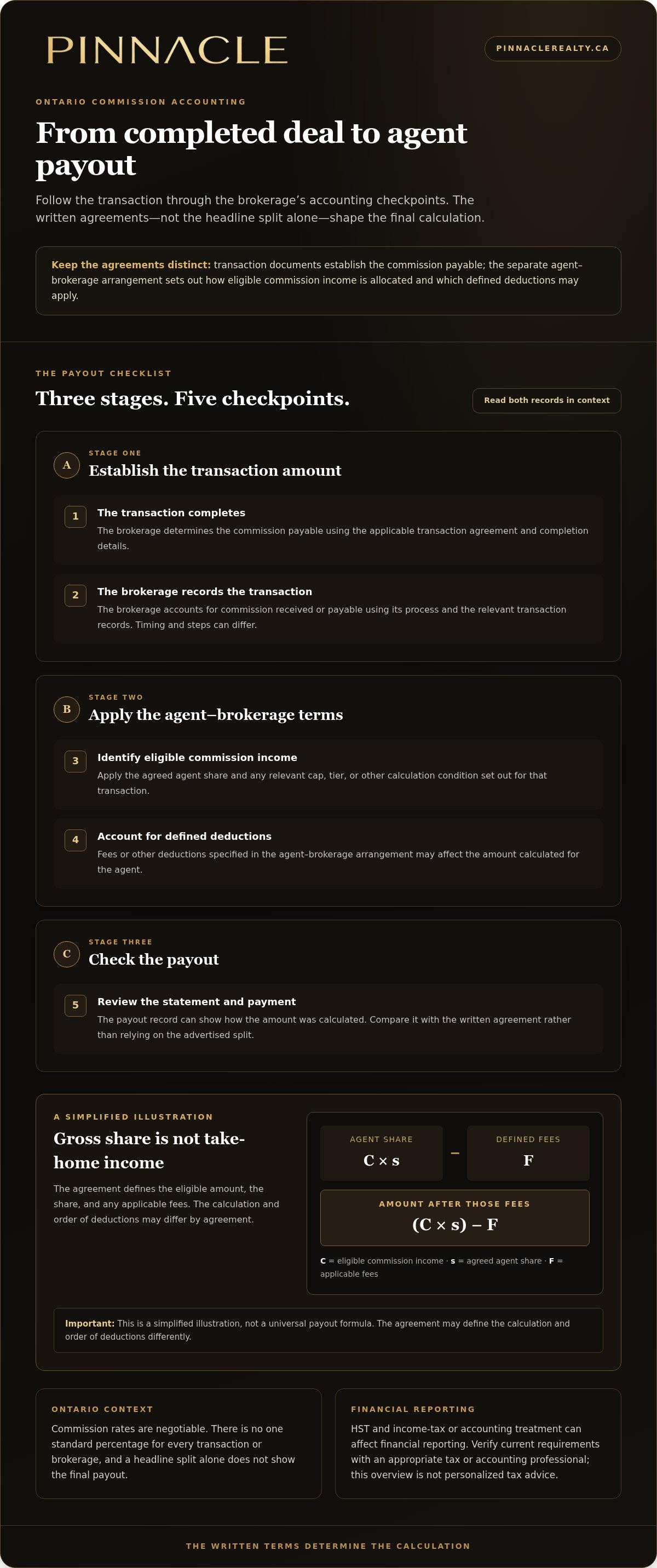
Follow the accounting in sequence: the transaction closes, commission is paid to the brokerage as set out in the transaction agreements, and the brokerage accounts for the eligible amount under its arrangement with the agent. The resulting payout may reflect deductions or fees defined in that agreement. The terms, not the advertised split alone, determine the calculation.
For a simple symbolic example, let C represent eligible commission income and s the agent’s agreed share. The agent’s share before defined fees is C × s. If applicable fees total F, the amount after those fees is (C × s) − F. This is a simplified illustration, not a universal payout formula. Agreements may define the calculation and order of deductions differently.
“Gross commission” generally refers to commission income before the agent-brokerage allocation and other applicable deductions. It isn’t the same as the agent’s final payout. HST and income-tax or accounting treatment can affect financial reporting, so verify current requirements with an appropriate tax or accounting professional. This overview isn’t personalized tax advice.
How a real estate brokerage commission split works from deal to payout
To see real estate brokerage commission splits explained in practical terms, follow a completed transaction through each accounting stage. The client’s transaction documents establish the commission payable under that agreement. The agent’s separate compensation arrangement with the brokerage determines how eligible commission income is allocated and which defined deductions may apply. The sequence can vary by agreement and brokerage process, so don’t assume one payment timeline or accounting workflow applies everywhere.
Follow the commission through a completed transaction
Think of the payout as a series of checkpoints, not a single calculation. Transaction records establish the commission amount, while the agent-brokerage agreement sets the compensation terms. Read both in context.
- The transaction completes. The brokerage determines the commission payable based on the applicable transaction agreement and completion details.
- The brokerage records the transaction. It accounts for the commission received or payable using its process and the relevant transaction records. The timing and steps can differ.
- The agreement is applied. The brokerage identifies the eligible commission amount and applies the agent’s agreed split, including any cap, tier, or other calculation condition that applies to the transaction.
- Defined deductions are accounted for. Any fees or other deductions specified in the agent-brokerage arrangement may affect the amount calculated for the agent.
- The agent receives a payout record and payment. The statement or accounting record can show how the amount was calculated. Review it against the agreement rather than relying on the headline split.
The written compensation agreement shapes the agent’s share by defining the eligible income, applicable split, and any agreed deductions. That’s why the same transaction commission could produce different agent payouts under different contractual terms.
Read a split calculation without relying on a headline percentage
Use this template to compare a calculation with the wording in your agreement:
Agent amount before tax = (G × A) − F
- G is the gross commission amount eligible for the split, as defined by the agreement.
- A is the agent’s applicable share, expressed as a decimal or percentage for that transaction.
- F is the total of applicable fees or deductions specified in the agreement.
- Agent amount before tax is the result after applying the stated share and deductions.
Before using the formula, substitute the agreement’s actual definitions. Check whether the split is calculated before or after specified deductions, whether a cap or production tier changes the applicable share, and whether a transaction-specific fee applies. Don’t insert an assumed Ontario rate. The written terms and transaction circumstances determine the inputs.
Keep tax treatment separate from this simplified illustration. HST and income-tax or accounting questions depend on current requirements and the agent’s circumstances. Seek qualified accounting guidance for advice specific to your situation.
For agents weighing compensation alongside professional development, Pinnacle Realty’s real estate sales training is part of the brokerage’s focus, alongside active recruitment of real estate professionals.
Compare brokerage commission split models by their full terms
Different compensation structures can produce very different results, even when their headline terms sound straightforward. To compare options, look at the calculation method, any additional charges, and what the arrangement says about support. The models below are possibilities, not promises that a particular structure is available from every brokerage.
| Model | Calculation basis | Potential added fees | Support considerations | Questions for the written terms |
|---|---|---|---|---|
| Percentage-based | Eligible commission income is divided according to an agreed percentage. | Transaction or other defined fees may apply. | Support depends on what the agreement or related documents specify. | What income is split, and which deductions apply before or after the split? |
| Cap-based | A share is paid to the brokerage until an agreed cap or threshold is reached. The terms then determine what changes. | Transaction fees or other charges may continue after a cap is reached. | Confirm whether support terms change when the cap is reached. | How is the cap calculated, when does it reset, and what charges remain? |
| Flat-fee | Compensation may involve a set fee per transaction or on another stated basis instead of a percentage allocation. | Other charges may apply if the agreement provides for them. | Identify which services or resources are included, if any. | When is the fee due, what does it cover, and are there additional deductions? |
| Salary or hybrid | May combine salary with commission, incentives, or another stated compensation method. | Any applicable deductions or conditions should be defined in writing. | Clarify whether training, marketing, administrative, or technology support is specified. | How is variable compensation calculated, and what conditions affect eligibility? |
Compare the full terms, not just the model label
A cap doesn’t automatically mean an agent keeps all commission after reaching it, and a flat fee doesn’t automatically include every service. Likewise, a higher percentage share doesn’t show what fees may reduce the payout. The agreement defines the details: calculation basis, thresholds, charges, timing, and conditions. Treat the model name as a starting point, not a complete description of the offer.
For a practical comparison, apply each arrangement’s written terms to the same realistic picture of your business. Consider your expected transaction volume and mix, including periods with fewer completed deals. Record the estimated brokerage allocation and all stated fees for each scenario. This won’t predict future earnings, but it can show how sensitive each structure is to production levels and additional costs.
Weigh compensation alongside working needs
Salary or hybrid arrangements differ from commission-only splits because compensation may include a fixed component or other conditions. Don’t assume a model name includes training, marketing, administrative help, or technology. Compare only support described in the agreement or related written materials, and consider whether it matches your experience, working style, and goals.
There’s no universally best structure. Your transaction volume, career stage, and preferred level of guidance all matter. A clear comparison brings the trade-offs into focus: calculation, cost, conditions, and support.
Assess an Ontario brokerage offer beyond the commission split
A clear offer should explain not only how commission is divided, but how the arrangement works across your business. Understanding a split is useful only if you also consider the full picture: calculation terms, costs, timing, changes to the relationship, and the support described in writing.
Compare the complete agreement and support structure, not the split alone. Use this checklist to organize your review and note any point that remains unclear.
- Split basis: Identify how the applicable share is calculated, what income it applies to, and which transaction types or conditions are covered.
- Deductions and fees: Record each stated charge and when it is applied in the calculation. Separate written terms from estimates or verbal descriptions.
- Caps or thresholds: If the arrangement includes a cap or production threshold, note how it is calculated, when it resets, and whether other charges continue.
- Payment timing: Find the written terms describing when an agent payout is processed and what transaction or accounting conditions affect it.
- Changes or termination: Review how the agreement describes changes to the brokerage relationship, outstanding transactions, and any amounts still payable. Don’t assume an informal explanation changes the written terms.
- Services and support: List the training, marketing, administrative, or technology support expressly described in the agreement or related written materials. Don’t treat a model label or conversation as a guarantee of specific services.
Check the written terms and Ontario references
For each item, note whether it appears in the agreement, another written document, or was explained verbally. This helps separate confirmed terms from assumptions before you decide. If documents use different wording, flag the discrepancy for clarification rather than treating one interpretation as settled.
Use current authoritative Ontario guidance for regulatory terminology and disclosure requirements. Consult the latest information from the Real Estate Council of Ontario (RECO) and review the relevant provisions of the Trust in Real Estate Services Act, 2020 (TRESA). This checklist is a comparison tool, not a legal interpretation. Seek qualified advice about your specific agreement.
Match the arrangement to your business and support needs
Test the written terms against your expected business, not a broad earnings claim. Build a few scenarios from your anticipated transaction mix and timing, including a slower period. Apply only the agreement’s stated calculation and fees. This can show how the arrangement fits your working assumptions without suggesting that a particular result is assured.
For agents serving Brampton and the surrounding GTA, consider whether the brokerage’s local focus aligns with your intended clients and property types. Give training and development real weight if they’re priorities in your next career chapter. Pinnacle Realty provides real estate sales training and actively recruits real estate professionals. Explore Pinnacle Realty’s agent opportunities as you consider your brokerage fit.
Choose a brokerage arrangement that supports your next career chapter
A brokerage decision shapes more than the amount allocated from a transaction. It influences the professional environment in which you build your business, develop your skills, and serve clients. Understanding commission splits is a useful starting point, but an informed choice also weighs the full written arrangement against your priorities.
What to weigh when choosing your professional environment
Start with the agreement: understand how compensation is calculated, what charges or conditions apply, and what support is described in writing. Then consider your business goals. An agent building experience may value a different level of guidance than someone focused on refining an established practice. Neither goal makes one compensation model universally better.
Consider fit, too. If you plan to serve clients in Brampton and the surrounding GTA, assess whether the brokerage’s local focus aligns with your intended clients and property mix. Residential and commercial work can call for different day-to-day priorities. Keep those priorities, your development plans, and the complete agreement in view together.
Explore a GTA brokerage focused on training and recruitment
Pinnacle Realty is a GTA brokerage focused on residential and commercial real estate, and it actively recruits real estate professionals. Its stated approach brings together elevated marketing, sharp negotiation, local insight, and clear guidance. The brokerage also provides real estate sales training, a relevant consideration for agents who weigh professional development alongside compensation in their next career move.
As you compare brokerage environments, consider what helps you progress with confidence: clear terms, a strong fit with your intended market, and development that aligns with your ambitions. Pinnacle Realty’s focus may be relevant to agents exploring their next professional chapter. Ground your decision in your goals and the written terms of any arrangement.
Explore a GTA brokerage focused on clear guidance and professional growth.
Make your next move with intention
Your next brokerage decision can be more than a change in how compensation is calculated. It can mark a deliberate shift in how you want to work, what you want to strengthen, and where you hope your business will grow. Use your understanding of commission splits as a foundation, then consider the professional environment that best fits the direction you’re building toward.
A thoughtful next step is to clarify your priorities, the kind of guidance you value, and the market you want to serve. Pinnacle Realty brings together a focus on professional growth with elevated marketing, sharp negotiation, and local insight for agents exploring their next chapter.
Explore a GTA brokerage focused on clear guidance and professional growth and consider whether Pinnacle Realty could be the right setting for your ambitions. Your next chapter can start with clarity and a confident sense of direction.
Frequently Asked Questions
What is a real estate brokerage commission split?
A real estate brokerage commission split is the compensation arrangement that sets how eligible commission income is allocated between an agent and their brokerage. It’s separate from the commission terms agreed with a buyer or seller. For example, two agents involved in similar transactions could receive different amounts if their brokerage agreements use different structures or define eligible income differently. The written terms determine the calculation.
Is an agent-brokerage split the same as the commission paid on a home sale?
No. The commission paid for a home sale is established through the client’s transaction agreement with the brokerage. The agent-brokerage split is governed by a separate compensation arrangement. If a seller’s transaction agreement provides for payment to more than one brokerage, that division still doesn’t set the internal share an individual agent receives. Keep the client agreement and the agent’s compensation terms distinct when reviewing a deal.
How much commission does a real estate agent keep in Ontario?
There’s no single amount or percentage that every Ontario agent keeps. The payout depends on the agent’s agreement, the eligible commission for a transaction, and any stated fees or conditions that apply. To estimate your share, apply those written terms to a transaction scenario you expect, then account separately for tax and business expenses. The result is an estimate, not guaranteed income.
Can a real estate agent negotiate a brokerage commission split?
An agent can discuss the proposed compensation arrangement with a brokerage before agreeing to its terms. Focus on more than the percentage: clarify the calculation basis, any thresholds or caps, additional charges, and what support is included in writing. If a term changes after a production threshold, for instance, identify exactly how that change is documented. Review the final agreement carefully so your decision reflects the terms that will govern your work.
What happens if a brokerage charges fees in addition to its commission split?
Any fees defined in the agreement can reduce the amount an agent receives from eligible commission income. The effect depends on the fee type and how the agreement says it is applied. To see the practical impact, list each charge beside the relevant transaction or accounting period, then compare the resulting payout with the stated split. Keep this calculation separate from personal income-tax advice, which depends on individual circumstances.
Which brokerage commission split model is best for a new agent?
No model is automatically best for a new agent. Consider how predictable your early transaction volume may be, how you prefer to manage ongoing costs, and what training or guidance the written offer describes. A new agent building a business in Brampton, for example, can test the terms against realistic expectations rather than relying on another agent’s production history. Choose for fit, not just a headline percentage.
Does Ontario set one standard commission split for real estate agents?
No. Ontario doesn’t set one standard percentage that every real estate agent must keep under a brokerage arrangement. Compensation terms vary by agreement, and client-facing commissions are negotiable rather than fixed at a mandated industry rate. A percentage presented as universal shouldn’t be treated as a rule. Read the actual written terms and distinguish the client’s transaction commission from the agent’s separate brokerage compensation arrangement.


