

Selling a home due to divorce in Brampton involves more than choosing a listing price. For married spouses in Ontario, Part I of the Family Law Act governs equalization of net family property, with assets and debts valued on the date of separation. If the home was the matrimonial home on that date, its full value is included in the equalization calculation, even if one spouse bought it before the marriage.
When a shared home becomes part of a separation, it helps to understand the available paths. A sale, a buyout or a delay can each affect timing, cooperation and how proceeds are handled. Agreeing on the real estate process does not resolve every family-law issue.
This article explains how equalization connects to the home, what sale preparation can involve, and what may happen when one spouse won’t cooperate. It also explores how a neutral REALTOR can help keep the transaction focused on practical decisions, clear communication and the next stage of life.
Key Takeaways
- Compare a sale with a buyout or a delayed sale by considering how each option affects timing, proceeds and the next housing decision.
- Coordinate valuation, mortgage responsibilities and sale preparation so practical decisions are clearer before the home goes to market.
- Understand how consent and ownership affect the sale process when spouses disagree, and what legal routes may address a deadlock.
- A neutral REALTOR can help keep pricing, marketing and transaction communication focused on the property rather than the separation.
Equalization of net family property
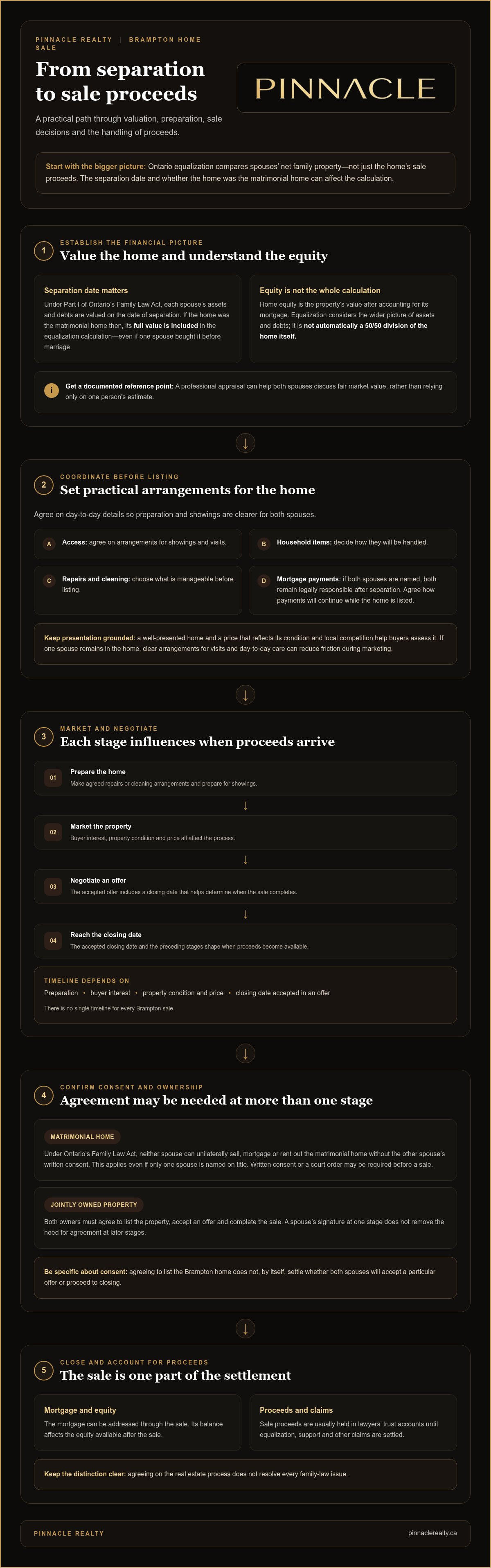
Ontario equalization compares spouses’ net family property, not just the home’s sale proceeds. When selling a home due to divorce in Brampton, the separation date and whether the property was the matrimonial home can affect the calculation.
Mortgage responsibilities in a home sale
A mortgage is debt secured against the home, and its balance affects the equity available after a sale. If both spouses are named on the mortgage, both remain legally responsible for payments after separation. The mortgage can be addressed through the sale, but until then, missed payments can affect both borrowers. Agreeing on how payments will continue while the home is listed can help avoid confusion.
Dividing home equity
Home equity is the property’s value after accounting for its mortgage, and it forms part of the wider equalization picture. Under Part I of Ontario’s Family Law Act, each spouse’s assets and debts are valued on the date of separation. If the home was the matrimonial home on that date, its full value is included, even if one spouse bought it before marriage. Sale proceeds are usually held in lawyers’ trust accounts until equalization, support and other claims are settled.
Equalization isn’t automatically a 50/50 division of the home itself. For example, subtract an account’s value at the beginning of the marriage from its value at separation, then divide the difference in half. This illustrates how changes in property value can matter alongside other assets and debts. That broader calculation shapes how home equity fits into the settlement.
Valuing the home for divorce
In divorce proceedings, a home’s value is its fair market value, assessed in the context of the property and the market. A professional appraisal can provide both spouses with a documented reference point when discussing the home’s worth, rather than relying only on one person’s estimate. This is a practical valuation step when selling a home due to divorce in Brampton.
Section 18 of Ontario’s Family Law Act defines a matrimonial home as property ordinarily occupied by spouses as their family residence at separation. The Act’s property-division and matrimonial-home rules apply to married spouses, not automatically to common-law partners. Common-law partners may claim a home interest through a constructive trust, but don’t automatically share its value under matrimonial-home rules. Ownership and relationship circumstances therefore matter.
Preparing for a home sale during separation
A separation sale involves decisions about taxes, preparation and timing. Each can affect the net proceeds and the transition to separate homes.
Tax implications of selling the home
Tax implications partly depend on whether the property qualifies for Canada’s principal residence exemption. For most divorcing couples, selling a principal residence does not trigger capital gains tax under that exemption. The tax treatment is a separate consideration from other financial questions involved in separation.
A couple can designate only one principal residence per year between them. If the spouses own or have designated another property, this limit may affect how they plan the sale and report the property. A spouse buying out the other’s share may be able to transfer it under spousal rollover rules without an immediate capital gain. Consider the tax treatment alongside sale and buyout discussions.
Sale timing and local market factors
There is no single timeline for every Brampton sale. The time required depends on preparation, buyer interest, the property’s condition and price, and the closing date accepted in an offer. The process has several stages: preparing the home, marketing it, negotiating an offer and reaching the closing date. Each stage affects when proceeds become available.
Before listing, agree on practical matters such as access for showings, household items, and which repairs or cleaning are manageable. A well-presented home and a price that reflects its condition and local competition help buyers assess it. If one spouse remains in the property, clear arrangements for visits and day-to-day care can reduce friction during marketing.
Compare Brampton properties currently on the market to understand how features and presentation vary across listings. Reviewing Brampton property listings can offer a useful point of comparison as you prepare your own home for buyers. Keep the agreed sale schedule aligned with both spouses’ housing plans and the closing date in the accepted offer.
Selling when a spouse will not cooperate
Disagreement can affect the listing, offer acceptance and closing. In Ontario, the required consent depends partly on whether the property is a matrimonial home or jointly owned.
Legal documents for the home sale
Written consent or a court order may be required before a matrimonial home can be sold. Under Ontario’s Family Law Act, neither spouse can unilaterally sell, mortgage or rent out the matrimonial home without the other spouse’s written consent. This applies even if only one spouse is named on title, because both spouses have equal rights to possess the home.
For jointly owned property, both owners must agree to list it, accept an offer and complete the sale. A spouse’s signature at one stage does not remove the need for agreement at later stages. The sale can stall if one owner will not sign the listing, accept an offer or complete the closing documents.
Make sure written consent clearly states which transaction it covers. For example, agreeing to list the Brampton home does not, by itself, settle whether both spouses will accept a particular offer or proceed to closing.
Court orders for the home sale
Ontario courts can address specific home disputes through orders under the Family Law Act and the Partition Act. Under section 23 of the Family Law Act, a court can address a spouse unreasonably withholding consent needed to deal with a matrimonial home. This may matter when one spouse blocks a proposed sale.
Section 24 of the Family Law Act allows a court to make an exclusive possession order. That order addresses who may occupy the matrimonial home; it does not itself change ownership or equalization rights. A separate route may apply to jointly owned property: Ontario courts can order its sale under the Partition Act.
In Brampton, both spouses have equal legal rights to remain in the matrimonial home until it is sold or a judge orders one spouse to leave. Depending on the dispute, a court order may address occupancy or sale. These are distinct issues: permission to live in the home, consent to sell, and the court’s authority to order a sale.
Choosing a neutral REALTOR or real estate team
A neutral process keeps the property transaction focused on shared decisions, not the reasons for separation. In Brampton, that means agreeing on expectations for pricing, showings, offers and communication before marketing begins.
A neutral process does not necessarily mean an agent has the same legal relationship with both parties. Both spouses should understand who receives updates, how instructions are recorded and what happens if they disagree. For example, they can agree on a single communication channel and have both receive the same listing information and offer details.
- Agree on decision points: Identify how the spouses will discuss list price, offer terms, repairs and closing dates.
- Set communication boundaries: Decide whether updates go to both spouses together, and keep transaction messages factual and documented.
- Separate sale issues from family-law issues: A REALTOR can explain the marketing and transaction process, while legal questions about ownership or equalization remain separate.
A written plan can reduce confusion during a Brampton listing. It can set out when showings may take place, who manages access, how feedback is shared and how quickly each spouse will respond to an offer. If one spouse lives in the home, practical arrangements for notice and preparation can help keep viewings organized. Clear steps also help distinguish a property-related delay from an unresolved separation issue.
Choose a process that gives both spouses consistent information without asking the REALTOR to mediate personal disputes or decide how proceeds should be divided. For support coordinating the property’s listing and marketing, discuss a coordinated home sale as you plan this transition.
Pinnacle Realty: Residential Listing Services
Pinnacle Realty provides Residential Listing Services for homeowners preparing to bring a property to market during separation. Once both spouses are ready and the necessary sale decisions are in place, a listing professional can help organize the home’s presentation, marketing and transaction details.
For a Brampton property, the listing process can give both parties a shared focus: presenting the home clearly to prospective buyers and managing the sale through its key stages. Agreeing in advance on communication, showing access and how offers will be considered can keep property decisions distinct from unresolved family-law matters. A REALTOR can support the real estate transaction, while legal questions about consent, ownership or proceeds remain separate.
If you’re considering a sale, contact Pinnacle Realty to discuss Residential Listing Services for your home.
Make your next move with clarity
Selling a home due to divorce in Brampton can be a practical turning point, not just the end of a shared chapter. Take time to consider your housing priorities, suitable timing and the property support you need. A clear plan can help you move through a complex transition towards a more settled next stage.
Before making a commitment, identify what you need from your next home, such as its location, layout or access to daily amenities. Keeping those priorities visible can make conversations about a future purchase more focused and provide a useful reference as sale decisions evolve.
Pinnacle Realty’s Residential Listing Services support the sale, while Buyer Agency Services can support your next purchase. Its Condominium Sales offering may also suit your housing plans. These services address property decisions; family-law and financial arrangements remain separate matters.
When you’re ready to discuss the real estate step, contact Pinnacle Realty. A considered next move can create space for a fresh beginning.
Frequently Asked Questions
Why is division of marital property important in Brampton?
It matters because Ontario equalization considers spouses’ financial positions, not just whose name appears on the home’s title. For married spouses, the matrimonial home can affect the overall net-family-property calculation and settlement discussions. As of May 2015, Brampton Family Law Rules required both spouses in a separation or divorce to provide full financial disclosure. Complete information helps each spouse understand the property and debt picture.
What are the steps to sell a home in Brampton during a divorce?
Start by deciding whether a sale, buyout or delay best fits your circumstances. Establish the home’s value, clarify mortgage payment arrangements, and agree on practical matters such as access, preparation and marketing. Before listing, confirm both spouses’ consent where required. When offers arrive, review the price, conditions and closing date together, then coordinate the transaction documents and your next housing arrangements.
Do both spouses need to agree or sign to sell the matrimonial home in Ontario?
Generally, both spouses must provide written consent to sell a matrimonial home, even if only one is on title. A jointly owned property also requires both owners’ agreement to list, accept an offer and close. Agreeing to list does not, by itself, mean a spouse has agreed to a later offer or signed the documents needed to complete the sale.
How does Ontario law divide proceeds from selling a matrimonial home after divorce?
Ontario does not automatically divide a home’s sale proceeds equally between spouses. The home’s equity is considered as part of equalization of net family property, alongside each spouse’s assets and debts. Sale proceeds are usually held in lawyers’ trust accounts while equalization, support and other claims are settled. The amount each spouse ultimately receives depends on the broader financial settlement, not simply the sale price.
Can one spouse force the sale of a jointly owned home in Ontario?
A spouse who cannot obtain the other owner’s agreement may ask the court to order the sale of jointly owned property under Ontario’s Partition Act. This differs from one owner listing the property without consent. For a matrimonial home, Ontario’s Family Law Act also allows a court to address unreasonable withholding of consent. The applicable route depends on ownership and the home’s status.
What risks arise if one spouse refuses to cooperate with the sale of the home?
A refusal can prevent key transaction decisions from moving forward. Disagreement about the listing, an offer or closing documents, for example, can delay the sale. If both spouses are named on the mortgage, both remain responsible for payments after separation, so a delay can prolong that shared obligation. Disputes may also require a court application to address consent or seek an order for sale.


