

If you’re searching “condo fees in Brampton what's included,” start by looking beyond the monthly amount. A lower fee may cover fewer services, while a higher one may include utilities, amenities or building expenses you’d otherwise pay separately.
The answer depends on the building. Condo fees can be difficult to compare across different unit types and properties, and the amount alone doesn’t show whether a building is well maintained or whether future costs could arise.
This guide explains what condo fees may cover, why they vary between Brampton properties and how to assess them in context. You’ll learn what to look for in a fee breakdown, financial statements, the reserve fund study and status certificate, as well as building rules and recent meeting minutes. Together, these details can help you identify what’s included, what may be billed separately and what deserves a closer look.
With a clearer picture of a building’s services and finances, you can compare suitable condos more confidently and make a considered purchase decision.
Key Takeaways
- For “condo fees in Brampton what's included,” look beyond the listing and compare the stated services, utilities and exclusions for each property.
- Assess fees alongside building amenities, unit type and shared expenses rather than treating unlike condos as direct comparisons.
- Use the declaration, budget, reserve-fund information and status certificate to understand the condominium corporation’s finances and maintenance outlook.
- Follow a structured review, from listing details to professional document review, before deciding whether a fee fits your budget and priorities.
- Buyer representation can help you interpret property details and compare Brampton condo listings with greater clarity.
Condo Fees in Brampton: What the Monthly Charge Means
Two similar-looking Brampton condos can have different monthly fees, but the amounts alone don’t explain what each owner receives or pays for separately. To assess condo fees in Brampton what's included, look beyond the listing figure to the building’s shared costs, services and governing documents.
Condo fees are regular contributions owners make toward a condominium corporation’s shared expenses, often called common expenses. These costs relate to operating and maintaining shared parts of the property. They’re separate from your mortgage payment, property taxes and personal insurance, which you’ll need to budget for independently.
What does a condo fee pay for?
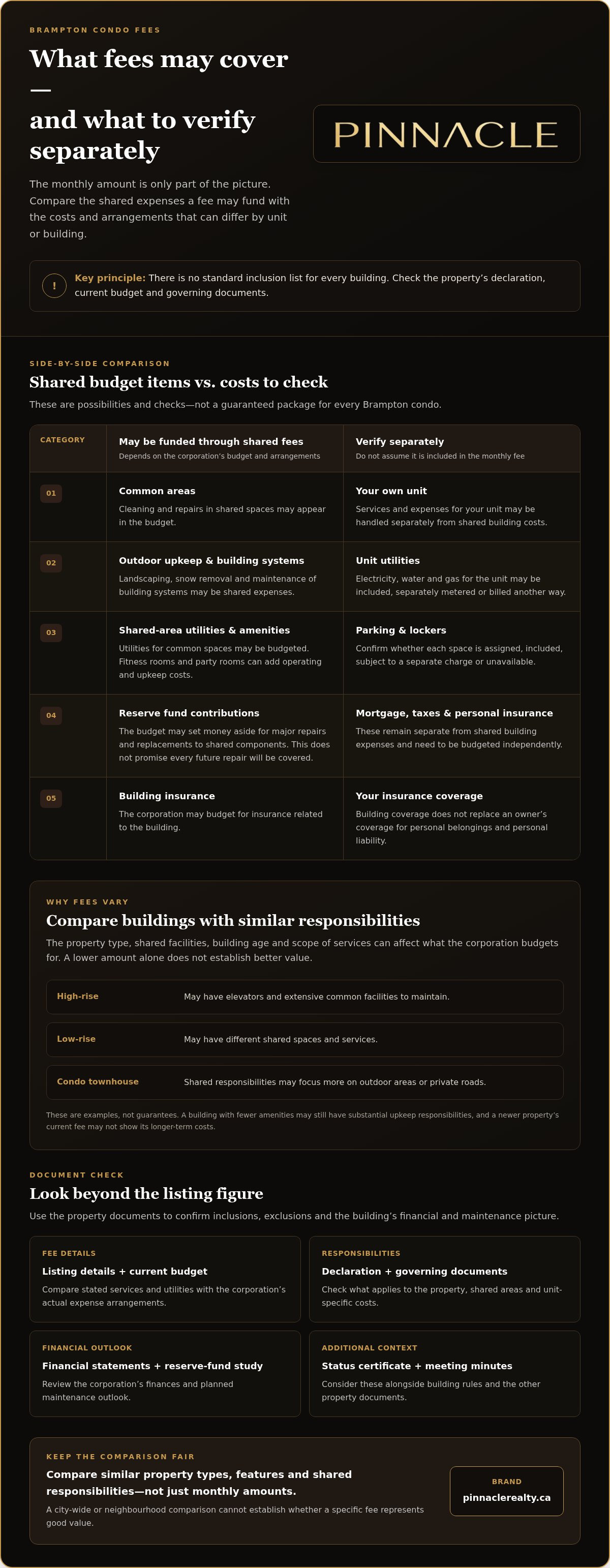
Condo fees are owner contributions toward a condominium corporation’s shared operating and maintenance expenses. The specific costs depend on the property’s budget and governing documents. There isn’t one standard list of inclusions for every building.
Depending on the arrangement, the budget may include upkeep of common elements, shared-area utilities or other building services. In condominium ownership, each owner has an individual unit and shares responsibility for common elements, as outlined in this overview of condominium ownership. The corporation’s declaration, budget and other governing documents set out the details for a particular property.
Don’t assume your fee covers every cost associated with your unit. Your mortgage, property taxes and personal insurance remain separate. Review the fee breakdown and documents to see which shared expenses are included and which costs may be billed directly to owners.
Why Brampton condo fees are not one-size-fits-all
Different property types have different shared responsibilities. A high-rise may have elevators and extensive common facilities to maintain, while a low-rise may have different shared spaces and services. In a condominium townhouse community, shared responsibilities may focus more on outdoor areas or private roads. These are examples, not guarantees, so check the arrangements for each property.
Building age can affect maintenance needs, while shared facilities and the scope of services influence what the corporation budgets for. A building with fewer amenities may still have substantial upkeep responsibilities. A newer property’s current fee also may not show its longer-term costs.
A Brampton neighbourhood or city-wide comparison can’t establish whether a specific fee represents good value. Compare properties with similar types, features and responsibilities, then review the documents behind each monthly amount. This gives you a more useful basis for judging cost and fit.
What Brampton Condo Fees May Include, and What They May Not
A monthly condo fee can fund several shared responsibilities, but the exact package varies by property. A high-rise with elevators and shared facilities may have different operating costs from a townhouse community with outdoor areas to maintain. Treat inclusions as building-specific, not as a standard bundle for every Brampton condo.
Shared expenses that may appear in the budget
Depending on the corporation’s arrangements, shared expenses may include cleaning and repairs in common areas, landscaping, snow removal and maintenance of building systems. Shared utilities, such as lighting or heating in common spaces, may also be budgeted. Amenities like a fitness room or party room can add operating and upkeep costs, though their presence and expenses differ between properties.
A budget may also set aside contributions to a reserve fund for major repairs and replacements to shared components. The amount and planned use are part of the corporation’s financial picture, not a promise that every future repair will be covered. The Condominium Authority of Ontario’s guide to fees offers further context on condominium finances. Review the current budget and governing documents to understand how these categories apply to the unit you’re considering.
Expenses buyers shouldn’t assume are included
Building insurance and personal insurance serve different purposes. A corporation may budget for insurance related to the building, but that doesn’t replace an owner’s coverage for personal belongings and personal liability. Plan for your own insurance needs separately.
Unit utilities may be included, separately metered or billed through another arrangement. Parking and locker costs also depend on the property. They may be part of the unit’s arrangements, subject to separate charges or unavailable. Don’t rely on a brief listing description alone to establish what applies.
- Utilities: Check whether electricity, water or gas for the unit is included or separately billed.
- Parking and lockers: Confirm how each space is assigned and whether its cost is separate.
- Personal expenses: Mortgage payments, property taxes, personal insurance and services for your own unit sit outside shared building expenses.
To answer “condo fees in Brampton what's included,” compare the listing information with the declaration and current budget. This helps distinguish advertised features from the corporation’s actual expense arrangements. You can review Brampton condominium listings and compare each property’s details against the services and costs that matter to you.
How to Compare Condo Fees in Brampton Without Judging by Amount Alone
Monthly fees are comparable only when you know what each one pays for. “Condo fees in Brampton what's included” is a useful starting question, but a fair comparison also considers property type, unit circumstances, services and building finances. A high-rise and a condominium townhouse may have very different shared responsibilities, so don’t treat their fees as direct matches.
Compare the services and responsibilities behind each fee
Use a simple table to record what’s stated and where the information comes from. Compare units with similar circumstances, including size and parking arrangements, and match advertised inclusions against property documents. An amenity may add convenience, but it can also mean ongoing upkeep. A difference in the monthly amount doesn’t necessarily indicate a difference in value.
| Comparison point | What to record | Where to verify |
|---|---|---|
| Monthly fee | Current amount and the unit it applies to | Listing details and current budget |
| Stated inclusions | Maintenance, shared services and other listed items | Listing documents and declaration |
| Amenities | Facilities available and related shared responsibilities | Listing details and property documents |
| Utilities | Which shared or in-unit utilities are included or billed separately | Current budget and unit arrangements |
| Known exclusions | Costs that owners pay separately | Listing documents and declaration |
For example, if one comparable unit’s fee includes a utility that the other owner pays separately, the fee amounts alone won’t show which option better fits your monthly budget. Documented inclusions make the comparison clearer.
Consider the building’s financial and maintenance context
Read the current budget and reserve-fund information alongside the fee. A reserve fund study helps inform long-term planning for major repairs and replacements. The related information can help you understand anticipated maintenance needs in context. Consider the building’s age, facilities and upkeep responsibilities as part of the same review.
A lower fee by itself doesn’t prove that a building is in strong financial condition. If maintenance has been deferred or future work isn’t adequately reflected in the information you review, the headline amount may not tell the whole story. Likewise, a higher fee isn’t automatically poor value if it reflects documented services and planned costs.
For a Brampton condo search, compare like with like and review the supporting documents before drawing conclusions. This helps distinguish a suitable monthly cost from a number that only looks attractive at first glance.
A Brampton Condo-Fee Due-Diligence Checklist Before You Buy
A listing is a useful starting point, not the full picture. To understand condo fees in Brampton what's included, review the advertised details and then examine the condominium corporation’s documents. The goal is to see how the fee, the unit’s arrangements and the building’s finances fit together.
- Review the listing. Note the stated monthly fee and any advertised inclusions, amenities, parking and locker details. Treat these as details to verify, not a complete account of your ownership costs.
- Compare the declaration and rules. Look for how the documents describe common elements, owner responsibilities and building-specific arrangements. Check whether parking or a locker is part of the unit’s arrangement or handled separately.
- Read the current budget. Review the expense categories and utility arrangements, including which costs relate to shared spaces and which may be billed to the unit. Compare the listing’s claims with the budget information available.
- Review the status certificate and related materials. This package can provide important information about the condominium corporation and the unit. Read its contents and accompanying records in context. Don’t assume a brief summary answers every financial or maintenance question.
- Consider reserve-fund and maintenance information. Review available reserve-fund planning, fee history and disclosed maintenance issues. Note what the records say and what remains unclear, without drawing conclusions from one figure alone.
- Have legal questions reviewed by your lawyer. A lawyer can interpret the condominium documents and explain how their terms apply to your purchase. This is especially useful if documents appear inconsistent or you’re unsure about an obligation or disclosed issue.
Read the listing and condominium documents together
Documents work best as a set. For example, consider an advertised utility inclusion alongside the budget and the unit’s billing arrangement. The declaration and rules add context about responsibilities, while the status certificate and related materials help inform your review of the corporation and unit. If a detail matters to your decision, identify where it’s documented and raise legal interpretation questions with your lawyer.
Check for financial and maintenance signals
Fee history can show how the monthly amount has changed, while budget and reserve-fund information provide context for planned expenses and repairs. Read these records together. A disclosed maintenance issue or planned repair isn’t, by itself, proof of a problem, but it is something to understand before committing.
Apply this checklist to your search by reviewing Brampton condo listings and comparing each property’s details. Careful review can make a major purchase decision clearer and better aligned with your priorities.
Use Condo-Fee Clarity to Choose the Right Brampton Home
A condo that fits your budget is about more than its monthly fee. Consider the amount alongside services, utilities, maintenance outlook and ownership costs you’ll pay separately. Clear comparisons help you decide which trade-offs suit your lifestyle, rather than choosing a property based on one number.
Build a complete ownership comparison
For each property, consider the condo fee with your other recurring expenses, including mortgage payments, property taxes, utilities and personal insurance. Don’t assume two units with similar fees will have the same overall costs. One may include a utility or service that another bills separately. Use the documents and listing details to build a property-by-property picture.
Separate essentials from preferences. Predictable utility arrangements or a particular maintenance setup may be priorities, while a gym, party room or other amenity may be optional. An amenity can add lifestyle value, but weigh that benefit against your preferences and the building’s documented responsibilities. Focus on what’s included, what’s separate and what matters most to you.
Find a Brampton condo that fits your priorities
Comparing condominium listings, interpreting property details and keeping your priorities in view can make the search more manageable. Pinnacle Realty provides condominium sales and buyer agency services to support buyers through a Brampton home search, with attention to the details that shape ownership beyond the purchase itself.
For buyers exploring the wider market, GTA buyer agency services connect the property search with informed comparison and buyer representation. The goal is not to find the lowest fee in isolation, but to identify a home whose costs, services and lifestyle align with your plans.
Explore Brampton condo listings and compare the documented details to identify properties that merit a closer look. A measured review can bring greater clarity to an important move.
Make Your Brampton Condo Decision with Confidence
Understanding condo fees in Brampton what's included starts with looking beyond the monthly amount. Fees can cover different shared services, utilities and maintenance responsibilities depending on the building. Compare similar properties, check the listing against the condominium documents, and consider the budget and reserve-fund information before deciding whether a fee fits your plans.
Keep the full ownership picture in view, including costs paid separately and the services that matter most to your lifestyle. A lower fee isn’t automatically better value, just as a higher one doesn’t guarantee more suitable services. Documented details help you make a grounded comparison.
Pinnacle Realty is a Brampton-based brokerage serving buyers across the GTA, with expertise in condominium sales and buyer representation. Explore Brampton condo listings and identify the properties that align with your priorities. With a clear review and the right guidance, you can move forward with greater confidence.
Frequently Asked Questions
What do condo fees in Brampton usually include?
Condo fees in Brampton may contribute to shared building maintenance and repairs, common-area utilities, landscaping, snow removal, building insurance and reserve-fund savings for major work. The exact mix depends on the condominium corporation and property. For example, a building may budget for upkeep of shared amenities while unit utilities are billed separately. Review the current budget and governing documents to see what applies to the specific condo.
Are utilities included in Brampton condo fees?
Sometimes, but utility coverage varies by property and by utility. Condo fees may cover utilities for common areas, while electricity, water or gas used inside a unit could be separately metered or billed. Don’t infer coverage from the fee amount or building type. Check the listing details against the current budget and unit arrangements, and include any separately billed utilities in your ownership-cost comparison.
Do condo fees include property taxes or home insurance?
Condo fees generally don’t include your mortgage payment or property taxes, and they don’t replace personal insurance for your belongings and liability. The condominium corporation may budget for insurance related to the building, which is different from coverage for your individual needs. Review the property documents to understand the corporation’s insurance arrangements, then account separately for your own insurance and other unit-owner expenses.
Why are condo fees different between buildings in Brampton?
Fees reflect the building’s budget and shared responsibilities, which can differ by property type, age, facilities, maintenance needs and utility arrangements. A high-rise with elevators and shared amenities may have different operating costs from a condominium townhouse community. Unit circumstances can matter too. Compare properties with similar features and responsibilities, then assess the documented services and financial context rather than relying on neighbourhood or fee amount alone.
Can condo fees increase after I buy a unit?
Yes, condo fees can change as the corporation’s budget and shared expenses change. Building maintenance, utility costs and planned contributions toward major repairs can affect future budgets. A fee shown in a listing is a current figure, not a guarantee that the amount will stay the same. Review available budget information and fee history to understand the context, and discuss questions about the corporation’s documents with your lawyer.
How can I find out what a condo fee covers before buying?
For “condo fees in Brampton what's included,” compare the listing with the corporation’s current budget and declaration, and review the status certificate and other available documents. Check the stated inclusions, utility arrangements, parking and locker details, and owner responsibilities. These records help build a clearer picture of the fee, though interpretation can require expertise. Have your lawyer review condominium documents and address legal questions before you commit.
Is a lower condo fee always better?
No. A lower fee isn’t automatically better value or proof of strong building finances. It may reflect fewer included services, different shared responsibilities or budget choices, while a higher fee may fund services or amenities you value. Compare similar properties and look at the current budget, reserve-fund information and maintenance outlook alongside the monthly amount. The better fit is the one whose documented costs and responsibilities suit your budget and priorities.


