

In the high-stakes world of GTA logistics, your physical footprint is more than a line item on a balance sheet. It's the engine of your operational success, a reflection of your brand's ambition, and a vital component of your supply chain. Understanding the average commercial lease rates Brampton offers in 2026 requires looking beyond the sticker price to the strategic value of the Peel Region. You've likely noticed that the market has matured, moving from the frantic scarcity of past years to a sophisticated, bifurcated landscape where quality and location command a premium.
This guide provides the clarity you need to navigate rising TMI costs and complex Triple Net structures with absolute precision. We promise to help you secure the most competitive terms by decoding the drivers of the current market. You'll gain a clear framework for evaluating lease offers, an understanding of the impact of the Hazel McCallion LRT, and the confidence to negotiate in a landscape defined by Canadian rail hubs, arterial highway access, and modern industrial standards. We'll examine how to compare disparate asset classes while ensuring your next move aligns with your long-term vision for growth, stability, and prestige.
Key Takeaways
- Understand how Brampton’s evolution into a global logistics powerhouse and the rise of the Innovation District are fundamentally shifting local property values.
- Gain a strategic advantage by benchmarking average commercial lease rates Brampton across industrial, retail, and office sectors to ensure your next move is grounded in data.
- Master the nuances between Triple Net and Gross lease structures to accurately calculate your total occupancy costs and avoid unexpected TMI escalations.
- Explore how modern infrastructure, such as the Hazel McCallion LRT, and sustainable building certifications create value premiums for discerning tenants.
- Learn how professional representation and access to off-market inventory can help you secure the most advantageous terms in a maturing metropolitan market.
The Evolution of Brampton’s Commercial Real Estate Market
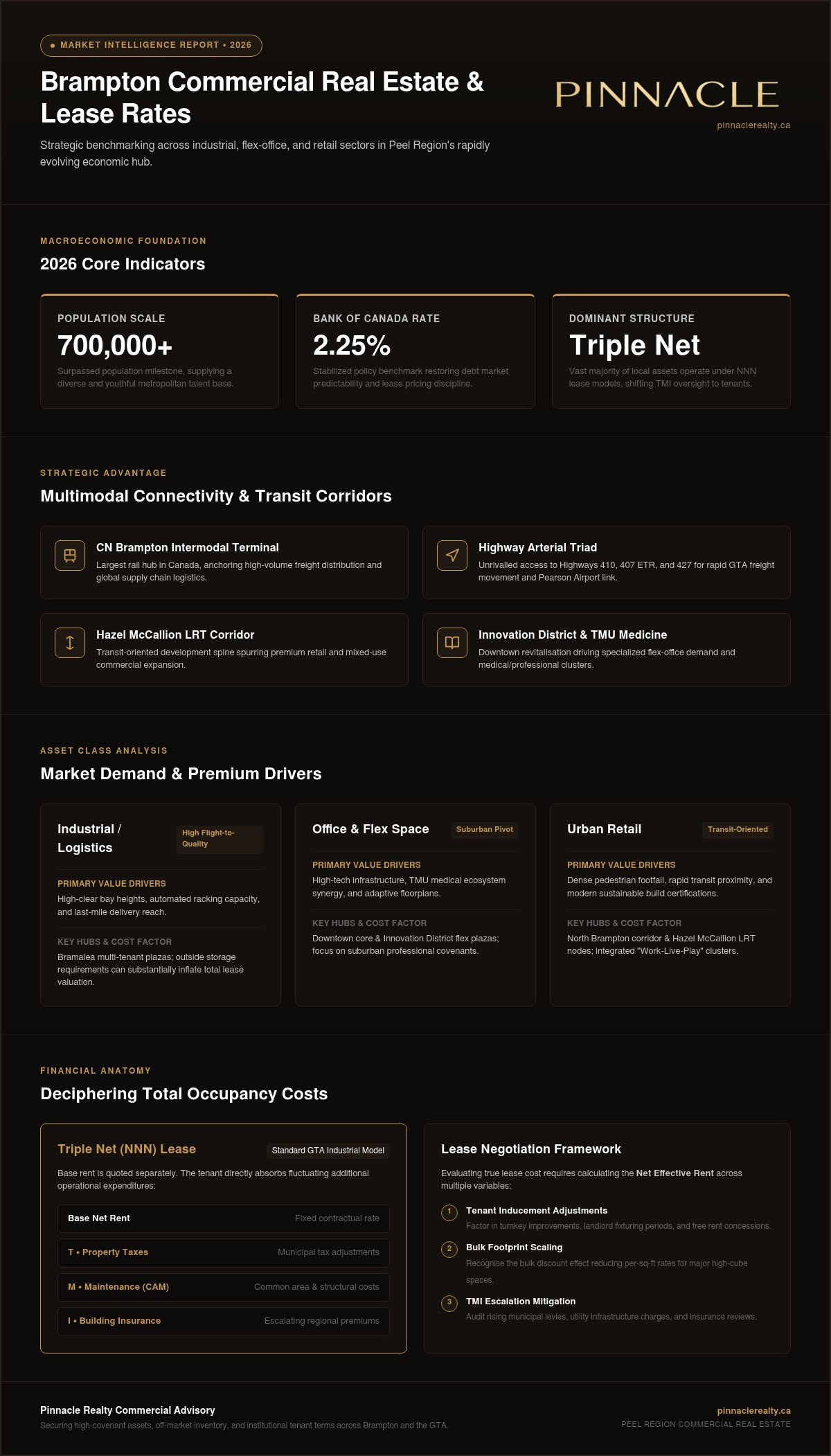
Brampton has transcended its historical identity as a residential enclave to become a central pillar of Canada's economic engine. This transformation is not accidental. It's the result of strategic infrastructure investment and a burgeoning demographic base that recently surpassed 700,000 residents. As the city matures, the average commercial lease rates Brampton landlords command have begun to reflect a more sophisticated urban reality. In 2026, the market has entered a phase of graceful stabilization following years of rapid correction. Owners now prioritize long-term covenant strength and high-quality assets, making professional representation through Pinnacle Realty essential for businesses seeking to align their physical space with their modern ambitions.
Market dynamics in 2026 are heavily influenced by a stabilized Bank of Canada policy rate of 2.25%, which has provided the debt market with much-needed predictability. While industrial supply has increased, the floor for quality space remains firm. Understanding commercial net lease structures is vital for any tenant in this environment, as the vast majority of local assets operate on a Triple Net basis. This shift toward a more transparent, data-driven market ensures that every square foot is an investment in future growth rather than just an operational expense.
Brampton as a Logistical Hub
The city’s dominance in the industrial sector is rooted in its unparalleled connectivity. Hosting the CN Brampton Intermodal Terminal, the largest rail hub in the country, provides a distinct competitive edge for logistics and distribution firms. Proximity to Toronto Pearson International Airport and immediate access to the 410, 407 ETR, and 427 highway corridors have turned the Peel Region into a preferred headquarters for international corporations. These firms recognize that logistical efficiency is a prerequisite for success. High-clear logistics facilities continue to see robust demand, even as tenants scrutinize their total occupancy costs to better manage escalating municipal levies and insurance rates.
The Shift Toward Mixed-Use Urban Centres
Brampton is pivoting toward a more integrated, mixed-use future. The revitalisation of the Downtown core, catalyzed by the Innovation District and the TMU School of Medicine, has introduced a new class of flex-office and retail demand. No longer confined to traditional business parks, companies are seeking "Work-Live-Play" clusters, particularly along the North Brampton corridor. This transit-oriented development is influencing the average commercial lease rates Brampton retail and office tenants experience as the city centre evolves into a high-density hub. For the discerning tenant, these shifts represent an opportunity to secure a location that offers both prestige and practical accessibility for a diverse, youthful workforce.
Benchmarking Lease Rates by Asset Class
Navigating the Brampton market requires a discerning eye for asset quality and functional utility. Unlike generic listings that treat all square footage as equal, sophisticated investors recognise that average commercial lease rates Brampton providers quote are deeply segmented by class and volume. Modern Class A builds, featuring high-clear heights and sustainable certifications, command a significant premium over legacy inventory. Net effective rent represents the true cost of occupancy after accounting for inducements, free rent, and additional rent escalations. While the bulk discount effect typically reduces the price per square foot for larger footprints, the rising costs of TMI across the GTA mean that total gross occupancy costs require meticulous calculation.
Industrial and Warehouse Space
The industrial landscape in Brampton is currently defined by a flight to quality. Demand for high-bay ceilings and last-mile delivery capabilities remains high, particularly for facilities that can accommodate automated racking systems. In established hubs like Bramalea, multi-tenant industrial plazas offer versatility for growing enterprises, though outside storage requirements can quickly inflate a lease's total valuation. When evaluating these assets, consulting the Government of Ontario commercial tenancy regulations ensures you understand the legal frameworks governing maintenance responsibilities and rent reviews.
Professional Office and Flex Space
The 2026 office market has pivoted toward medical and professional services within suburban business parks. Users are opting for smaller, higher-quality footprints that prioritise modern aesthetic standards and employee wellness. Finished medical suites and Class A suburban offices now require a polished visual appeal to attract top-tier talent and clientele. This transition from quantity to quality means that while overall square footage may decrease, the investment in premium finishes and technological integration has never been more critical for brand alignment.
Retail and Street-Front Opportunities
Retail success in Brampton is a matter of visibility and strategic positioning. High-traffic anchors in grocery-protected centres continue to show pricing power, whereas secondary plaza locations offer more flexible terms for boutique brands. Signage rights and arterial exposure along corridors like Bovaird Drive or Queen Street East are primary drivers of value. Whether you are considering an independent street-front opportunity or a mall-based lease, the key is matching the asset’s profile with your specific demographic reach. To explore current opportunities that match your business's prestige, you can review our latest commercial listings to find a space that reflects your modern ambitions.
Deciphering Lease Structures: Net vs. Gross
A commercial lease is far more than a simple exchange of capital for square footage; it's a sophisticated legal framework that defines your business’s operational agility. In the Peel Region, the baseline for most contracts is the net lease. This structure separates the base rent from the property’s operating expenses. Conversely, a gross lease provides a single, all-encompassing figure. While the latter offers simplicity, it's increasingly scarce in high-demand corridors. Most landlords now insist on the Triple Net (NNN) model. This ensures that while average commercial lease rates Brampton firms pay might look competitive on paper, the true cost depends on the efficiency of the building’s management and the accuracy of its cost allocations.
The Triple Net structure has become the gold standard for GTA landlords because it ensures their base rent remains a predictable return while the tenant assumes the variable costs of ownership. This transparency can be a double-edged sword. It allows for lower base rents but requires tenants to be vigilant about how their additional rent is managed. Successful business owners don't just sign these agreements; they view them as a partnership that requires ongoing oversight and professional auditing to maintain fiscal health.
Understanding TMI (Taxes, Maintenance, Insurance)
Your additional rent, commonly referred to as TMI, represents the variable portion of your monthly commitment. Property taxes in Brampton are subject to municipal assessments that can shift based on local infrastructure projects and regional growth. Common Area Maintenance (CAM) fees cover the collective essentials: landscaping, security, and structural repairs. It's vital to verify that these costs are transparent and that your "fair share" is calculated with absolute precision. Referring to the Statistics Canada Commercial Rents Services Price Index can help you understand how these benchmarks evolve across the country. Smart tenants audit year-end reconciliations to ensure every dollar contributes to a premium environment rather than administrative bloat.
Negotiating Inducements and Tenant Improvements
Securing the right terms involves a delicate balance of immediate incentives and long-term stability. Rent-free periods are a powerful tool. They allow you to manage the financial transition of a move without the immediate pressure of full overhead. Similarly, Tenant Improvement (TI) allowances can transform a basic shell into a bespoke centre of excellence. Whether the landlord provides a cash allowance or performs the work themselves, the build-out is a significant milestone in your brand’s journey. You should evaluate how average commercial lease rates Brampton landlords offer interact with these inducements. A lower base rate might be paired with higher annual escalations, requiring a detailed multi-year projection. At Pinnacle Realty, we act as your visionary guide through these negotiations, ensuring your lease structure supports both prestige and progress.
Factors Influencing Lease Premiums in Brampton
Securing a commercial space in the GTA is a multifaceted decision where site-specific variables often outweigh generic market averages. While the average commercial lease rates Brampton businesses encounter provide a useful benchmark, the final figure is frequently driven by a building's technological and environmental maturity. We often see a distinct "Green Premium" for assets featuring modern HVAC systems, sustainable building materials, and LEED certifications. These features don't just reduce long-term operating costs; they align with the contemporary aesthetic standards that modern corporations demand. Beyond these utilities, for medical and retail users, parking ratios have become a non-negotiable driver of value. A site with ample, accessible parking for clients and staff will always command a higher position in the market than one constrained by legacy urban planning.
At Pinnacle Realty, we refer to the "Pinnacle Factor" as our ability to identify undervalued pockets within these high-demand corridors. By looking beyond the immediate surface, we help our clients realise value where others see only a standard listing. Our sophisticated approach ensures that your real estate transition is handled with the precision required to secure a competitive edge.
Transit and Connectivity
The impact of infrastructure on property valuation is nowhere more evident than along the Main Street corridor. The Hazel McCallion LRT has fundamentally reshaped landlord expectations for 2026. Properties within a short walk of these transit nodes now command a premium due to their immense appeal for employee recruitment and retention. Similarly, accessibility to GO Transit stations allows firms to tap into a broader talent pool across the Golden Horseshoe. For industrial users, the efficiency of trucking routes remains the primary driver. Proximity to the 400-series highways and the CN Intermodal Terminal reduces drayage times, directly impacting the bottom line for logistics-heavy operations.
Zoning and Permitted Uses
Scarcity is often a product of municipal policy rather than a lack of physical land. Restrictive zoning designations can create artificial bottlenecks that drive up average commercial lease rates Brampton tenants must navigate. Understanding the nuances between M1, M2, and light industrial designations is critical for a quick business launch. A "pre-approved" use for a specific site can save months of bureaucratic delays, representing a significant hidden value. Whether you are looking for prestige employment zones or functional warehouse space, these zoning nuances require a partner who understands the local landscape at a granular level. To find a space that perfectly matches your operational requirements and professional drive, explore our curated commercial listings today.
Securing Your Space with Pinnacle Realty
Selecting a commercial address is a significant life milestone. It requires more than a casual search; it demands a premier partner who understands that every transaction is a step toward your modern ambitions. At Pinnacle Realty, led by Jag Saini, we approach tenant representation with a level of sophistication that matches the prestige of your brand. We don't just find buildings. We identify environments where progress is inevitable. Our deep regional knowledge of the Peel Region allows us to access off-market opportunities that never reach public eyes, providing you with a distinct advantage in a competitive metropolitan market.
While the average commercial lease rates Brampton landlords post offer a starting point, our role is to refine those numbers through meticulous negotiation. We navigate the offer process with grace and precision, ensuring that every clause protects your long-term success. From initial discovery to the final lease review, we align your business goals with a physical location that reflects your drive. This visionary approach ensures your real estate transition is handled with the care and substance your business deserves.
The Pinnacle Advantage in Leasing
Our strategy is built on absolute confidence and data-led insights. We utilize strategic market timing to capitalize on lease expirations, positioning our clients to move when leverage is highest. By challenging landlord rate demands with actual market benchmarks rather than just asking prices, we ensure you don't overpay for the "Pinnacle Factor" of a prime location. We link your commercial lease to your business growth milestones, creating a flexible framework that evolves as you do. This bespoke approach moves away from high-pressure tactics toward a refined professional demeanor that values clarity over chaos.
Next Steps: From Search to Keys
The transition to a new space begins with preparation. We recommend preparing a comprehensive commercial "bio" that highlights your business's strength. This attracts top-tier landlords who value stable, high-quality covenants. You can begin exploring current opportunities by reviewing our Pinnacle Realty Listings, where we showcase assets that meet our high aesthetic and functional standards. When you are ready for a sophisticated guide to help you navigate the average commercial lease rates Brampton offers, contact our office for a bespoke market consultation. We are invested in your success, handling every detail with the precision required for a seamless service experience.
Elevate Your Business Footprint in the Peel Region
Brampton’s metamorphosis from a residential suburb into a premier Canadian logistical hub is now a reality. As we have explored, success in this maturing market requires more than a surface-level understanding of the average commercial lease rates Brampton landlords currently offer. It demands a meticulous evaluation of asset quality, a firm grasp of Triple Net structures, and a strategic eye on infrastructure like the Hazel McCallion LRT. Your physical space is a cornerstone of your brand’s prestige. It should reflect your modern ambitions while providing the operational efficiency necessary for sustainable growth.
At Pinnacle Realty, our dedicated commercial leasing division provides the sophisticated negotiation strategies and deep regional expertise required to navigate the Peel Region’s unique dynamics. We handle every transaction as a significant milestone, ensuring your transition is seamless and your terms are competitive. Whether you are seeking high-bay logistics space or a polished professional suite, we are ready to guide you with absolute confidence. Explore Premier Commercial Listings in Brampton today and secure a foundation that matches your vision for the future. Your next era of growth begins with a partner who values clarity, precision, and your long-term success.
Frequently Asked Questions
What is the difference between a Net lease and a Gross lease in Brampton?
A Net lease separates the base rent from the property's operating expenses, whereas a Gross lease includes those costs in a single monthly payment. In the Brampton market, Net leases are the standard for industrial and retail spaces. This structure allows for transparency regarding maintenance and taxes. Gross leases are increasingly rare, typically reserved for smaller office suites or executive parks where simplicity is preferred over detailed cost allocations.
How is TMI calculated for commercial properties in the Peel Region?
TMI is calculated by summing the total property taxes, maintenance fees, and insurance premiums for the entire building and dividing that by the total square footage. Your "fair share" is then based on the specific square footage of your unit. In the Peel Region, these costs are reconciled annually. It is crucial to review these year-end statements to ensure you aren't paying for capital improvements that should be the landlord's responsibility.
Are commercial lease rates negotiable in the current Brampton market?
Yes, commercial lease rates in Brampton remain negotiable, though the leverage often depends on the asset class and your business's covenant strength. While landlords might hold firm on face rates to maintain property valuation, they often provide concessions such as rent-free periods or tenant improvement allowances. In 2026, the average commercial lease rates Brampton providers quote are often just the starting point for a more sophisticated discussion regarding long-term value and inducements.
What is a typical lease term for a new business in Brampton?
The standard lease term for most new businesses in Brampton is five years, often with a five-year option to renew. Landlords generally prefer longer commitments to justify the costs of tenant improvements and commissions. Shorter terms of three years are occasionally available in multi-tenant plazas or flex-office spaces, but they may come with fewer inducements. A ten-year term is typically reserved for major anchor tenants or specialized industrial build-to-suit projects.
Does the average lease rate include utilities and property taxes?
The average commercial lease rates Brampton landlords advertise usually represent the "net" base rent, which does not include property taxes or utilities. Under a standard Triple Net agreement, property taxes are part of the TMI payment, while utilities are often separately metered and paid directly by the tenant. It's essential to clarify these boundaries during the offer stage to avoid significant discrepancies in your projected monthly cash flow and total occupancy costs.
How does the Hurontario LRT project affect commercial rents in Brampton?
The Hazel McCallion LRT project has created a valuation premium for commercial properties located along the Hurontario and Main Street corridors. As the line reaches full operational status in 2026, transit-oriented developments are seeing increased demand from retail and professional services. This connectivity enhances employee recruitment and customer access, allowing landlords in these specific zones to command higher rates compared to properties that are strictly dependent on highway access or local vehicle traffic.
What are the most common hidden costs in a commercial lease agreement?
The most common hidden costs include administrative management fees, capital replacement reserves, and utility hook-up charges. Some leases also include percentage rent clauses for retail tenants or unexpected HVAC maintenance responsibilities that fall entirely on the occupant. Meticulous review of the lease's Additional Rent definitions is vital. You should look for caps on management fees and clear exclusions for structural repairs to ensure your occupancy costs remain predictable and fair.
Should I hire a real estate broker for a commercial lease negotiation?
Hiring a professional commercial broker is essential for navigating complex negotiations and accessing off-market inventory. At Pinnacle Realty, we provide a sophisticated approach to tenant representation that goes beyond finding a space. Our expertise in Peel Region dynamics ensures that your lease terms are competitive and aligned with your long-term ambitions. We act as your visionary guide, handling the intricate details of the offer process so you can focus on your business's growth.


