

The fastest-looking option can become the least practical once you account for your Toronto destination. For commuting from Brampton to Toronto, a GO train to Union may suit a downtown office, while driving or another transit connection may work better for a destination elsewhere in the city.
It’s reasonable to want a commute that feels predictable, not one that depends on perfect traffic or a tight transfer. The right choice depends on your starting point, arrival location and schedule, as well as the trade-offs you’re willing to make between transit convenience, driving flexibility and parking.
This guide compares the main ways to travel, including the Kitchener Line, local transit connections and key driving routes. A GO train from Brampton GO to Union takes approximately 43 to 50 minutes, but your full journey also includes getting to the station and reaching your final stop. You’ll find what to account for when planning around schedules, transfers and road congestion, and how station access can shape a Brampton home search. With a clearer picture of your regular travel pattern, you can build a routine that fits your workday and lifestyle.
Key Takeaways
- For commuting from Brampton to Toronto, match your travel mode to your starting point, Toronto destination and daily schedule.
- Plan a GO trip in sequence: choose a station, review the train schedule, arrange station access and map your onward connection.
- Compare driving’s flexibility with traffic, parking and destination access, and assess Highway 410 and Highway 401 for your specific trip.
- Make your routine more resilient by checking official schedules and service alerts, testing the journey and planning a contingency.
- When considering a Brampton home, compare the full trip from the property to your regular Toronto destination, including station access and your typical schedule.
Commuting from Brampton to Toronto: Start with your route and destination
There isn’t one route that works equally well for every Brampton-to-Toronto trip. Your starting point in Brampton and your final address in Toronto affect which station, road or connection makes sense. A commuter heading to an office near Union Station has different needs from someone travelling to midtown, Toronto’s west end or another part of the city.
Compare the whole journey, not just the time spent on a train or behind the wheel. Door-to-door time includes getting from home to a station or highway, waiting, transfers, parking and the final connection to your destination. A direct drive may still involve parking and walking at the other end. A train trip may require a local transit ride or a walk after arrival.
The best route depends on your destination, departure time and travel priorities. GO Transit, driving and mixed transit-and-driving journeys each suit different routines. Make the comparison using your full trip on the days and at the times you actually travel.
Which Toronto destination are you travelling to?
Start with your final address or nearest practical arrival point. Union Station can work well for downtown destinations and connections to other transit, but arriving there may add a substantial cross-city leg if your workplace is elsewhere. For midtown, the west end or another Toronto neighbourhood, compare the onward trip from Union with a route that brings you closer to your destination.
Write down your precise starting area in Brampton and your Toronto destination before comparing options. “Downtown” can still mean a long walk or another connection, and two addresses in the same part of the city may have different transit access. Mapping both endpoints gives you a more useful starting point than a city-to-city estimate.
GO Transit’s Kitchener line serves Brampton and connects with Union Station. For background on the regional rail and bus network, see GO Transit. Whether that connection suits your trip depends on station access and how easily you can complete the last leg in Toronto.
Choose a commute around your priorities
Consider what matters most on a typical travel day: a predictable departure, flexibility to change plans, fewer transfers, convenient parking or arriving close to work. Driving may give you more control over when you leave, but traffic and parking affect the journey. Transit can reduce the need to drive into Toronto, though schedules, connections and the walk or ride from a station all count.
Your travel pattern matters, too. A regular weekday commute calls for a routine that works repeatedly during your actual departure window. Occasional or off-peak travel may give you more choice about when to leave, but you’ll still need to check service and connections. A mixed journey, such as driving to a station and continuing by GO, may balance access and flexibility if the station approach and onward trip suit your schedule.
Rather than ranking one mode as universally best, compare the trade-offs against your own day. The most practical option is the one that gets you from your Brampton starting point to your Toronto destination with a workable balance of time, transfers, flexibility and arrival convenience.
Taking GO Transit from Brampton to Toronto: Stations, trains and connections
GO Transit’s Kitchener line serves Brampton and connects with Toronto’s Union Station. For commuting from Brampton to Toronto, rail can simplify the main part of a trip, but the train ride is only one part of the journey. The time it takes to reach your station, wait for your train and travel from Union to your final destination all affect how practical the route feels.
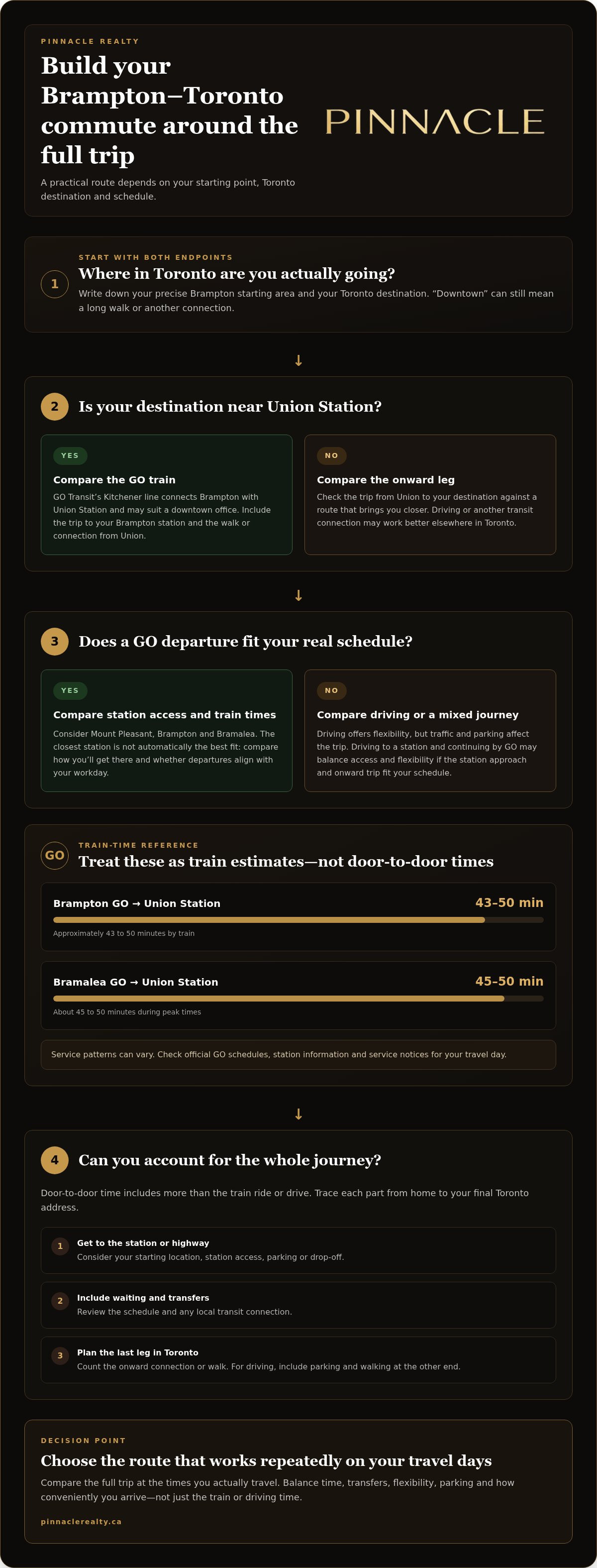
A door-to-door GO commute includes the trip to your Brampton station, the train ride and every connection between Union Station and your final destination. As a guide, the train from Brampton GO to Union takes approximately 43 to 50 minutes. From Bramalea GO, the trip is about 45 to 50 minutes during peak times. These are train journey estimates, not guaranteed end-to-end travel times. Service patterns can vary, so use the official GO Transit website to review current schedules, station information and service notices for your travel day.
Choose a station that works for your whole trip
Mount Pleasant, Brampton and Bramalea are potential stations to compare, but the closest one to home isn’t automatically the best fit. Consider how you’ll get there, whether you need parking or a drop-off, and which station’s train times align with your workday. Check each station’s current access arrangements and amenities in GO Transit’s official information rather than relying on assumptions or an old trip plan.
A slightly longer trip to a station may be worthwhile if its train schedule or access better matches your routine. On the other hand, a convenient station may be less useful if its available departures don’t fit your arrival time in Toronto.
Plan the trip in order
Build the journey from home to your final Toronto address. Follow this sequence before settling on a regular train:
- Choose your station. Compare Mount Pleasant, Brampton and Bramalea based on your starting location and station access.
- Check the train. Find a departure that fits your arrival time, and review the return journey if you’ll travel both ways.
- Plan your access. Account for the trip to the station, whether you’re walking, being dropped off, parking or connecting by local transit.
- Confirm your onward trip. From Union, decide whether you can walk to your destination or need the TTC or another connection.
Make Union Station part of the plan
Union Station can be a convenient arrival point for some downtown destinations and a connection point for onward travel. If your destination is elsewhere in Toronto, include the next leg in your plan. The TTC may suit the final connection, but check the specific route, transfer and timing instead of assuming Union is close to your address.
Before departure, review live schedules, service notices and transfer details. If station access and train timing are shaping your Brampton home search, buyer representation for your home search can help you weigh commute priorities alongside neighbourhood needs.
Driving from Brampton to Toronto: Compare flexibility with traffic and parking
Driving gives you control over your departure and can take you directly to destinations that are difficult to reach by transit. That flexibility comes with trade-offs: congestion, parking and the final walk or connection can all affect your day. GO travel follows a schedule and may require station access and an onward connection, but it lets you avoid driving the full route into Toronto.
Highway 410 south to Highway 401 east is a key corridor for trips from Brampton into Toronto. It won’t suit every destination or departure, so map the full route rather than choosing a highway by habit. Congestion, collisions and other incidents can change road conditions. Check current traffic information, such as Ontario 511, before leaving, and treat any travel-time estimate as a snapshot, not a guarantee.
Use this qualitative comparison as a starting point. Your destination, schedule and preferred arrival point determine which trade-offs matter most.
| Factor | Driving the full route | GO train for the main leg |
|---|---|---|
| Departure flexibility | You choose when to leave, while traffic can affect arrival. | Plan around scheduled train departures. |
| Transfers | Usually fewer transit connections, but parking and the final walk still count. | Station access and onward travel may add steps. |
| Destination access | Can suit dispersed destinations or work that requires equipment. | Can work well when Union and onward connections suit your destination. |
| Arrival planning | Account for parking availability and the trip from the parking spot. | Account for station access, train timing and connections. |
When driving may suit your commute
Driving may be practical if your work takes you to several locations, you carry equipment or your hours don’t align with transit schedules. It can also offer flexibility when plans change during the day. But a direct drive isn’t automatically faster or easier. Traffic can shift, and parking availability and the last part of the journey still need to fit your plans.
Compare the full mixed commute
A mixed trip can mean driving to a GO station, then taking the train instead of driving all the way into Toronto. Park-and-ride or drop-off may be options where current station arrangements support them. Check the specific station’s access details before relying on either. Compare the full sequence, including the drive to the station, parking or drop-off, train, onward connection and return trip.
For commuting from Brampton to Toronto, count every step, not just time in a car or on a train. A mixed journey may reduce the amount of city driving, but it also adds a transition. Map both approaches for your usual departure period, then weigh flexibility, connections and how well each option supports your arrival plan.
Plan a more reliable Brampton-to-Toronto commute with this checklist
A dependable routine starts with details that are easy to overlook: the walk to a stop or station, time to park, a transfer and the final leg to work. Before settling on a regular option, map the full journey, check service for your actual travel period and try the route on a representative day. Planning a backup can make an unfamiliar commute feel more manageable.
Use this sequence to build a plan you can adjust as your schedule changes:
- Map both endpoints. Use your Brampton starting point and exact Toronto destination, including the last walk or connection.
- Choose a mode. Compare GO Transit, driving and a mixed trip against your schedule and arrival needs.
- Check service and traffic. Review official schedules and service alerts for the day and departure period. Check current road conditions if driving.
- Test the journey. Try the route before relying on it for a time-sensitive appointment or your first day at work.
- Add a contingency. Decide what you’ll do if a train is disrupted, traffic builds or a connection is missed.
Commute comparison checklist
- Start and end addresses are mapped.
- Walking, station access, transfers and the final trip segment are included.
- Schedules, service alerts or traffic conditions have been checked for the planned departure.
- A trial journey and a backup option are considered.
- Reliability, comfort, parking and schedule fit are noted alongside duration.
Build a weekday plan and a backup
Plan around the day you actually have. If a train is delayed, know which alternative connection or departure you could take. If heavy traffic affects your drive, consider whether a different departure time or a transit option is workable. For a missed connection, leave enough room in your schedule to assess the next available step instead of assuming the original timing will hold.
Hybrid work and flexible start times can change the balance. On office days, a departure outside the busiest period may be possible. On other days, a route with more flexibility may matter less. Include every transfer, walk and access leg when deciding whether the plan fits.
Track the factors that matter to you
Record your actual door-to-door experience across representative commute days, not just one unusually smooth trip. Note when you travelled, how each connection worked, whether parking or station access was convenient, and how comfortable the routine felt. Looking across several trips can show which option works reliably for your schedule, even if it isn’t the shortest on paper.
If commute testing is informing where you want to live, explore buyer representation for a Brampton home search with your station access and travel priorities in mind.
Choosing a Brampton home with your Toronto commute in mind
A commute can shape more than your weekday routine. It can influence which parts of Brampton feel practical, how you get to a GO station or major road, and how much time you want to allow before work. As you compare homes, consider location as part of the full journey rather than relying on a neighbourhood’s distance from downtown Toronto.
Start with your likely Toronto destination and the schedule you expect to keep. A home that works well for a Union-bound train commute may not be as convenient for a workplace elsewhere in the city. Likewise, proximity to a driving corridor matters differently if you expect to travel at peak times, work hybrid hours or commute only occasionally. No neighbourhood can guarantee a shorter or easier trip. The details of your route and routine matter.
Turn commute requirements into home-search criteria
Decide which access features matter most before comparing properties. You might prioritize a manageable trip to your preferred GO station, a useful local transit connection or practical access to the main driving corridor for your regular route. Then weigh those needs alongside household priorities such as space, schools, daily amenities and the type of home that suits your plans.
Explore current Brampton and GTA property listings with those criteria in mind. For each prospective home, map the trip from the actual address to your station or route, then continue to your Toronto destination. Consider how you’ll get to the station, whether your usual departure aligns with service and what the final connection looks like. A neighbourhood-to-downtown distance alone won’t show those steps.
If possible, test the journey from a shortlisted area during the period you expect to travel. This can reveal practical details a map may not capture, such as how the station approach fits your morning or whether a transfer complicates your routine. Ground your evaluation in your own schedule rather than assuming a nearby station or highway access point settles the question.
Make the next move with a clear plan
A considered home search balances commute access with the features that support everyday life. Write down your preferred travel mode, Toronto arrival point, typical departure window and essential household needs. Use the same criteria to compare each property, so a compelling interior or promising map location doesn’t overshadow the practical journey.
Buyer representation can help you assess homes against those location priorities as you search. Learn about buyer agency with Pinnacle Realty, a Brampton-based brokerage serving clients across the GTA. If your commute research is shaping a move, discuss your GTA home search with Pinnacle Realty. A clear plan can bring your travel routine and next home into better alignment.
Make your next move with confidence
Your commute is part of your home’s everyday fit. As your work location, schedule or household needs evolve, revisit what matters most and use those priorities to guide your next move. A well-considered search looks beyond the route on a map to how a home supports the rhythm of your life.
If commuting from Brampton to Toronto is shaping where you want to live, bring that perspective into your property search. Pinnacle Realty is a Brampton-based brokerage serving residential clients across the GTA, with buyer agency and listing services to support home-search and selling needs.
Explore GTA homes with your commute in mind, and take the next step towards a home that aligns with your goals. Your next chapter can start with a clearer sense of what works for you.
Frequently Asked Questions
How long does it take to commute from Brampton to Toronto?
It depends on your mode, departure time and exact endpoints. Driving to downtown Toronto can take about 35 to 40 minutes in off-peak conditions, compared with 60 to 90 minutes or more during peak rush hour. The train ride from Brampton GO to Union is approximately 43 to 50 minutes, before station access and onward travel. Treat these as estimates, not promises, and check current conditions.
Is there a direct GO train from Brampton to Toronto?
Yes. GO Transit’s Kitchener line serves Brampton and connects to Union Station in Toronto. The train ride from Bramalea or Brampton GO can take roughly 45 to 50 minutes during peak periods, but journey time and service depend on the specific departure. Before travelling, check the current Kitchener line schedule and service notices, especially if you have a timed connection or need to arrive for an appointment.
What is the best way to travel from Brampton to downtown Toronto?
For a destination near Union Station, the GO train may be a practical choice because it brings you into downtown without requiring you to drive the full route. Driving can be useful if you need a car at your destination, but peak traffic and parking affect the plan. Compare the total trip for your departure period, including access to your starting point and the final walk or connection.
Can I commute from Brampton to Toronto without a car?
Yes. You can travel by GO train, or combine Brampton Transit with GO and, where needed, the TTC. A Brampton Transit and TTC trip may take approximately 75 to 100 minutes, depending on the route and connections. Check each leg for your planned departure, including the local trip to a GO station and the final connection in Toronto. Without a car, station access and transfer timing become especially important.
Is driving from Brampton to Toronto a practical daily commute?
It can be practical if your destination is difficult to reach by transit, your schedule falls outside convenient service times or you need a vehicle during the workday. The roughly 40-kilometre drive to downtown can take 35 to 40 minutes off-peak, or 60 to 90 minutes or more in peak rush hour. Factor in parking and check traffic conditions for the specific day and route.
Which Brampton GO station should I use for a Toronto commute?
Compare Mount Pleasant, Brampton and Bramalea GO based on where you live, how you’ll reach the station and which departures suit your schedule. For example, a station with a convenient train time may work better than the closest one if it fits your arrival needs. Check current station access, parking or drop-off arrangements and train schedules before choosing a regular station.
Should I consider my Toronto commute when buying a home in Brampton?
Yes. Your commute can shape which home locations suit your routine, but it shouldn’t be your only consideration. Map the trip from a prospective address to your actual Toronto destination, then weigh station or road access alongside household needs such as space, schools and daily amenities. If your work location or schedule changes, consider whether the home still offers options that support a different route or travel pattern.


