

The neighbourhood with the biggest homes or the most familiar reputation might not be the best fit for your family. The best Brampton neighbourhoods for families are the ones that make everyday routines work, from getting outside after school to reaching recreation, errands and transit.
Broad rankings can be appealing, but they rarely explain how one area feels different from another day to day. Your priorities might be green space and trails, convenient family activities, a manageable commute or a home that suits a multigenerational household. The right balance is personal, and a neighbourhood label alone won’t reveal it.
This 2026 guide compares areas including Heart Lake, Springdale, Castlemore, Mount Pleasant and Credit Valley through parks, recreation, everyday convenience and lifestyle fit, rather than naming a universal winner. You’ll also find practical details to verify as you narrow your options, including school boundaries, program availability and routes that matter to your routine. Use the comparisons to build a focused shortlist, then shape your home search around the places and priorities that feel right for your family.
Key Takeaways
- The best Brampton neighbourhoods for families depend on your household’s routines, priorities and preferred balance of outdoor space, recreation and convenience.
- Compare Heart Lake’s nature-focused appeal with Bramalea and Chinguacousy Park’s established recreation options to see which better fits your family’s outings.
- Explore Mount Pleasant, Fletcher’s Meadow, Credit Valley and Springdale by lifestyle fit, including the community activities and everyday amenities you value.
- Use a five-step process to shortlist areas, test weekday and weekend routes, and verify practical details such as school boundaries and recreation programs.
- Turn your preferred activities, daily routes, housing needs and must-have amenities into a focused home-search brief.
How to compare Brampton neighbourhoods for family life
One household may want a quiet route to a playground, while another needs recreation options, convenient errands and a workable commute. There isn’t one combination that suits every family. This guide compares Brampton areas through everyday activities and practical access, not a best-to-worst ranking. The goal is to help you identify which trade-offs fit your week.
Neighbourhood fit depends on how well an area supports your household’s routines, priorities and preferred way of getting around.
Look beyond a neighbourhood name and consider what shapes daily life: access to parks and trails, recreation facilities, transit connections, shopping, school boundaries and the housing setting you prefer. Do you picture a detached home with a yard, a townhouse near everyday amenities or a condominium that suits your family’s needs? These factors can vary within a broad area, so compare a home’s specific location with the places your family expects to visit.
A general overview of Brampton, Ontario can help orient you to the city’s history and neighbourhoods. For your shortlist, focus on current routes and household needs. Treat broad labels as a starting point, not a final verdict.
What does family-friendly mean for your household?
Think about who will use the neighbourhood and how. Toddler-friendly outings may call for a nearby playground and manageable walks. School-age children may need regular access to sports or arts programs. For teens, consider transit and routes to activities that could support more independence. Multigenerational households may prioritize accessible outings, nearby services or space for different daily rhythms.
Separate weekly essentials from occasional attractions. A park you visit every Saturday may matter more than a destination you reach a few times a year. Consider the actual route, including crossings, connections and travel time, rather than relying on a broad neighbourhood label.
A practical Brampton neighbourhood comparison checklist
Before shortlisting areas, write down the activities, travel needs and amenities that matter to your household. Compare routes at the times you would use them, including weekday school and work trips as well as weekend outings and errands. A route that looks convenient on a map may feel different during your usual schedule.
- Activities: List the parks, trails, programs and outings your household uses most.
- Travel: Note regular destinations and whether you expect to drive, walk, cycle or use transit.
- Essentials: Identify shopping, recreation and other amenities you want within practical reach.
- Housing: Record your preferred home type, setting and space needs.
- Verification: Check school boundaries, facility schedules and current transit information directly, since boundaries, hours and routes can change.
Use the checklist to compare a few specific locations, not entire districts as if they were uniform. A clear brief makes it easier to weigh what matters most and carry your priorities into the home search.
Brampton neighbourhoods for parks, trails, and outdoor family activities
Outdoor access might mean a conservation-area visit on a free afternoon, a nearby place for everyday play or a park that gets your family outside in every season. Heart Lake, Bramalea and Snelgrove offer different starting points for comparing those routines. Rather than choosing by reputation, consider how often you’d use each kind of space and how easily you can reach it from a specific home.
Heart Lake and nearby areas for nature-focused routines
Heart Lake Conservation Park is an option to explore if your family enjoys spending time in a natural setting. Check the park’s current activities, access arrangements and seasonal details before planning regular visits. A destination park can make for memorable outings, but it won’t necessarily replace a nearby green space for a quick walk, playground stop or spontaneous outdoor break.
As you look around Heart Lake and nearby areas, map the everyday options from the homes you’re considering. A short trip to a conservation area may suit planned weekend outings, while a convenient local path or play space may matter more on a busy weekday. Compare both and note whether the routes work for your family’s usual travel mode.
Bramalea and Snelgrove for park-centred family time
Chinguacousy Park is a useful reference point for families considering Bramalea and established park amenities. Think about whether its current facilities and seasonal activities suit the outings your household would actually repeat. The City’s Brampton Recreation Programs and Facilities page is a helpful place to review current recreational options and schedules.
Snelgrove is another area to investigate if a quieter, nature-oriented setting is high on your list. Compare each home’s location with nearby outdoor spaces and the routes you’d take to reach them. Bramalea may appeal to households whose plans centre on established recreation, while Snelgrove may suit those looking to explore a more nature-focused daily setting. Your preferred activities are the deciding factor.
Use this quick comparison to organize your first visits. Treat the details to verify as part of your research, not as assumptions about what’s available at every address.
| Activity preference | Area to explore | Details to verify |
|---|---|---|
| Conservation-area outings and nature time | Heart Lake and nearby areas | Current park activities, access, and nearby everyday walking or play options |
| Established park visits and family recreation | Bramalea, near Chinguacousy Park | Current amenities, program schedules, and travel route from a prospective home |
| A quieter, nature-oriented routine | Snelgrove | Nearby outdoor spaces and practical routes to regular destinations |
For families who value outdoor time, the distinction is often between a special destination and a space that fits naturally into an ordinary week. As you turn that preference into a home-search brief, buyer representation for your Brampton home search can help connect your location priorities with the homes you consider.
Where Brampton families can find recreation, community, and everyday outings
Community life might take shape around a regular library visit, a recreation program, a walk to local services or an outing with neighbours. Mount Pleasant, Fletcher’s Meadow, Credit Valley and Springdale are all worth considering, but compare them by the activities and connections your household wants, not by a single ranking. Amenities and travel options can vary within each area, so start with destinations that matter to you and assess each home’s precise location.
A nearby facility can make an activity easier to reach, but it doesn’t guarantee that a program is currently offered or that your family is eligible to join. Check schedules, registration details and participation requirements before making them part of your routine.
Mount Pleasant and Fletcher’s Meadow for connected routines
Mount Pleasant Village can be a reference point for community-oriented outings. Look into its current amenities and programming, then consider whether they match how your family spends time together. For both Mount Pleasant and Fletcher’s Meadow, assess transit, neighbourhood services and recreation separately. An area’s reputation for convenience doesn’t tell you how easily a particular home connects to each one.
Walkability depends on the location of the home, not just the neighbourhood name. Trace the route to places you’d use, paying attention to crossings, distance and how the route works for your household. For transit, compare current routes and schedules with school, work and activity destinations. A connection that works for one family’s commute may not serve another’s routine.
Credit Valley and Springdale for varied family priorities
Assess Credit Valley and Springdale through the same practical lens: which parks, everyday services and recreation options would your family use regularly, and how would you get there? Don’t treat broad descriptions of an area as proof of school quality or safety. If those factors matter to your decision, use current official information for the specific address and confirm school boundaries and relevant local details.
Make the comparison concrete. Choose a few destinations for each household member, such as a library, recreation facility, park or regular errand, then estimate travel from the homes you’re considering. Recheck routes at the times you’d actually travel. This helps show whether an amenity is a convenient part of the week or a place you might visit occasionally.
- For community outings: Check current offerings around Mount Pleasant Village.
- For connected routines: Compare transit, services and recreation separately in Mount Pleasant and Fletcher’s Meadow.
- For a tailored shortlist: Compare Credit Valley and Springdale by the specific parks, services and activities your family prioritizes.
The best Brampton neighbourhoods for families are not necessarily the ones with the longest amenity list. They’re the areas where useful destinations fit naturally into your household’s week. Keep a record of routes, schedules and location-specific details as you explore. Those notes can help you distinguish an appealing community overview from a home location that supports your family’s daily life.
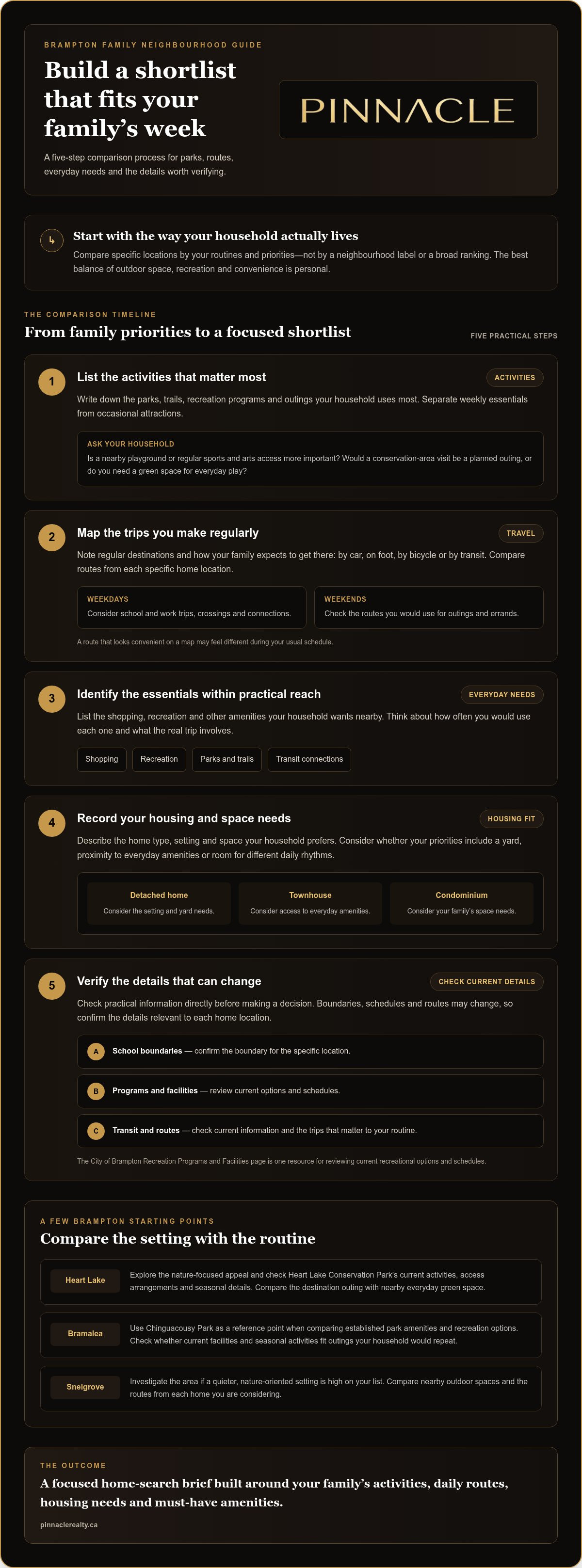
How to choose a Brampton neighbourhood that fits your family’s activities
A neighbourhood shortlist becomes more useful when it reflects how your family spends its time. Instead of choosing based on broad reputations, work through the same priorities for each area. Compare school and work travel on weekdays with recreation, errands and visits with family or friends on weekends. The best Brampton neighbourhoods for families are the ones that make your important routines practical, not simply the ones with the longest amenity list.
Build a shortlist around real weekly routines
Start with a household conversation. Ask each person to name the activities they want to keep, the places they visit regularly and the amenities that would make daily life easier. Separate essentials from nice-to-haves so trade-offs are clear. A nearby park may be non-negotiable for one family, while another may place greater value on a particular commute or access to recreation.
Use this five-step process to turn those priorities into an area shortlist:
- List routines: Record regular school, work, shopping, recreation and family destinations.
- Select priorities: Mark must-haves, then identify the conveniences you’d be willing to trade.
- Shortlist areas: Compare candidate neighbourhoods against those priorities rather than a general reputation.
- Test routes: Check travel to weekday destinations and weekend activities at the times you’d normally go.
- Verify details: Confirm location-specific information before you rely on it in a home decision.
Make the comparison specific. If a child has a regular activity, consider the journey there and back, not just the facility’s location on a map. If you usually combine errands with another trip, test whether that route feels manageable from each candidate location. This gives every household member a voice while keeping the shortlist focused.
Verify local details before choosing an area
Local information can vary by address and change over time. Check current school boundaries and program information through the relevant school board’s official resources. Review transit routes and schedules with the transit agency, and confirm facility access and community programming through the organizations that operate them. Don’t assume that a nearby school, bus route or recreation facility will meet your household’s needs without checking the specifics.
Visit candidate streets at different times, including a typical weekday and a weekend if possible. Notice traffic flow, noise, parking and how people move through the area. A visit adds context that a map can’t provide and helps you assess whether the street itself fits your preferred pace of life.
Once you’ve defined the areas and practical requirements that matter most, compare them with current Brampton property listings. A considered shortlist makes it easier to focus on properties that fit both your housing needs and the routines you want to preserve.
Turn your Brampton neighbourhood shortlist into a confident home search
A neighbourhood shortlist is most useful when it becomes a clear brief for the home itself. The best Brampton neighbourhoods for families will differ by household, so carry forward the priorities you’ve identified rather than trying to find one area that suits everyone. Record what your family wants to do, where you need to go and what kind of home will support your next stage of life.
Translate lifestyle priorities into a property brief
Connect preferred parks, recreation, errands and other regular destinations to each candidate home’s precise location. Then separate neighbourhood preferences from property requirements: desired space, layout, home type and features that matter to your household. A well-known area name can help organize a search, but it can’t replace address-specific research into routes and nearby amenities.
Keep the brief practical and easy to compare. For example, note whether a park should be within walking distance or whether a short drive is acceptable. List regular destinations and the route or travel mode your family expects to use. This makes it easier to see whether a home meets an essential need or offers a feature that’s appealing but less important.
- Preferred activities: Record the parks, programs and outings your family expects to use.
- Daily routes: Note school, work, errands and regular recreation destinations.
- Housing needs: Describe the space, layout and home type that fit your household.
- Non-negotiables: Identify amenities or location features you’re not willing to trade away.
Take a measured next step with local buyer guidance
Once your priorities are clear, buyer representation can help organize the home search around your preferred locations and household needs. Pinnacle Realty represents residential buyers in Brampton and across the GTA. To move from area research to property comparisons, learn more about buyer agency services in the GTA.
As you review homes, keep the brief beside your neighbourhood notes. Compare each property’s location and routes with the routines that matter most, then revisit any assumptions that don’t hold up at the address level. That process turns a broad shortlist into a focused search without forcing your family into a one-size-fits-all choice.
If you’re ready to shape your shortlist into a home search, explore buyer representation with Pinnacle Realty. The right next step is the one that brings your household’s priorities and preferred home into clearer view.
Make your next move with a clearer sense of fit
Your shortlist doesn’t need to be perfect before you begin looking. Treat it as a working brief: as you compare homes, note which locations support the routines you want to keep and where you may need to adjust your priorities. That perspective can make the search for the best Brampton neighbourhoods for families more personal and grounded in how your household wants to live.
For households comparing residential properties, buyer agency guidance can bring structure to the next stage, from refining location preferences to assessing homes against your needs. Pinnacle Realty is a Brampton-based brokerage providing residential buyer representation throughout the GTA.
Explore buyer representation for your next move and take the next step at a pace that feels right. Your family’s ideal fit is yours to define, and a thoughtful search can help bring it into focus.
Frequently Asked Questions
What are the best Brampton neighbourhoods for families?
The best Brampton neighbourhoods for families depend on the household, but Heart Lake, Springdale, Castlemore, Mount Pleasant and Credit Valley are useful areas to explore. Treat them as starting points, not a definitive ranking. Compare the kind of home you want with the activities you expect to use often, then assess candidate streets and properties individually. A neighbourhood name alone can’t tell you whether a particular home suits your family.
Which Brampton neighbourhoods have the best parks and outdoor activities for families?
Heart Lake is worth exploring for nature-focused outings, while Bramalea offers a point of comparison around Chinguacousy Park. Consider what outdoor time looks like for your family: a planned visit to a conservation area, an informal play stop or a walk that fits into an ordinary day. Check current access and amenities before relying on them, and consider how the route works for strollers, young children or older relatives.
Is Brampton a good place to raise a family?
Brampton can suit families looking for a range of residential settings and local places to spend time, but the experience depends on your household’s needs and the specific home location. Consider your commute, access to schools and recreation, and how much space your family wants. Visit the surrounding streets at different times and discuss what would make daily life comfortable and convenient for everyone in your household.
How do I choose a family-friendly neighbourhood in Brampton?
Compare a few candidate areas against your family’s real priorities. You could create a simple scorecard, giving the most weight to essentials such as manageable school travel, a suitable home layout or access to a regular activity. Keep optional features separate so an appealing extra doesn’t outweigh a daily need. Check details for the address you’re considering rather than assuming they apply across the whole neighbourhood.
Which Brampton neighbourhoods are best for families who use public transit?
There isn’t one best area for every transit-using family. Mount Pleasant and Bramalea may be useful neighbourhoods to include in an initial comparison, but the right fit depends on current routes to your actual destinations. Check trip options for school, work and after-school activities, including transfers and service times. If a teen may travel independently, assess the full route and schedule for the times they’d need to make the trip.
Are schools and school boundaries the same throughout a Brampton neighbourhood?
No. School boundaries can vary within a neighbourhood, so a nearby school’s name or location doesn’t establish which school serves a particular property. Before making a decision, use the relevant school board’s official address lookup or boundary information. Also review current enrolment and program details that matter to your family. Confirm these for the specific address, since boundaries and offerings may change over time.
What should families verify before buying a home in Brampton?
Verify the details that could affect both the property and your routine. Review the home’s condition with an appropriate inspection, confirm school information for the address, and check current transit connections, recreation schedules and facility access. Visit the area at different times to observe traffic, noise and parking conditions. Keep a written checklist, then compare what you learn with your family’s priorities before moving forward with a purchase decision.


