

The home with more space isn’t always the one that gives you more freedom. If you’re weighing living in a condo vs house Brampton offers, the better fit depends on how you want your days to feel: consider repairs and outdoor upkeep, shared building responsibilities, privacy and the way you use your space.
It’s natural to focus first on room to grow or the appeal of a simpler routine. But ownership also brings day-to-day commitments that shape your time, flexibility and expenses. A condo may trade some independence for shared responsibilities, while a house may offer more control alongside more upkeep.
This guide compares space, maintenance, ownership responsibilities and everyday convenience to help you assess each option against your lifestyle and longer-term priorities. Use the practical questions below to narrow your Brampton search and decide what to look at more closely.
Key Takeaways
- Compare the ownership model as carefully as the home itself: each option brings different responsibilities and routines.
- Assess space, privacy, upkeep, shared rules and outdoor areas that matter to you when considering living in a condo vs house Brampton.
- Factor commute patterns, errands and household routines into your location priorities before narrowing your search.
- Build a shortlist by identifying your non-negotiables, preferred space and comfort with shared responsibilities.
- Use tailored buyer guidance and local insight to compare Brampton homes against your lifestyle and long-term priorities.
Living in a Brampton Condo or House: What Ownership Really Means
The decision isn’t about choosing the more prestigious address. It’s about understanding what you own, what you share and which responsibilities suit your life. In a comparison of living in a condo vs house Brampton, “condo” describes a form of ownership, not one particular style of home. A condo might be an apartment or a townhouse, while a townhouse may also be freehold. The ownership structure matters as much as the home’s appearance.
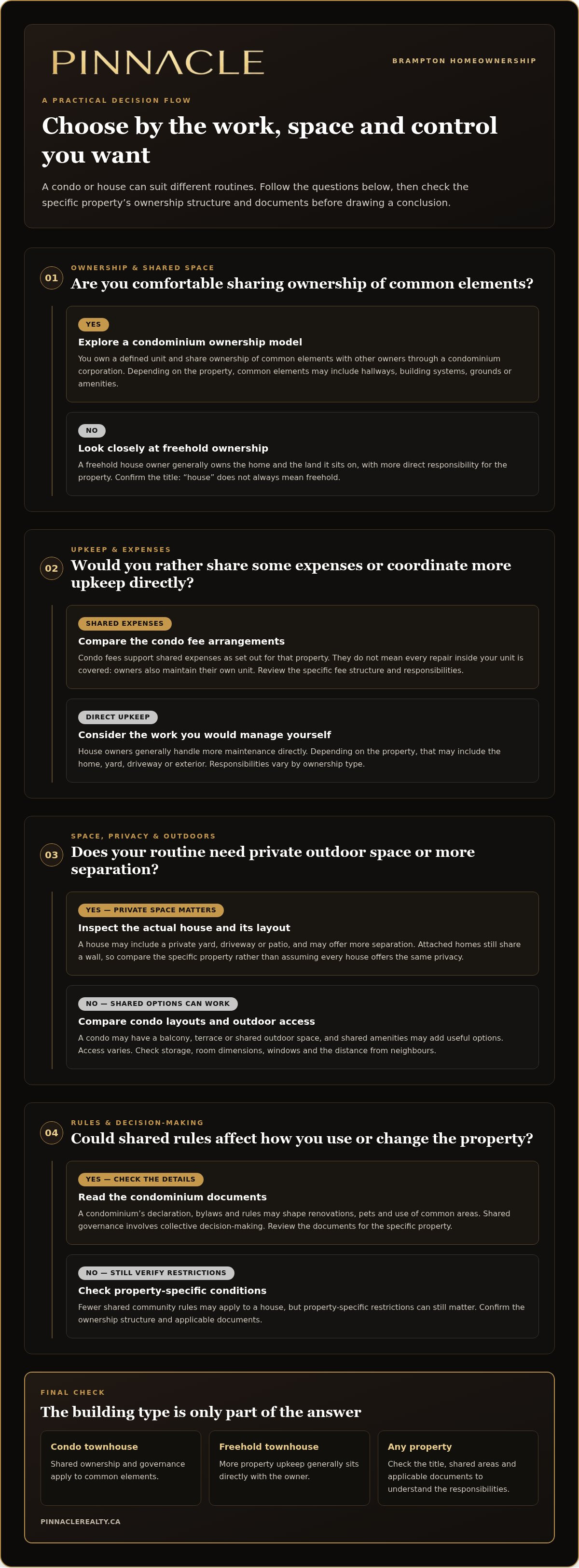
In plain language: A condominium owner owns a defined unit and shares ownership of common elements with other owners through a condominium corporation. A freehold house owner generally owns the home and the land it sits on, with more direct responsibility for the property. The title and governing documents determine the specifics.
That distinction can shape everyday life, from how shared spaces are governed to who arranges and pays for maintenance. Brampton’s range of homes reflects the city’s varied residential settings; Brampton, Ontario offers general context on its geography, population and economy. For buyers, the practical question is how a property’s ownership model fits the way they want to live.
What does owning a condo in Brampton involve?
With a condominium, you own your individual unit, while shared areas belong to the condominium’s owners collectively through the corporation. Depending on the property, common elements may include hallways, building systems, grounds or amenities. A condominium corporation governs and manages shared aspects of the property, guided by its governing documents and Ontario’s condominium framework.
That shared structure doesn’t mean every condo offers the same experience. A high-rise apartment and a condo townhouse can differ in layout, shared facilities, maintenance arrangements and community rules. The declaration, bylaws and rules set out details that affect owners, so review the documents for the specific property rather than relying on assumptions about condos as a category. Shared governance involves collective decision-making, and some choices are shaped by rules that apply to the community.
What does owning a house in Brampton involve?
A freehold house can offer more private space and greater control over how you use and care for the property. That autonomy often comes with more direct upkeep. Owners may need to plan for maintenance of the home and, where applicable, the yard, driveway and exterior. The exact responsibilities depend on the property and its ownership structure.
“House” doesn’t always mean detached or freehold. Brampton buyers may consider detached homes, semi-detached homes and townhouses, and ownership arrangements can vary among them. A freehold townhouse generally places more property upkeep directly with its owner, while a condominium townhouse has shared ownership and governance for common elements. Look beyond the building type: understand the title, shared areas and applicable documents before deciding how much control or responsibility comes with the home.
Brampton Condo vs. House: Compare Space, Privacy, and Upkeep
The day-to-day difference isn’t simply “less space” versus “more space.” A condo can offer a well-planned layout and shared amenities, while a house may provide more private outdoor room but leave more upkeep in your hands. When comparing living in a condo vs house Brampton, look at the specific property, its ownership structure and the routines it needs to support.
| Factor | Condo | House |
|---|---|---|
| Space and storage | Layouts vary; storage may be within the unit or in shared facilities. | May offer more rooms or storage, depending on the property. |
| Privacy and sound | Neighbours may be close by, with sound and privacy shaped by the building and unit. | Can offer more separation, though attached homes still share a wall. |
| Upkeep | Condo fees support shared expenses as set out for the property; owners also maintain their unit. | Owners generally handle more upkeep directly, with responsibilities varying by ownership type. |
| Shared rules | Condominium documents and rules may shape renovations, pets and use of common areas. | Fewer shared community rules may apply, but property-specific restrictions can still matter. |
| Outdoor areas | May include a balcony, terrace or shared outdoor space; access varies. | May include a private yard, driveway or patio, depending on the home. |
Which home offers the space and privacy your household needs?
Picture an ordinary week, not just a viewing. Where will coats, sports equipment or a stroller go? Do you need a quiet room for work, a place for visiting family or outdoor space for gardening? A condo’s shared amenities can add useful options, but they don’t replace private space if your routine requires it. A house may provide more room, yet an attached townhouse won’t offer the same separation as a detached home.
Layouts differ within both categories. During viewings, check the storage, room dimensions, windows and distance from neighbours. Consider how the home could work if your household’s needs change.
How do maintenance and condo rules affect daily life?
Condo fees are recurring payments towards shared expenses, as set out in the condominium’s arrangements. They don’t mean every repair inside a unit is covered. A house owner generally coordinates more maintenance directly, although the details depend on whether the property is detached, semi-detached or a townhouse. Compare the fee structure and responsibilities with the upkeep you’d manage yourself, rather than treating either option as maintenance-free.
Before committing, review the condominium’s declaration, bylaws and rules. They may set conditions for renovations, pets and shared spaces, which can affect plans to alter a unit or use common areas. A house may allow more day-to-day control, but confirm the property’s own obligations and restrictions. Convenience and control come with different ownership trade-offs. To compare homes against your priorities, explore Pinnacle Realty’s buyer guidance.
How Brampton Location Changes the Condo-or-House Decision
A home’s location can make its layout and ownership model feel more or less practical. A condo near places you visit often may suit a routine built around transit, errands and shared amenities. A house may make more sense if your household prioritizes private outdoor space or needs room for equipment and supplies. Neither property type is automatically more convenient. The fit depends on where you go, how you travel and what you need at home.
Which Brampton location fits your daily routine?
Start with the week you actually live. List regular destinations, preferred ways to travel and when you need to get there. Depending on your routine, that might mean checking access to Brampton Transit or GO Transit, planning trips to work, school, appointments or errands, and considering how household members’ schedules overlap. For destinations across Peel Region, compare the full trip rather than focusing only on the home’s address.
Proximity is personal. A nearby stop may matter greatly to one buyer and little to another who drives most days. Check current routes and schedules against the specific listing, then consider the walk, drive or transfer involved. Think through recurring tasks too: carrying groceries, getting children to activities, walking a pet or returning home late. The most convenient location is the one that works for your routine, not a general label attached to a neighbourhood.
How can buyers compare available Brampton homes?
Compare similar properties across locations. Looking at a condo apartment and a detached house side by side may reveal different lifestyles, but it won’t isolate the effect of location. Instead, compare similar property types, then consider how each address changes your daily travel and errands. Keep a shortlist and record what each listing actually offers, rather than assuming features based on the property category.
- Layout: Check room sizes, storage and how the floor plan supports your household’s routines.
- Parking and access: Note the parking arrangement and how you’d reach transit, major destinations or everyday services.
- Outdoor space and facilities: Distinguish private areas from shared facilities, and consider how often you’d use them.
Listing descriptions help you screen options, but the details that matter most are specific to each property. Track the features you value alongside location, then revisit your shortlist against your weekly schedule. Browse Brampton property listings as a starting point for comparing homes and their features. A considered search helps you see whether the location supports the lifestyle you want, rather than requiring you to adapt your routine around an address.
A Practical Brampton Checklist for Choosing a Condo or House
A clear decision starts before the first viewing. Set your priorities, test them against your real routines, then use the same criteria to compare each property. This keeps an appealing feature or polished presentation from overshadowing the practical details that will shape everyday life.
Set priorities before viewing Brampton properties
Begin with your household’s current routines and the changes you can reasonably anticipate. Separate needs you can’t compromise on from preferences you’d enjoy but could live without. For example, a dedicated work area may be essential, while a particular outdoor feature may be desirable rather than necessary. This distinction makes trade-offs easier to assess.
Turn your priorities into a realistic shortlist
Use this sequence to move from broad preferences to a focused set of homes. Apply the same questions to each listing so your comparisons stay consistent.
- Define your non-negotiables. Identify the minimum space, number of rooms, location needs and property features your household requires. Consider regular routines, not just special occasions.
- Rank your priorities. Put space, privacy, upkeep and location in order of importance. Decide which matters most if you can’t find a home that satisfies everything.
- Set your ownership comfort level. Consider how much direct maintenance you’re prepared to take on and how comfortable you’d be with shared responsibilities and community rules. For a condo, note questions about its governing documents; for a house, identify the upkeep you’d manage.
- Consider the next chapter. Think about how a change in household size, work routine or mobility could affect your needs. You don’t need to predict every change, but a home should make sense beyond move-in day.
- Compare specific listings. Record each property’s features against your ranked criteria. Note the compromises and any questions about layout, ownership documents, rules or maintenance responsibilities.
Keep your shortlist focused on properties that meet your essentials, not simply the ones with the most appealing photos. A condo may suit your priorities if shared rules and responsibilities feel manageable; a house may be a stronger match if private space and greater control rank higher. Neither is the universal winner. The right choice for living in a condo vs house Brampton is the one that best supports your routines and ownership preferences.
Before deciding, revisit unanswered questions about the property’s ownership structure or responsibilities. A brief note beside each listing can help separate genuine deal-breakers from acceptable compromises, especially when several homes seem equally compelling.
For tailored buyer guidance and a considered Brampton search, explore Pinnacle Realty’s buyer agency guidance.
Choose Your Brampton Home With Clear, Local Buyer Guidance
The strongest choice isn’t defined by property type alone. It comes from how well a home’s ownership structure, location and day-to-day demands fit your routines and longer-term priorities. A condo may suit a preference for shared responsibilities and a particular layout; a house may better fit a desire for greater private space or direct control. What matters is how those trade-offs feel in your life, not which option sounds better in the abstract.
How buyer guidance can make the search more considered
A focused search turns your priorities into practical criteria. Pinnacle Realty provides buyer guidance for Brampton and GTA buyers, with lifestyle, location and long-term value in view. Curated searches help bring relevant options into focus, while real local insight helps you assess how a property’s features and ownership model relate to your needs. That clarity is useful when two listings appeal for different reasons.
For example, you might weigh a condo’s location and shared facilities against a house’s private space and upkeep responsibilities. The important question isn’t which listing wins on one feature, but how each fits the full picture: daily travel, household routines, desired space and comfort with the ownership arrangements. Explore Pinnacle Realty’s buyer agency guidance to shape a considered property search and approach the purchase with clear priorities.
Take the next step toward a Brampton property search
Bring your preferences into the conversation. Share whether you’re leaning towards a condo, a house or still weighing both, along with the location, space and ownership responsibilities that matter most. If your priorities are still taking shape, that’s a useful starting point too. A clear discussion can help organize your search around the features and trade-offs that deserve attention, without assuming one type of home will suit every buyer.
Choosing between living in a condo vs house Brampton is a meaningful step in your next chapter. Pinnacle Realty brings curated searches and real local insight to the decision, helping you compare options with care and confidence. Request a private consultation to begin a Brampton property search shaped around your priorities.
Make Your Next Brampton Move With Confidence
Your next home should support the life you’re building, not just solve today’s housing question. As you weigh living in a condo vs house Brampton, stay open to both possibilities until a specific property aligns with your priorities. The right choice may become clearer as you compare homes and picture your routines taking shape there.
Pinnacle Realty is a Brampton-based brokerage serving buyers across the GTA. Its buyer guidance for residential and condominium purchases brings curated searches and real local insight into the process, helping you approach the next step with greater clarity. Share what matters to you, whether you have a preferred property type or are still deciding.
A considered move begins with a conversation grounded in your goals. Request a private consultation with Pinnacle Realty and take the next step towards a home that feels right for your future.
Frequently Asked Questions
Is a condo or house better for first-time buyers in Brampton?
Neither is automatically better for a first purchase in Brampton. Think about the home you can comfortably manage, not just the type you hope to own. If your schedule leaves little time for exterior upkeep, a condo may be worth considering; if you need a dedicated workshop or private yard, a house could be a closer fit. Compare actual listings and ownership details against your routines before deciding.
Are condo fees included in the purchase price in Brampton?
No, condo fees are generally an ongoing expense separate from the purchase price. The amount and what it covers vary by property and its condominium arrangements. Review the listing and available documents to understand the fee’s scope, then consider how those shared expenses relate to your own upkeep responsibilities. A fee that covers certain common services may affect your personal maintenance planning, but it doesn’t automatically cover repairs inside your unit.
Can you renovate a condo in Brampton?
Renovation possibilities depend on the unit, the proposed work and the condominium’s governing documents. Before planning a kitchen change or removing a wall, find out whether the work affects shared areas or building systems, and review applicable requirements. Some projects may need additional approvals. Don’t assume a renovation is permitted just because it’s inside your unit; confirm the property-specific conditions before committing to a design or starting work.
Do Brampton condos usually include parking?
Parking varies by building and unit, so don’t assume a space comes with every condo. A listing may describe a parking arrangement, but the property documents can provide important details about what’s included and how the space is assigned. Consider your household’s vehicle needs, storage requirements and how visitors will park. If parking is essential, make it a must-have in your search criteria and compare the specific arrangements for each property.
Is a house always more private than a condo in Brampton?
No. Privacy depends on the specific home, its layout and its surroundings, not just whether it’s called a house or condo. A semi-detached home shares a wall, while a condo’s position within a building can affect sound and sightlines. During a viewing, notice window exposure, neighbouring doors and outdoor areas. If privacy matters, visit at a time that reflects your routine and consider which areas you’ll use most.
How do I decide between a condo and a house in Brampton?
Start by ranking what matters most, such as space, location, privacy, upkeep and comfort with shared rules. Then compare a small group of actual homes using the same criteria, noting which trade-offs feel acceptable. For example, you might decide that a shorter trip to regular destinations matters more than a private yard. A focused search for living in a condo vs house Brampton can help turn your priorities into a practical shortlist.


