

A warehouse that looks right on paper can still be wrong for the way your business operates. When searching for a warehouse for sale Brampton businesses can grow into, the challenge isn’t simply finding available space. It’s determining whether the location, building features and potential flexibility align with your operational needs and plans.
Listings offer useful details, but rarely explain how a property may support your workflow, staffing, deliveries or expansion. It’s easy to compare asking prices and specifications while overlooking the questions that matter to daily operations. Start with a clear brief, then use each listing to test the property’s fit and identify what needs further review.
This guide will help you assess Brampton warehouse listings, compare properties against your business needs and identify due-diligence questions to resolve before moving forward. You’ll learn how location and building characteristics shape suitability, how to build a focused shortlist, and how a private consultation and curated search can bring greater clarity to the process. With local insight and a practical framework, you can approach a commercial property purchase with confidence.
Key Takeaways
- Define your operational priorities and ownership goals before evaluating warehouse listings in Brampton.
- Look beyond headline details by comparing each property’s evidence, suitability and unanswered questions.
- Use a shortlist matrix to separate must-haves from preferences and issues requiring further review.
- Move from initial comparison to property-specific due diligence, including review of permitted use, title, building condition and transaction terms.
- Commercial real estate guidance can help shape a focused search and bring clarity to the acquisition process.
Warehouse for Sale in Brampton: Start With the Business Need
A listing can describe a warehouse, but it can’t determine whether the property fits your business. Before comparing a warehouse for sale Brampton opportunity, define what you need the space to do and what you want ownership to achieve. This is a commercial property decision shaped by daily operations, location priorities and longer-term goals, not just square footage or a prominent feature.
Start with your buying perspective. An operational buyer may prioritize a practical flow for receiving, storing and dispatching goods. An investor may focus on ownership objectives and the property’s potential as an asset. A business planning for future capacity may value room to adapt as its staffing, inventory or processes change. These are different ways to assess a property, not fixed checklists. Your priorities depend on your business and plans.
Local context can help frame the search, but it shouldn’t replace property-level assessment. Brampton’s economic and demographic background, outlined in this overview of Brampton, Ontario, offers broader context for considering the market. Your own supplier relationships, customer base and operating routes will determine which locations make sense.
What does your business need the warehouse to do?
Define the intended function before reviewing specific properties. Storage may centre on inventory organization and access. Distribution may depend on the sequence of incoming and outgoing goods. Production can bring different workflow and space considerations, while mixed-use operations may need distinct areas for several activities. These examples help shape your search, but don’t establish what a particular property is permitted to accommodate. Use your intended activities to guide the search, then review the property’s specific permitted-use information during due diligence.
Map a typical workday: how goods arrive, where they move, who works in each area, and whether customers visit the site. Consider delivery frequency and the routes staff, suppliers and customers use. Even a simple sketch of these movements can reveal practical requirements that a listing’s headline details won’t show.
Which Brampton location priorities matter most?
Compare each area against your real connections: staff commute patterns, supplier locations, customer access and established business routes. A location that supports frequent deliveries may be less convenient for a team travelling from elsewhere, so decide which trade-offs matter most. Bramalea South Industrial, Gore Industrial South, Brampton East Industrial and Steeles Industrial appear in listing results. Treat these names as search starting points, not rankings or guarantees of current inventory.
Build a brief before browsing:
- Intended use: Storage, distribution, production or a combination.
- Space needs: Areas and workflow requirements essential to daily operations.
- Location priorities: Staff, suppliers, customers and established routes.
- Anticipated changes: Expected shifts in capacity, staffing or operations.
A private consultation can help clarify these requirements before you narrow the search. With a defined brief, it’s easier to judge whether a listing is relevant to your business, rather than being swayed by headline appeal alone.
How to Evaluate a Brampton Warehouse Listing Beyond Its Headline
A listing is a useful starting point, not a complete property assessment. Measurements, photographs and feature descriptions help you decide what deserves closer attention, but may not show how the building will function for your business. Evaluate each warehouse for sale Brampton candidate against the requirements you’ve already identified. Keep stated facts separate from assumptions that need investigation.
Which listing details deserve a closer look?
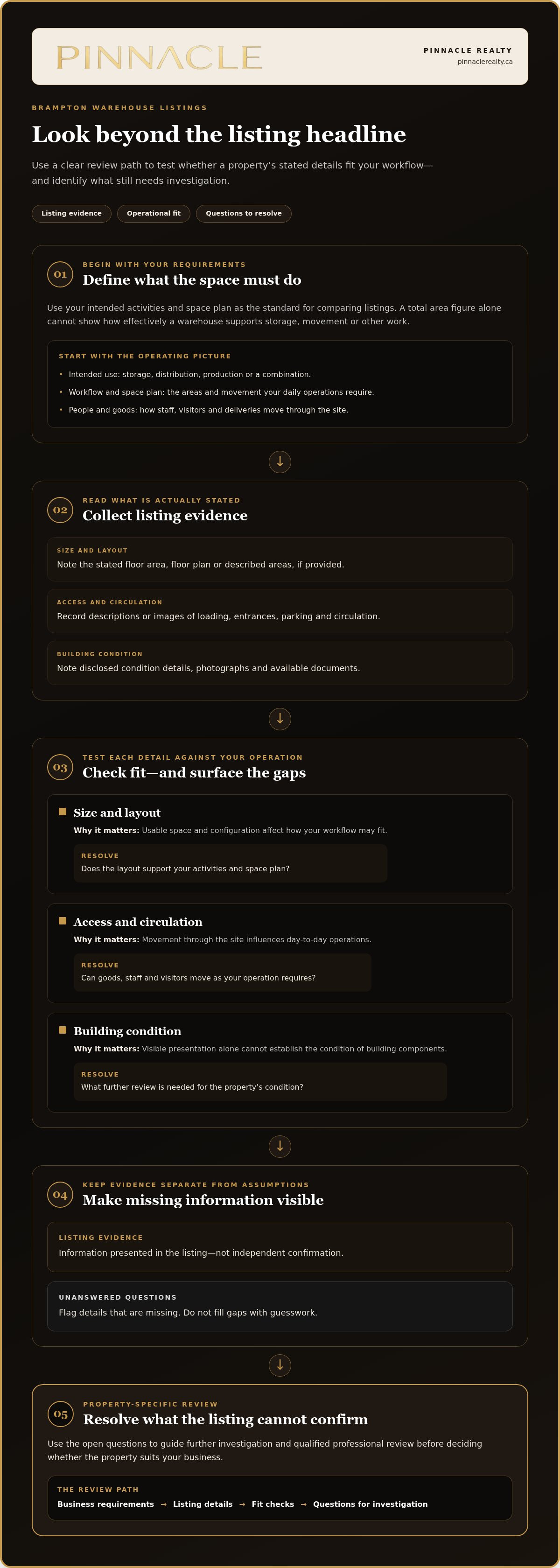
Read beyond the headline. Compare the stated floor area and any available layout information with your workflow and space plan. A total area figure alone won’t tell you how effectively the space can support storage, movement or other intended activities. If loading details, parking, access or building condition appear in the listing, record what is actually stated and flag missing information rather than filling gaps with guesswork.
Use a comparison table to make those gaps visible. “Listing evidence” means information presented in the listing, not independent confirmation. The questions column identifies matters for property-specific investigation and qualified professional review.
| Criterion | Why it matters | Listing evidence | Questions to resolve |
|---|---|---|---|
| Size and layout | Usable space and configuration affect how your workflow may fit. | Stated floor area, floor plan or described areas, if provided. | Does the layout support your activities and space plan? |
| Access and circulation | Movement through the site influences day-to-day operations. | Descriptions or images of loading, entrances, parking and circulation. | Can goods, staff and visitors move as your operation requires? |
| Building condition | Visible presentation alone cannot establish the condition of building components. | Disclosed condition notes, photographs and available documents. | What further review by qualified professionals is appropriate? |
| Location | Travel and delivery connections should align with your priorities. | Address, mapped area and location description. | How does the site work with staff, suppliers, customers and routes? |
| Fit with intended use | A suitable layout does not itself establish permitted use. | Any stated use or property classification. | What do current, property-specific documents say about permitted use? |
How do you compare industrial areas and property types?
Bramalea South Industrial, Gore Industrial South, Brampton East Industrial and Steeles Industrial are search labels, not quality rankings or guarantees of available inventory. Compare each candidate by its actual location and access against your priorities. For wider context on industrial conditions, Cushman & Wakefield’s Canadian Industrial Market Trends Q2 2026 provides a market-level reference; it doesn’t determine an individual property’s suitability.
If a listing identifies an industrial condominium or a freestanding property, compare the formats using information the listing supports. Don’t assume either offers a particular advantage. Focus on documented features, fit with your intended use and unresolved questions. Pinnacle Realty’s commercial property listings can be a starting point for a focused search; property-specific details still warrant appropriate review.
Compare Brampton Warehouse Options With a Clear Shortlist
A shortlist turns a broad search into a practical decision. Keep it manageable and compare every candidate against the same criteria. Don’t let one attractive feature, such as a newer appearance or larger floor area, dominate the discussion. The strongest option is the one whose documented qualities best support your priorities, with trade-offs and unanswered questions clearly visible.
How should you rank warehouse candidates?
Before ranking properties, label each requirement as essential, preferred or negotiable. Essential items connect directly to operating needs; preferred features add value but may have alternatives; negotiable points are trade-offs you could accept. Give more weight to workflow, access and location needs than to cosmetic preferences or polished listing presentation.
Build a simple matrix and assess every property in the same way. For each requirement, record its priority, the evidence available, how well the candidate appears to fit and what remains unresolved. Mark missing information as unknown, not as a pass. This keeps an appealing photograph or headline claim from being mistaken for verified suitability.
| Candidate | Requirement and priority | Evidence reviewed | Fit | Open question |
|---|---|---|---|---|
| Property A | Required workflow feature, essential | Details stated in listing | Appears to fit, needs review, or does not fit | What property-specific evidence is still needed? |
| Property A | Location preference, preferred | Address and route comparison | Appears to fit, needs review, or does not fit | Does the location work for regular operations? |
Apply the same rows to each candidate. Separate confirmed listing information from your assessment and from questions requiring further review. A property with an unresolved essential requirement shouldn’t rank ahead solely because it performs well on a negotiable feature.
Compare trade-offs in context. A location that better supports established routes might come with a less suitable layout. Property format or condition may raise different questions, while room for operational change may matter more to a growing business than immediate visual appeal. Don’t assume a feature is an advantage until you connect it to your use and review the relevant property details.
When should a nearby GTA search area enter the comparison?
Consider Mississauga or Toronto only if your business requirements support widening the geographic search. For example, another location may deserve consideration if it better aligns with important staff, supplier, customer or route connections. That’s a reason to compare, not proof that another area is superior or has suitable inventory.
Use identical criteria for every location: operating fit, access, property details and unresolved issues. Review current property listings as opportunities to assess against your matrix, not as a substitute for it. A curated search shaped around your priorities can help keep the comparison focused as you move from a broad set of options toward a confident shortlist.
What to Resolve Before Buying a Brampton Warehouse
A shortlist is a decision tool, not a green light to proceed. Before buying a warehouse for sale Brampton property, move from broad comparison to careful, property-specific review. Keep conclusions tied to current documents and qualified professional input. A listing description alone can’t establish permitted use, building condition or transaction suitability.
Which property and use questions need verification?
Use an ordered review so key questions don’t disappear when you find a promising property:
- Confirm the intended use. Identify the specific activities your business plans to conduct, then review applicable planning and permitted-use information for the property’s address through current authoritative sources. Don’t treat an industrial label or marketing description as confirmation that a proposed use is permitted.
- Review property records and documentation. Organize available records and transaction documents for appropriate review by qualified professionals. Property-specific title matters, building details and other documentation need careful consideration in context.
- Assess building condition. Listing photographs or brief descriptions can help identify topics for follow-up, but they don’t establish the condition of building systems or components. Arrange relevant professional review and record any findings or areas requiring further investigation.
- Examine transaction terms. Review the proposed terms and documents with the appropriate professionals. Note what each term means for your decision, what remains open and whether the information aligns with your plans.
Keep a clear evidence trail. For each question, record the document or source reviewed, the date of review, the conclusion supported by that evidence and any remaining uncertainty. If information is missing, inconsistent or subject to change, mark it for resolution rather than assuming the most favourable answer.
How can you prepare to make an informed decision?
Bring your shortlist, operating criteria, listing materials and open questions together in one review file. This makes it easier to distinguish three separate considerations: condition, which calls for property-specific review; operational flexibility, which concerns how the space may accommodate your plans; and transaction terms, which shape the proposed purchase. Evidence in one category shouldn’t substitute for evidence in another.
Before progressing, revisit each candidate against the same criteria and note what has changed since the initial comparison. Has new documentation answered a critical question? Does the proposed use still align with current information for that address? Are there building or transaction matters that need further professional attention? A concise record helps keep the decision grounded, especially when several parties are reviewing different parts of the transaction.
Commercial real estate guidance can bring clarity to the steps between shortlist and acquisition. Pinnacle Realty provides commercial real estate representation and local insight throughout the transaction, helping buyers navigate the process with a considered approach. Explore commercial real estate guidance as you prepare to move from property comparison to informed review.
Find a Brampton Warehouse With Pinnacle Realty’s Commercial Guidance
A focused shortlist and a clear record of due-diligence questions give you a stronger foundation for evaluating which opportunity merits serious consideration. Pinnacle Realty provides commercial real estate services for buyers and investors across the GTA, bringing local insight and clarity to the transaction. The guidance is grounded in your goals, not in a one-size-fits-all view of what a warehouse for sale Brampton should offer.
What does a tailored commercial property search involve?
A tailored search begins with your business needs and ownership priorities. A private consultation can help clarify the criteria that matter most, from your intended operations and preferred location to the property characteristics you’re seeking. Those priorities then shape a curated search, helping you focus on opportunities that align more closely with your requirements instead of sorting through listings without a clear framework.
Local insight adds context as you evaluate Brampton opportunities. It can help you consider how a property’s location relates to your priorities and which details deserve closer attention as the transaction develops. It doesn’t replace current property documentation, professional review or your own operating assessment. Instead, it helps bring the search into sharper focus, so you can consider each opportunity with greater clarity.
As your shortlist evolves, keep the evidence and open questions alongside your priorities. A property may appear promising at first glance, but the next step is to understand how its documented details relate to your intended use and what requires further review. Brokerage guidance can help you navigate the commercial transaction while keeping the decision connected to your objectives.
How can Pinnacle Realty guide your next step?
Commercial real estate decisions involve more than identifying a suitable listing. They require clear communication about what you’re seeking, careful consideration of property information and attention to the transaction as it progresses. Pinnacle Realty brings together local insight, confident guidance and sharp negotiation to support buyers as they evaluate opportunities and move through a commercial property acquisition.
That guidance is most useful when your priorities are clear but the right opportunity still needs to be identified. Bring your shortlist, essential criteria and unresolved questions into the conversation. Together, these provide a practical starting point for clarifying what should guide the search, which trade-offs may be acceptable and what information matters as you assess potential properties. The process stays centred on your needs and informed by the details of each opportunity.
Buying a commercial property is a meaningful step in a business’s next chapter. A considered search can make that transition more deliberate, with local perspective and a clear understanding of the questions to resolve along the way. Begin with a private consultation to clarify your Brampton warehouse search priorities and discuss your commercial property goals. Arrange a commercial property consultation.
Make Your Next Property Decision With Purpose
The right warehouse can shape how your business operates and where it can go next. Treat the search as one step in that larger plan: identify what needs to be true for the property to support your next chapter, and keep that vision in view as you move from consideration to decision. A warehouse for sale Brampton search becomes more purposeful when the choice reflects both today’s operations and the direction you want to build towards.
Pinnacle Realty brings commercial real estate sales and leasing together with local insight, clarity and sharp negotiation. If you’re ready to define your next move, a conversation can help turn your priorities into a considered path forward.
Start a commercial property consultation, and take the next step with confidence.
Frequently Asked Questions
What should I look for when buying a warehouse in Brampton?
Assess intended use, layout, location, access, building condition and supporting documentation against how the business will operate. For example, a delivery-focused operation should consider whether the described access and circulation suit the movement of goods, rather than relying on photos alone. Treat floor area or loading details in an advertisement as listing statements until corroborated by property-specific records, site review or qualified professional assessment. Record what remains unclear.
How do I find warehouses for sale in Brampton?
Search commercial property portals, then narrow results by warehouse or industrial property type and Brampton location. Use your business needs to set filters, such as a relevant size range or preferred area, where those options are available. Listing counts and availability change, so revisit results as your search progresses. Build a shortlist and compare each candidate using one consistent criteria matrix; search position and headline wording aren’t recommendations.
Can a warehouse listing confirm that my business can operate there?
No. A listing description is marketing information, not confirmation that a proposed business activity is permitted at that specific property. Identify the exact address and intended operations, then verify current planning and permitted-use information through authoritative sources. Review relevant records and documents with appropriate qualified professionals. Keep a written note of the sources consulted and any unanswered points, since general descriptions or property labels may not settle questions about a particular site.
What should I compare between Brampton warehouse properties?
Compare each property’s operational fit, area, layout, access, condition, location and potential to accommodate operational changes. The priority of each factor depends on the intended business use; a location convenient for suppliers may not be the best fit for staff or customer access. Record the evidence behind each assessment and the due-diligence questions still open. This gives your shortlist a reasoned basis instead of relying on quick headline comparisons.
Is an industrial condo different from a freestanding warehouse?
Yes. An industrial condominium and a freestanding warehouse are different property formats, and ownership arrangements, shared areas, operations and property details can vary between individual properties. Don’t assume either format is less costly, less restrictive or inherently more suitable. Review the specific listing and available property documents to understand what is being offered, then consider relevant questions with appropriate professionals before deciding how the format aligns with your business plans.
How much warehouse space does my business need?
There’s no universal size that suits every business. Estimate space by mapping inventory, workflow, equipment and staffing, then consider how each may change as operations develop. For example, account for the areas needed to receive, organize and dispatch goods, not only the space used to store them. Compare that plan with documented details for each candidate, and assess permitted use separately for the specific property.
What happens if the warehouse’s listed details do not answer my questions?
Treat unanswered details as open questions, not as confirmed features or defects. Keep a separate record for each property, noting the information available, what’s missing and how the gap could affect your decision. Review relevant documentation and seek appropriate professional input for questions that need specialized assessment. This creates a clearer basis for comparison and helps you decide what needs resolution before advancing with a particular opportunity.


