

The smallest home isn’t always the smartest downsize. When you’re downsizing your home in Brampton, the right next step depends on more than square footage. It should support your daily routines, future priorities and preferred way of living. Start with the life you want, then work backwards to the property and move.
It’s natural to wonder whether to sell first or find your next home before making a move. You may also be weighing which belongings to keep, how much space is enough, and whether a condominium, townhouse or smaller detached home will suit you over time. A considered plan can help you make those choices without rushing a major transition.
This guide will help you compare staying in Brampton with relocating, identify the space and features that matter most, and organize your sale, purchase and move into manageable stages. You’ll also see where residential listing and buyer agency support may help you assess your options and make informed decisions. A well-planned downsize isn’t simply about having less. It’s about making room for what comes next.
Key Takeaways
- Define what a better fit means for your routines, priorities and desired level of upkeep before deciding how much space to give up.
- Break downsizing your home in Brampton into manageable stages, and sort belongings at a pace that leaves room for thoughtful decisions.
- Compare staying put, choosing a condominium or smaller freehold home, and relocating against the features that matter most to you.
- Plan the sale and purchase sequence around your finances, preferred timing and next-home search to reduce avoidable pressure.
- Understand how listing and buyer representation can support real estate decisions, while arranging packing and moving separately.
Downsizing your home in Brampton: define what a better fit means
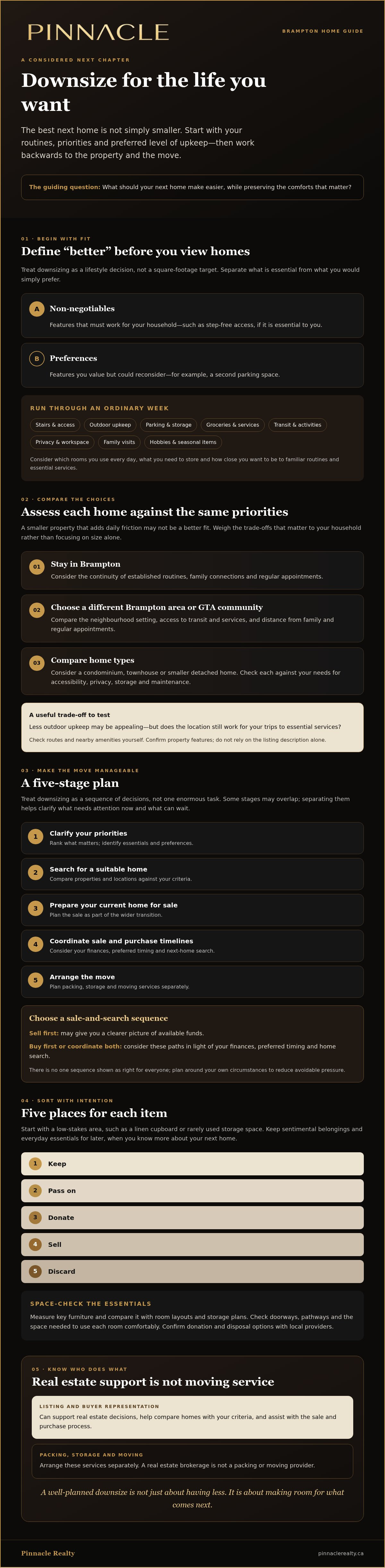
Downsizing isn’t simply a move into fewer square feet. It can mean choosing a home that’s easier to maintain, better suited to your routines or more aligned with the next stage of life. A smaller property that adds daily friction may be a poor fit. A thoughtfully chosen one can preserve the comforts that matter while reducing space you no longer use.
Before looking at listings, rank your priorities: location, accessibility, privacy, storage and maintenance. Decide which are essential and which are preferences. For example, step-free access might be essential, while a second parking space could be negotiable. A successful downsize is a lifestyle-led housing decision, not a square-footage target.
Clarify what you want your next home to make easier
Picture an ordinary week, not just moving day. Consider stairs, outdoor upkeep, parking, storage and how close you want to be to groceries, health services, transit or familiar activities. A home with less yard work may still need enough storage for seasonal items or hobbies. Thinking about simpler living can also help you identify what you genuinely use. The philosophy of simple living offers context for choosing fewer possessions intentionally, rather than clearing space just to meet a number.
Discuss routines and privacy with everyone in your household. Which rooms do you use every day? Does anyone need a quiet workspace or a room to host family? Consider future flexibility, too, without assuming that every possible need must be solved in advance. Keep a short list of non-negotiables and a separate list of features you could reconsider as you view homes.
Set Brampton priorities before exploring properties
Staying near established routines may offer continuity, while another part of Brampton or a different community in the GTA could better match your priorities. Compare the trade-offs: distance from family and regular appointments, access to transit and services, and the neighbourhood setting you prefer. Don’t rely on a listing description alone. Check routes and nearby amenities yourself, and confirm property features before making decisions.
Use your ranked priorities to assess each option consistently. If a property reduces outdoor upkeep but adds a longer trip to essential services, decide whether that exchange works for your household. When you’re ready to explore current options, browse Brampton home listings. A buyer’s representative can also help you compare smaller homes and condominiums against your criteria, rather than focusing on size alone.
How to downsize in Brampton without letting the move take over
Downsizing your home in Brampton is easier to manage when you treat it as a sequence of decisions, not one enormous task. Set a pace that leaves room to consider your next home, prepare your current property for sale and coordinate the move without making every choice at once.
A practical plan can move through five stages: clarify your priorities, search for a suitable home, prepare your current home for sale, coordinate the purchase and sale timelines, then arrange the move. Some steps may overlap, but separating them makes it easier to see what needs attention now and what can wait. If you’re exploring later-life options, the Government of Ontario’s Ontario programs and services for seniors guide may help you identify relevant provincial information.
Create a manageable sorting and space-planning process
Begin in low-stakes areas, such as a linen cupboard or rarely used storage space. Sort items into five groups: keep, pass on, donate, sell or discard. Leave sentimental belongings and everyday essentials until later, when you have a clearer sense of the space you’ll have. There’s no need to force decisions about meaningful items before you’re ready.
As you shortlist homes, measure key furniture and compare those dimensions with room layouts and storage plans. Check more than whether a sofa fits: consider pathways, doorways and the space needed to use the room comfortably. Make a list of items that need storage and check whether each property can accommodate them. Confirm donation and disposal options with local providers, and arrange any storage or moving services separately. A real estate brokerage can assist with listing and buyer representation, but it isn’t a packing or moving provider.
Build a Brampton sale-and-search timeline
Decide whether you’d prefer to sell first, buy first or coordinate both transactions. Selling first may give you a clearer picture of your available funds, while buying first may offer more certainty about where you’ll move. Coordinating both can help align the transition, but timing and availability may not match perfectly. The right sequence depends on your finances, the homes available when you’re searching and how much uncertainty you’re comfortable carrying. Review your financial position and discuss possible timing with the appropriate professionals before committing.
Work backwards from your preferred move date, allowing time to search, prepare the current home and coordinate closing dates. Sale preparation should suit the property, your timeline and your plans; it doesn’t need to become an open-ended renovation project. For more detail on preparing a property for listing, read the Brampton home selling guide. When you’re ready to compare available options, you can also explore Brampton home listings.
Compare smaller-home options in Brampton before you choose
There’s no single best way to downsize. Staying in your current home, moving to a condominium, choosing a smaller freehold property or relocating can each bring a different balance of space, privacy and upkeep. Use the comparison below as a starting point, then assess the specific property and its features.
Compare each option against the same questions: How much upkeep will it involve? What level of privacy and storage do you need? Is outdoor space important, and how accessible is the layout? How far will you be from the people, services and activities that shape your week? Applying the same questions to every property can make trade-offs clearer. The right option depends on your priorities, the details of the property and verified availability.
When a Brampton condominium may fit your priorities
A condominium may appeal if you want a more compact private space or value amenities shared within the building. Don’t assume that a smaller footprint means lower overall costs or less responsibility. Review the specific unit and building, including applicable fees and rules, parking, storage, accessibility and how outdoor space is provided. Confirm details before deciding.
When a smaller freehold home or a different location may suit you
Freehold homes differ: one may have a manageable yard, while another requires more outdoor work. Compare the actual layout, storage, access and maintenance needs rather than relying on property type alone. If considering another Brampton neighbourhood or elsewhere in the GTA, check how the address fits your regular routes and routines. Buyer agency support can help you assess purchase options against your criteria.
When downsizing your home in Brampton, weigh the day-to-day experience of each specific property, not just its size or category.
Prepare to sell and buy in Brampton with fewer surprises
A clear sequence can make the sale and purchase easier to manage, even when some decisions overlap. Begin by reviewing your finances with the appropriate professional, then consider your timing preferences and discuss possible sale and purchase sequences with your real estate representative. Next, prepare your current home for a listing conversation, search for properties that fit your priorities and coordinate proposed closing dates. Confirm transaction conditions and legal details with your real estate and legal professionals before making commitments.
There’s no guaranteed sequence that suits every homeowner. Selling first, buying first or coordinating both can each involve different considerations. Your finances, the options available during your search and your comfort with uncertainty all matter. Ask questions early, and avoid relying on an assumed sale price or timeline when planning the next step.
Prepare your current Brampton home for a listing conversation
Gather useful information before discussing a marketing plan. Make a record of known repairs, improvements and features, and collect any relevant documents you already have. This gives you and your listing representative a clearer basis for discussing how the home might be presented. Be candid about items that may need attention; the conversation can help identify which details warrant further consideration.
Presentation choices should suit the property, your timeline and your intended sale strategy. Staging or other preparation may be considered, but it shouldn’t become a one-size-fits-all checklist. For more information about representation when preparing to list, explore the available Brampton residential listings.
Coordinate the next purchase with your sale plan
As you review actual listings, compare each home with your space, location and accessibility priorities. Discuss timing preferences and questions about conditions with your real estate representative; ask a legal professional to explain the implications of any proposed terms. If financing is part of your plan, confirm your options directly with the appropriate financing professional. These conversations can help you understand what needs to align without treating any closing date as assured.
Keep the sale and purchase calendars visible together. Before agreeing to dates or conditions, verify the details with your real estate and legal professionals, and ask them to clarify how the transactions relate. A residential listing representative can help you develop a sale plan, while buyer agency can support your search for a suitable next home. For downsizing your home in Brampton, measured preparation and clear communication can help you make decisions with greater confidence.
To discuss representation for your Brampton sale or next-home search, connect with Pinnacle Realty.
Choose the right Brampton real estate support for your next chapter
Downsizing your home in Brampton brings two distinct real estate decisions: how to present and sell your current property, and how to find a next home that fits your priorities. A brokerage can provide residential listing and buyer representation for those transactions. Packing, moving, decluttering, legal advice, mortgage financing and property management are separate matters, so clarify who will handle each part of your plan.
The right professional relationship should make your choices clearer, not add pressure. Look for someone who listens to what you want daily life to look like, explains the proposed approach and communicates in a way that works for you. Pinnacle Realty is a Brampton-based brokerage serving the GTA, with residential listing and buyer agency services, including condominium sales.
Questions to ask before choosing real estate representation
Use an initial conversation to understand how the agent’s approach aligns with your needs. Consider asking:
- How will you learn about my priorities, timing and preferred next-home features?
- How would you develop a sale approach for my property, and what information would you need from me?
- How will you communicate updates and explain important decisions?
- How will you help me compare homes or condominiums against my search criteria?
- How will you discuss negotiation choices and coordinate communication around a sale and purchase?
Listen for clear explanations, thoughtful questions and realistic discussion of what can and can’t be known in advance. Compare the fit of each professional relationship, including whether you feel comfortable asking for clarification. Ask how marketing recommendations will be tailored to the home and proposed sale strategy, rather than assuming the same presentation suits every property.
Plan a considered move with local guidance
Keep your next steps focused: define what matters most, compare suitable Brampton or GTA options, and discuss sale and purchase timing before committing. A real estate representative can explain listing and buyer representation within their role; consult legal and financing professionals directly about matters in their fields. Arrange decluttering, packing, storage and moving support separately if needed.
There’s no need to have every detail settled before starting a conversation. If you’re weighing a sale, a condominium or another Brampton home, you can discuss your move with Pinnacle Realty and share your priorities, timing and questions. A measured discussion can help you decide whether the brokerage’s listing and buyer agency services suit the next stage of your plans.
Make your next move with clarity and confidence
Successful downsizing starts with a clear idea of what you want daily life to look like. Rank your priorities, compare the trade-offs between staying in Brampton and moving elsewhere, then plan the sale and purchase around your finances, preferences and timing. A measured approach can help you choose a home that feels right, not simply smaller.
For downsizing your home in Brampton, local real estate guidance can help you assess your current home’s sale and compare suitable next-home options. Pinnacle Realty is a Brampton-based brokerage serving the GTA, offering residential listing and buyer agency services, including condominium and pre-construction property sales.
Every transition is personal. If you’re ready to discuss your priorities, timing and potential Brampton options, Discuss your Brampton move with Pinnacle Realty. Start with one clear conversation about your next steps.
Frequently Asked Questions
Is downsizing your home in Brampton a good idea?
It can be a good idea if a different home better supports your routines, priorities or preferred level of upkeep. Consider what you hope to make easier, such as managing outdoor space, accessing daily services or having less unused room. Then weigh those benefits against trade-offs like storage, privacy and distance from familiar places. The best choice depends on your household and the specific properties you consider, not square footage alone.
How do I start downsizing my home in Brampton?
Start by writing down your essential home features, preferred location and timing considerations. Then review your belongings gradually, sorting them into keep, pass on, donate, sell or discard groups. Begin with low-stakes spaces and leave sentimental items until you have a clearer picture of your next home. As you explore properties, measure key furniture and compare it with room layouts. Keep sale preparation, purchase planning and moving arrangements as separate tasks.
Should I sell my Brampton home before buying a smaller one?
There’s no sequence that suits everyone. Selling first may clarify your sale proceeds before you purchase, while buying first may provide more certainty about where you’ll live next. Coordinating both transactions can involve timing considerations, and neither approach guarantees that dates will align. Review your finances, availability and comfort with uncertainty, then discuss possible conditions and dates with your real estate and legal professionals before making commitments.
What should I compare when choosing a smaller home in Brampton?
Compare the details that will shape everyday life: layout and accessibility, maintenance, privacy, storage, parking and outdoor space. Check travel distances to the services, people and activities you rely on, and verify transit and neighbourhood details for each property. For a condominium, review the specific unit and building, including applicable fees, rules and storage. For a freehold home, assess its actual upkeep needs rather than assuming all properties of that type are alike.
Can I downsize in Brampton without moving to a condominium?
Yes. A smaller freehold home may suit you if you want a different balance of indoor space, outdoor area and privacy. The maintenance required will depend on the individual property, so assess its yard, layout, storage and condition rather than relying on the label. You could also consider relocating within Brampton or elsewhere in the GTA. Compare each option with your routines and priorities, and verify current property details before deciding.
How long does it take to downsize and move in Brampton?
There’s no fixed timeline. The process depends on how quickly you make decisions, how much sorting and sale preparation you choose to do, what suitable homes are available and how the sale and purchase dates work out. Build a flexible plan covering home search, listing preparation, transaction coordination and moving arrangements. Confirm proposed dates and conditions with your real estate and legal professionals, and avoid basing plans on an assumed sale or closing timeline.
Should I hire a real estate agent when downsizing in Brampton?
A real estate professional can provide representation for listing your current home or searching for a next one. Ask how they’ll learn your priorities, explain the proposed sale approach, communicate updates and support your purchase search. Pinnacle Realty is a Brampton-based brokerage serving the GTA, with residential listing and buyer agency services, as well as condominium sales. Packing, moving, legal and financing support are separate; confirm those arrangements with the appropriate providers.


