

What if the most important detail in a condo status certificate isn’t a glaring warning, but a pattern that calls for a closer look? If you’re searching “how to read a condo status certificate Ontario,” start by knowing that this package brings together financial statements, rules and legal documents. Routine information can sit beside details that may affect your decision.
Treat the certificate as a risk map, not a pass-or-fail grade. It offers a snapshot of the condominium corporation, but it can’t guarantee the building’s future condition. Your goal is to spot what deserves follow-up, not to make a legal assessment on your own.
This guide explains the certificate’s purpose and limits, then highlights the financial, legal and governance details to review, including reserve fund information, fee changes, special assessments and litigation. You’ll also find practical questions to raise with your real estate representative, who can help organize property-specific concerns, and points to discuss with your lawyer for legal review. With a clearer process, you can make a more informed purchase decision, whether you’re considering a condo in Brampton or elsewhere in the GTA.
Key Takeaways
- Understand what an Ontario status certificate can reveal, and why it’s a snapshot rather than a guarantee of the condominium corporation’s future condition.
- Learn how to read a condo status certificate Ontario buyers receive by distinguishing routine financial details from items that may need closer review.
- Use the reserve fund information, fee details and financial statements to identify questions about future costs.
- Check how the declaration, by-laws, rules, insurance and legal disclosures could affect your ownership and day-to-day use of the unit.
- Follow a clear review process, then direct property questions to your real estate representative and legal interpretation to your lawyer.
What an Ontario condo status certificate tells you, and what it cannot guarantee
A condo status certificate is a condominium corporation’s disclosure package about its current status and key records. Buyers reviewing a resale condo in Ontario use it to understand the unit’s financial obligations and the corporation’s documents before completing the purchase. Ontario’s Condominium Act, 1998 and regulations set out the certificate’s prescribed contents. The package may also include supporting records that add context.
Think of it as a risk map, not a pass-or-fail grade. The certificate reflects information available when it was prepared. It can help reveal matters that need attention, but it doesn’t predict future repairs, fee changes or disputes, and it isn’t a guarantee of the building’s future condition.
What documents and information may come with the certificate?
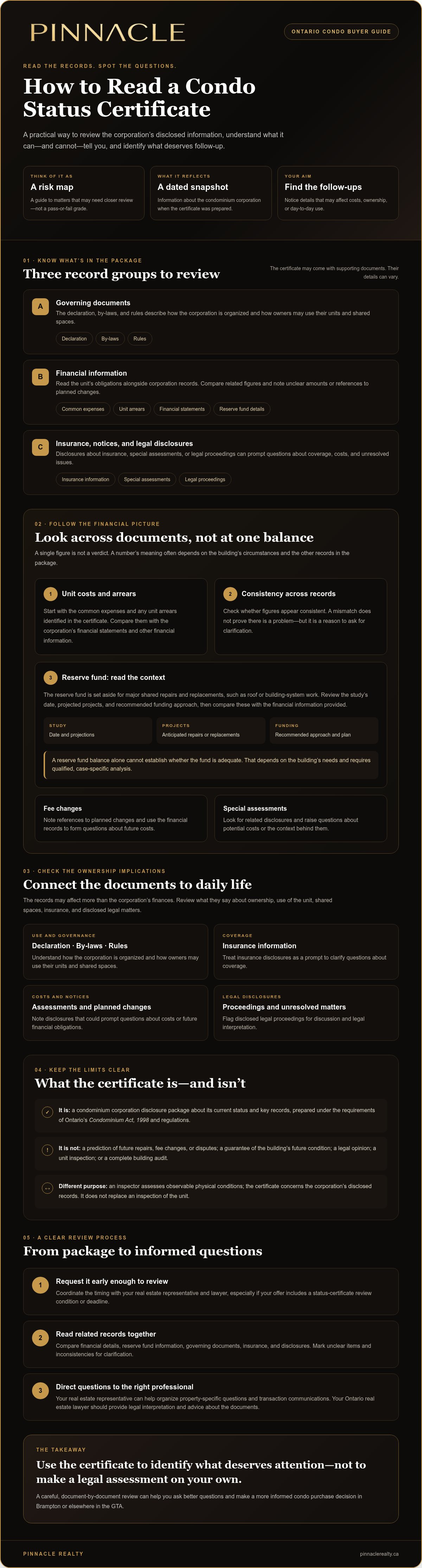
The certificate and accompanying documents can feel like a small library. As you review the package, look for these common categories:
- Governing documents: The declaration, by-laws and rules describe how the condominium corporation is organized and how owners may use their units and shared spaces.
- Financial information: Common expenses, unit arrears, financial statements and reserve fund details can help explain the corporation’s financial position.
- Insurance and notices: Insurance information and disclosures about matters such as special assessments or legal proceedings can prompt questions about coverage, costs or unresolved issues.
Ontario prescribes what a status certificate must contain, but supporting documents and the details disclosed can vary. For background on the related real estate concept, see Estoppel certificate. Don’t treat a single figure or document as a verdict. Its meaning often depends on the building’s circumstances and the other records in the package.
Who should review it, and when?
Request the package early enough in your transaction timeline to allow for a careful review and follow-up. Coordinate timing with your real estate representative and lawyer, especially if your offer includes a status-certificate review condition or a deadline. Your representative can help organize property-specific questions and transaction communications. Your Ontario real estate lawyer should provide legal interpretation and advice about the documents.
A status certificate is a dated disclosure of a condominium corporation’s status and records, not a legal opinion, building inspection or guarantee of future conditions. It doesn’t replace an inspection of the unit, and it isn’t a complete building audit. An inspector assesses observable physical conditions; a status certificate concerns the corporation’s disclosed records. Knowing how to read a condo status certificate Ontario buyers receive starts with understanding that distinction, then identifying what needs professional follow-up.
How to read the certificate’s finances, reserve fund, and possible costs
Start with the unit’s common expenses and any arrears identified in the certificate. Compare those details with the corporation’s financial statements and other financial information in the package. Check whether figures appear consistent across documents, and note unclear amounts or references to planned changes. A mismatch isn’t proof of a problem, but it is a reason to ask for clarification.
When learning how to read a condo status certificate Ontario corporations provide, read the financial details together rather than treating one balance as a verdict. A reserve fund balance, for example, makes more sense alongside the study’s projections, the board’s funding plan and the repairs or replacements anticipated for shared components.
How should you interpret the reserve fund information?
The reserve fund is money set aside for major shared repairs and replacements, such as work on the roof or building systems. A study estimates future needs and considers the fund’s financial path. Look for the study’s date, projected projects and recommended funding approach, then compare them with the financial information provided. A balance alone can’t establish whether the fund is adequate. That depends on the building’s needs and requires qualified, case-specific analysis.
Note projects that appear in the study and check whether the documents explain how they’ll be funded. If the study, funding plan and financial statements seem difficult to reconcile, ask your Ontario real estate lawyer to interpret the records and identify what further information may be needed.
What do fees, arrears, and assessments signal?
Common expenses affect your ongoing ownership costs, so check the amount stated for the unit and look for any disclosed proposed increase. Arrears information can identify unpaid amounts associated with the unit. Confirm what is owed, by whom, and how it is expected to be addressed as part of the transaction.
A special assessment or fee increase deserves investigation, but neither automatically means the corporation is poorly managed. Clarify whether an assessment is approved, proposed, disputed or only discussed, and what expense it relates to. Ask whether a disclosed cost could affect the unit or your transaction, and have your lawyer interpret the applicable documents.
- Compare: Check that financial statements, reserve fund details and disclosed costs tell a consistent story.
- Clarify: Ask what an expense covers, when it may apply and whether its status is confirmed.
- Escalate: Send unclear liabilities, conflicting figures and upcoming costs to your lawyer promptly.
Your buyer’s representative can help organize property-specific questions and coordinate transaction communications, while legal interpretation belongs with your lawyer. Buyers considering representation can learn more about buyer agency services through Pinnacle Realty.
Check the condo corporation’s rules, insurance, and legal disclosures
Financial information is only part of the picture. The declaration, by-laws and rules can shape how you use the unit and shared spaces, while insurance and legal disclosures may raise questions for your lawyer. As you learn how to read a condo status certificate Ontario buyers receive, compare the documents with your plans rather than assuming a rule or disclosure has the same effect in every building.
Which governing documents can affect your plans?
Read the declaration, by-laws and rules for provisions that relate to your intended use. For example, check what they say about pets, leasing, renovations, parking and amenities. If you plan to install new flooring or rent out the unit, look for applicable restrictions or approval processes, then ask your lawyer how the documents apply to your circumstances. Don’t rely on a brief summary if the wording is unclear.
| Document or disclosure | What to look for | Follow-up question |
|---|---|---|
| Declaration, by-laws and rules | Terms affecting pets, leasing, renovations, parking or amenities | Do these terms allow my intended use or require approval? |
| Insurance information | Disclosed coverage, deductibles and exclusions | What does the corporation’s policy cover, and what should my personal policy address? |
| Claims, litigation or notices | The nature of the matter and any related documents or updates | What is the status, and could it affect the corporation or this purchase? |
How should you approach insurance, claims, and litigation?
Review the insurance details provided in the package, but distinguish the corporation’s coverage from insurance you may need for your own unit and belongings. The certificate’s information may not answer every question about policy terms or your personal coverage. Ask your insurance provider about your needs, and have your lawyer clarify any document-specific legal questions.
A reference to a claim or legal proceeding is a prompt to investigate, not a conclusion about its seriousness or outcome. Look for supporting details, notices or updates in the package, and ask your lawyer to explain what the disclosure means for the corporation and your transaction. A disclosed legal matter needs context because a brief entry alone may not reveal its status, scope or potential effect.
Keep a written list of questions tied to specific clauses or disclosures. Your real estate representative can help organize property-related questions and coordinate transaction communications, while your lawyer can interpret the governing documents and legal disclosures.
Use this Ontario condo status certificate checklist to spot follow-up questions
A structured review helps you separate simple clarification requests from disclosures that may affect your costs, intended use or purchase decision. If you’re learning how to read a condo status certificate Ontario buyers receive, keep a dated question log as you go. Record the page or document, the wording that raised a question, and who needs to answer it. That makes follow-up more precise, especially when transaction deadlines are approaching.
A practical review workflow
- Confirm the package. Check that you have the certificate and the documents it refers to. Note the issue date and flag any referenced attachments that appear to be missing.
- Scan the key sections. Review the financial information, reserve fund materials, governing documents, insurance details and disclosed notices or legal matters. Compare related figures and statements across documents.
- Log uncertainties. Write down unclear wording, unexplained changes or inconsistencies. Include the page number, document title and date so the question can be traced back to its source.
- Escalate by significance. Routine requests might include confirming a document’s meaning or locating a referenced attachment. Send potential cost liabilities, use restrictions, litigation and conflicting information to your lawyer for review.
What should you flag for your lawyer?
Share questions about unclear common expense changes, special assessments, arrears, legal proceedings and inconsistencies across the certificate package. Ask your lawyer to explain what each disclosure could mean for the unit, the condominium corporation and your transaction. A disclosure may require additional documents or clarification before you can assess its significance.
Also confirm deadlines and the effect of any status-certificate condition in your purchase agreement with the lawyer handling the transaction. Don’t assume a deadline can be extended or that a concern can be resolved later. The absence of a listed issue isn’t proof that no risk exists either. The package is a disclosure snapshot, not a complete account of every possible future event.
Which questions should you ask before waiving a condition?
Before making a decision, ask what a disclosure means for the unit, the corporation and your planned use. Check whether you need further documents, written clarification or legal interpretation before the applicable deadline. If an answer is outstanding, contact your lawyer promptly. Don’t waive a contractual protection based on assumption or informal reassurance. Get legal advice on your specific agreement and options.
For support organizing property questions and coordinating purchase communications, explore buyer agency services in the GTA.
Turn your status certificate review into a confident condo-buying decision
A useful review doesn’t produce a simple pass or fail. It gives you a clearer picture of what’s confirmed, what needs an answer, and how the property fits your plans. As you consider how to read a condo status certificate Ontario buyers receive, use a measured sequence: understand the disclosures, get qualified answers, then assess whether the purchase suits your budget, intended use and comfort with uncertainty.
How do you weigh an issue without overreacting?
Separate documented facts from estimates, unanswered questions and possible future scenarios. A planned repair, for example, is different from a confirmed cost, and a brief reference to a concern may not explain its status or implications. Ask what is known, what remains uncertain and whether additional information is available.
Then consider the answer in the context of your own priorities. A restriction may matter greatly if it conflicts with your plans; a potential cost may need careful consideration against your budget. One line in a certificate shouldn’t automatically decide whether you proceed or withdraw. Seek advice from the right professional, and make decisions only after you understand the issue and any relevant transaction deadlines.
Who can help you through the review?
Your real estate representative can help organize questions about the property, coordinate communications during the purchase and keep the review aligned with the transaction timeline. A representative can also help you clarify which questions need to go to your lawyer. They don’t provide legal interpretation of the certificate.
Your Ontario real estate lawyer should explain the legal documents, advise on legal consequences and help you understand how purchase-agreement conditions apply. For concerns about the building’s physical condition, consult an appropriately qualified technical professional. Each role has a clear purpose: organize the process, interpret the legal details and assess technical questions.
Pinnacle Realty is a Brampton-based brokerage serving the Greater Toronto Area, with buyer agency and condominium sales experience. If you’re considering support as you evaluate a condo purchase in Brampton or elsewhere in the GTA, explore buyer representation in the GTA. Clear questions and informed professional guidance can help make this next step feel considered, not rushed.
Move forward with clarity and confidence
A condo status certificate is best read as a guide to questions, not a verdict on the building. Focus on the corporation’s financial picture, the rules that may shape your plans, and any legal or insurance disclosures that need context. Knowing how to read a condo status certificate Ontario buyers receive means recognizing what the documents say, what remains uncertain, and when to seek qualified advice.
Keep your review measured: understand the disclosures, ask your lawyer to interpret legal matters, and assess the answers against your budget and intended use. A buyer’s representative can help organize property-specific questions and coordinate communications through the transaction, while technical building concerns may call for a qualified professional.
Pinnacle Realty is a Brampton-based brokerage serving the Greater Toronto Area, with buyer agency and condominium sales expertise. If you’d like support with your condo purchase, explore buyer representation in the GTA. With the right questions and guidance, you can take your next step with greater confidence.
Frequently Asked Questions
What is a condo status certificate in Ontario?
A condo status certificate is a condominium corporation’s disclosure package about its status and records. For a resale condo buyer, it can include information about the unit’s common expenses and arrears, alongside financial statements, reserve fund details, governing documents, insurance information and notices. The package helps you identify matters to investigate before completing a purchase. It’s a dated snapshot, not a guarantee of the corporation’s future financial or physical condition.
How do I read a condo status certificate?
To understand how to read a condo status certificate Ontario buyers receive, confirm that the package is complete, then review its financial details, reserve fund information, rules, insurance and legal disclosures. Compare related statements across documents and note unclear wording, costs or inconsistencies with the page number. Ask your real estate representative to help organize property questions, and send legal interpretation and document-specific concerns to your Ontario real estate lawyer.
What red flags should I look for in an Ontario status certificate?
Flag unclear fee increases, special assessments, unpaid amounts, reserve fund concerns, litigation, restrictions that conflict with your plans, and inconsistencies between documents. These are prompts for follow-up, not automatic proof that a condo corporation is in trouble. Ask what a cost or legal matter relates to, whether it’s confirmed or proposed, and whether more information is available. Have your lawyer assess its significance and potential effect on your purchase.
Does a status certificate show whether a condo corporation is financially healthy?
It offers useful financial information, but it doesn’t provide a simple, definitive rating of the corporation’s financial health. Read the reserve fund balance alongside the reserve fund study, funding plan, financial statements, anticipated projects and any disclosed costs. A balance on its own may not show whether future repair needs are adequately planned for. Ask your lawyer to interpret unclear or conflicting records, and seek qualified advice where the financial picture needs deeper analysis.
How long does it take to get an Ontario condo status certificate?
In Ontario, a condominium corporation must provide a status certificate within 10 calendar days after receiving a written request and payment of the fee. An expedited option may be available for an additional charge. Build the request and review into your purchase timeline so you and your lawyer have time to consider the package and ask follow-up questions before relevant agreement deadlines. Buyers in Brampton should coordinate timing with their transaction team.
Can I review a condo status certificate without a lawyer?
You can read the package yourself and note questions, but legal interpretation is best left to an Ontario real estate lawyer. A lawyer can assess how the documents apply to your transaction, explain legal disclosures and advise on purchase-agreement conditions. Your real estate representative can help organize property-specific questions and coordinate communications. This division of roles helps you review the material carefully without relying on your own reading for legal advice.
How much does an Ontario condo status certificate cost?
The standard status certificate fee in Ontario is capped at C$100, including applicable taxes. A condominium corporation may charge more for expedited delivery. Confirm the fee and available delivery options when arranging the written request, and allow time for the package to be reviewed once received. The certificate fee is separate from any professional fees you may incur for legal review; ask your lawyer about their fees directly.


