

A property with apparent upside may still be the wrong investment for your goals. To assess real estate investment opportunities Brampton investors can consider, look beyond the listing to the property’s costs, risks and fit with your plans.
You may be weighing resale homes, condominiums, pre-construction properties and commercial real estate, while deciding which option suits your budget and investment horizon. Brampton’s neighbourhoods and property types vary, and market conditions can change. No location or asset type guarantees growth or rental income.
This 2026 guide compares the main investment options and gives you a consistent way to assess neighbourhood appeal, carrying costs, property condition and local considerations such as zoning. You’ll also find ways to identify risks, check current information and decide when to seek professional real estate or legal guidance. The goal is a shortlist based on fit and verifiable details, not promises.
Key Takeaways
- Compare residential rentals, condominiums, pre-construction properties and commercial real estate against your goals, risk tolerance and time horizon.
- Assess real estate investment opportunities Brampton offers by separating confirmed property details from assumptions about future rent, demand or resale.
- Research neighbourhoods for your intended use, and verify transit access, amenities, planning information and nearby development proposals.
- Build due diligence into your decision process. Review property documents and seek professional real estate and legal guidance where needed.
- Buyer representation can help you compare properties, organize questions and approach offer discussions with greater clarity.
What real estate investment opportunities can you explore in Brampton?
Property investment options should be assessed against your goals, risk tolerance, time horizon and available resources. Real estate investment opportunities Brampton offers may include residential rentals, condominiums, pre-construction properties and commercial real estate, but each requires a different review. A listing is only a starting point. No property type or location guarantees income, appreciation, tenant demand or resale value.
Property type describes what you buy; investment strategy describes what you plan to do with it. A condominium, for example, might be considered for long-term ownership or future personal use. The right match depends on your intended use and the details you can verify, not simply the label on a listing.
Local context can help guide your research. Explore Brampton's history and demographics as background, then verify current property, neighbourhood and market details through relevant authoritative sources before drawing conclusions.
Which Brampton property types may suit different investors?
Residential houses may suit investors considering long-term rental ownership. Condominiums have a different ownership structure, so review the unit, governing documents, recurring costs and rules before deciding whether one suits your intended use. Pre-construction is another option to investigate. Review the purchase terms, proposed timeline and available information about the property. Availability and outcomes vary.
Commercial property calls for a separate approach. Investigate permitted use, space requirements and the potential tenant profile rather than applying residential assumptions. Pinnacle Realty offers commercial real estate sales and commercial leasing, as well as condominium and pre-construction property sales.
How do your goals shape the search?
Start by ranking your priorities. Are you looking for potential rental income, long-term ownership, diversification or a property for future use? Consider how much time you can commit, how readily you might need access to your capital and how comfortable you are with uncertainty. Your answers can narrow the property types and questions worth exploring.
Buyer representation can support a structured comparison of properties and offer discussions. Learn more about GTA buyer agency services as you consider the role of representation in your search. Before moving forward, distinguish confirmed facts from assumptions about future costs, rent, demand or resale. A sound shortlist starts with fit, evidence and clear questions.
How to assess Brampton investment properties beyond the listing
A polished listing can describe a property’s features, but it can’t show whether the investment fits your plans. Compare each option against the same criteria, separating documented facts from estimates about future rent, demand or resale. This makes real estate investment opportunities Brampton properties present easier to evaluate without treating optimistic assumptions as evidence.
What should you compare across property options?
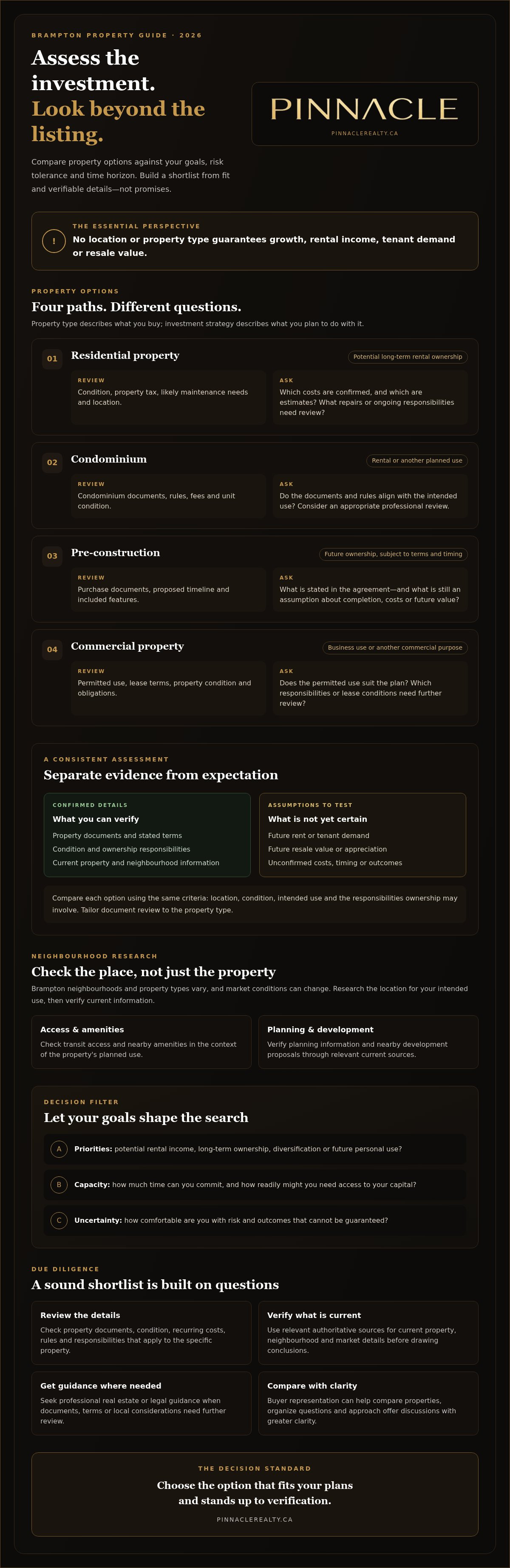
Start with location, condition, intended use and the responsibilities ownership may involve. Then tailor your document review to the property type. Use this table to organize your initial questions:
| Property type | Intended use | Key diligence | Questions to investigate |
|---|---|---|---|
| Residential property | Potential long-term rental ownership | Condition, property tax, likely maintenance needs and location | Which costs are confirmed, and which are estimates? What repairs or ongoing responsibilities need review? |
| Condominium | Ownership for rental or another planned use | Condominium documents, rules, fees and unit condition | Do the documents and rules align with the intended use? Ask an appropriate professional to review them. |
| Pre-construction | Future ownership, subject to project terms and timing | Purchase documents, proposed timeline and included features | What is stated in the agreement, and what remains an assumption about completion, costs or future value? |
| Commercial property | Business use or another commercial purpose | Permitted use, lease terms, property condition and obligations | Does the permitted use suit the plan? What responsibilities or lease conditions need further review? |
For a residential property in Brampton, the 2026 total residential property tax rate is 1.253381%, according to the City of Brampton. Use the applicable tax details for the specific property when estimating ownership costs. For commercial options, the City’s overview of Brampton's key economic sectors can add business context, but it can’t confirm demand for a specific unit or tenant.
How can you test the assumptions behind an investment?
Projected returns depend on assumptions that need independent checking. Build conservative scenarios and identify which estimates could change your decision, such as achievable rent, vacancy, repairs, ownership costs or resale value. Label each input as verified, estimated or unknown. An illustrative calculation is a planning tool, not a forecast or guaranteed outcome.
Financing terms, tax treatment, insurance coverage and legal documents should be reviewed by appropriately qualified professionals. A real estate representative can help organize property comparisons and offer discussions. Qualified financial, tax, insurance and legal professionals can address questions within their expertise. For a closer look at available properties, review current real estate listings and assess each against the same criteria.
Which Brampton locations and property signals deserve closer research?
No Brampton neighbourhood suits every investment plan. Begin with the property’s intended use, then research whether nearby services, connections and planning context support that use. For a potential rental, consider access to transit, employment, daily services and amenities relevant to prospective occupants. For commercial property, look at connections and nearby businesses related to its proposed use. These are research considerations, not evidence of future returns.
How should you research Brampton neighbourhood fundamentals?
Check current transit routes and service information, and consider how practical the location is for the people or businesses the property is meant to serve. Use City of Brampton planning resources to review local planning information and proposals, and regional sources for broader transportation and service context. Confirm whether a nearby development is proposed, approved, underway or complete before treating it as an existing feature of the area.
Infrastructure and proximity can inform your assessment, but they don’t prove that a property will appreciate or attract tenants. The City’s Invest in Brampton portal offers broader economic-development context. Treat it as a starting point for research, not an endorsement of a specific location or investment.
What should investors verify about a specific property?
Move from area research to property-level checks. Confirm the property’s current zoning and permitted use through authoritative municipal information. Verify that your intended use is allowed rather than relying on a listing description. If a zoning change or development proposal could affect your decision, check its current status with the City. Planning rules and project details can change, so use current information before making claims or commitments.
For a condominium, review relevant condominium documents and rules with appropriate professional advice. For commercial property, examine lease documents and property-specific obligations. Assess condition and expenses with qualified professionals, including legal, tax and inspection expertise where appropriate. Reviews and advice should address the specific property and intended use.
Local listing details can help you identify properties to investigate, but verify material facts independently. Review current property listings as examples for comparison, not as proof of rental demand, appreciation or resale prospects. Keep a record of each location’s verified features, the source and date checked, and any unanswered questions. This helps you assess neighbourhood appeal as one part of real estate investment opportunities Brampton may present, rather than treating proximity or headlines as a promise.
What risks and due diligence steps matter before investing in Brampton?
No property category or Brampton neighbourhood guarantees a positive outcome. Market conditions can change, a property may sit vacant, maintenance needs can emerge, financing terms can shift and contract conditions can affect your options. Due diligence won’t eliminate uncertainty. It can help you understand the risks before committing and decide whether they fit your circumstances.
What due diligence steps should you complete?
Start with your own parameters: define the intended use, budget, ownership horizon and level of uncertainty you can accept. Then gather available records for the specific property. Depending on the asset, these may include title information, disclosures, condominium documents, lease agreements and purchase contracts. Ask appropriate professionals to review documents you don’t understand instead of relying on a listing summary.
Next, verify the property’s condition, intended or permitted use and material operating assumptions. A building inspection may help identify condition concerns. Treat projected rent, vacancy and maintenance costs as estimates until independently supported. Consider how a less favourable scenario, such as a longer vacancy or an unexpected repair, would affect your decision. Keep a written record of what’s confirmed, what’s assumed and what still needs an answer.
Which local rules and responsibilities should you check?
If residential tenancy is relevant, consult the Landlord and Tenant Board for current Ontario information and seek qualified advice on how it applies to your situation. For zoning, permitted use and planning questions, check current City of Brampton information for the specific property. Don’t assume that a listing description, previous use or nearby development confirms what’s allowed now.
Have a lawyer review legal documents and contract terms, and consult a tax professional about ownership and tax implications. Financing and insurance also need property-specific review by appropriately qualified professionals. For commercial property, examine lease terms and related obligations. For a condominium, have the relevant documents and rules reviewed. Each asset raises different questions.
A disciplined process makes real estate investment opportunities Brampton buyers are considering easier to assess: define your limits, verify the facts, review the risks and proceed only when you understand the remaining uncertainties. For support comparing properties and discussing an offer, explore buyer representation with Pinnacle Realty.
How can Pinnacle Realty help you evaluate Brampton investment opportunities?
Once you’ve defined what you’re looking for, buyer representation can help turn a broad search into a focused conversation. A representative can help you understand listing details, compare options against your priorities, organize questions for further investigation and discuss offer terms. The aim is clarity at each step, not pressure to pursue a property that doesn’t fit.
What support can a Brampton brokerage provide?
Pinnacle Realty is a Brampton-based brokerage serving the GTA. Its services include residential buyer representation, condominium sales, pre-construction property sales, commercial real estate sales and commercial leasing. The right service depends on the property and your intended use. For commercial purchases or leases, consider the space, permitted use, lease terms and transaction documents on a property-specific basis. Review Pinnacle Realty’s brokerage information for an overview of its services.
Brokerage guidance can help you consider properties and navigate real estate discussions, but it doesn’t replace advice from other qualified professionals. A lawyer can address legal documents and contract questions; a tax professional can advise on tax implications; and financing and property condition questions should go to appropriately qualified professionals. Knowing which questions belong with each advisor helps you build a more complete picture.
What should you prepare before speaking with an agent?
A concise brief can make an initial conversation more useful. Consider bringing:
- Your preferred property types and intended use, such as residential, condominium, pre-construction or commercial.
- Your target timeframe and the priorities that matter most in your search.
- Questions about listings, transaction discussions or property details you want to clarify.
- A note on professional reviews or lender discussions you still need before making a decision.
You don’t need every answer before starting a conversation. Being clear about what you know, what you’re still exploring and what requires outside advice can help shape a considered search for real estate investment opportunities Brampton may offer. Listings and availability can change, so assess current opportunities on their details rather than assuming a category or location will deliver a particular result.
If you’re ready to discuss your goals and review suitable opportunities, contact Pinnacle Realty to discuss Brampton investments. A focused first conversation can help you identify the next questions to ask and the properties worth examining more closely.
Make your next Brampton property move with clarity
The strongest real estate investment opportunities Brampton may offer are those that align with your goals and hold up to careful review. Compare options by intended use, separate verified details from assumptions, and investigate neighbourhood and property-specific risks before deciding. No asset type or location guarantees a particular result.
A clear shortlist can make your next steps more focused. Pinnacle Realty is a Brampton-based brokerage serving clients across the Greater Toronto Area, with residential buyer representation, condominium and pre-construction sales, and commercial real estate services. Brokerage guidance can help you compare opportunities and discuss offers, while legal, tax, financing and inspection questions belong with appropriately qualified professionals.
Whether you’re refining your criteria or ready to assess specific properties, take the next step at a pace that suits you. Discuss Brampton investment opportunities with Pinnacle Realty and start shaping a considered path forward.
Frequently Asked Questions
What are the main real estate investment opportunities in Brampton?
Investors can explore residential properties, condominiums, pre-construction homes and commercial real estate in Brampton. Each option involves different ownership responsibilities, documents and risks, so the right fit depends on your goals and circumstances. Availability and suitability can change, and no category is automatically best. Assess specific properties on their merits, and get independent legal, financing and tax advice before committing to a purchase or lease.
Is Brampton a good place to invest in real estate?
Brampton may suit some investors, but whether it’s a good fit depends on the property, intended use, finances, ownership horizon and risk tolerance. Transit, amenities, planning information and employment context can inform your research, but they don’t guarantee rental demand or appreciation. Look for current, property-specific evidence, verify important details and consult qualified professionals before relying on assumptions about future income or value.
Can I invest in Brampton pre-construction property?
Yes, pre-construction property is an option to investigate, but review the agreement and project details carefully before signing. Understand the stated timeline, deposit terms, included features and provisions that address possible changes. Ask an Ontario real estate lawyer to review the contract, and confirm applicable protections and obligations through authoritative sources. Completion timing, future value and rental performance are uncertain, so don’t treat estimates as guaranteed outcomes.
How much money do I need to invest in Brampton real estate?
There’s no single amount that applies to every investor or property in Brampton. The funds required depend on the property, financing terms, deposits, closing expenses, ongoing costs and lender requirements. Develop a budget for the specific opportunity with a mortgage professional, and consult legal or tax advisors about relevant expenses and implications. This guide doesn’t estimate purchase prices or confirm affordability, so verify figures before making a commitment.
What happens if my Brampton investment property is vacant?
A vacancy can interrupt rental income while some ownership expenses may continue, but the effect depends on the property and its financing arrangements. Before purchasing, consider whether your budget can accommodate a period without a tenant, repairs and unexpected expenses. Research local rental conditions, but don’t treat asking rents as guaranteed income. For a residential rental, seek current advice on tenancy rules, insurance coverage and your responsibilities as an owner.
Do I need a real estate agent to buy an investment property in Brampton?
You can work with a real estate representative to identify listings, compare property details and navigate offer discussions. Buyer representation may help organize your search, but it doesn’t guarantee investment performance or replace advice from a lawyer, inspector, lender, accountant or tax professional. Before proceeding, ask what the representation includes, clarify how it works and review any applicable agreements so you understand the arrangement.
Is commercial real estate a suitable investment in Brampton?
Commercial real estate may suit investors whose goals and resources align with a property’s intended use, condition, lease structure and ownership responsibilities. Investigate permitted use, lease terms, operating obligations and tenant-related considerations for the specific asset. These details vary, so have relevant documents reviewed by qualified professionals. Don’t assume commercial properties are inherently more profitable or stable than residential options; assess the evidence and risks property by property.


