

The right Brampton home for your family may not be the one with the most bedrooms. A spacious layout can look compelling in listing photos, but the school run, commute, nearby parks and room to grow will shape how it feels to live there. That’s why comparing Brampton real estate for young families works best when you consider daily routines alongside floor plans.
Before you move, you’ll want a clearer picture of school boundaries, transit and everyday services. A home that suits your family now may feel different as routines and needs change, so weigh each option against both your current priorities and likely future needs.
This guide will help you compare Brampton neighbourhoods and home types by looking at school and enrolment details, commuting patterns, outdoor space and long-term flexibility. You’ll also find practical checks to make before an offer, including how to verify current school boundaries and transit schedules. With a consistent comparison process and professional buyer representation, you can focus on the home that fits your family’s needs.
Key Takeaways
- Build your home search around daily routines, including school trips, commuting, errands and time outdoors.
- Compare Brampton neighbourhoods such as Mount Pleasant, Bramalea, Heart Lake and Fletcher’s Meadow by researching how each fits your family’s priorities.
- Weigh detached homes, townhouses and condos against your needs for space, outdoor access, upkeep and location.
- Before making an offer, verify school boundaries, test regular travel routes and review the property alongside current records.
- Use a consistent comparison process to assess Brampton real estate for young families, then use buyer representation to organize property questions and offer negotiations.
Brampton real estate for young families: start with the life you want
The right family home isn’t simply the one with the most bedrooms. It’s the one that supports the rhythm of your days, from getting everyone out the door to making space for work, play and rest. When comparing Brampton real estate for young families, consider layout, location, commute and future flexibility together. A home can look ideal online but feel impractical if it doesn’t support your everyday routines.
Before browsing, separate non-negotiables from preferences. Your family might prioritize a manageable commute, enough bedrooms for current needs and convenient storage for strollers or outdoor gear. A finished basement, a larger yard or a particular architectural style might be preferences rather than requirements. This distinction gives you a consistent way to compare homes and keeps polished listing photos from distracting you from practical needs.
Compare the routines a home makes possible alongside the features it puts on display.
Which home features matter as family routines change?
Bedroom count tells only part of the story. Consider whether the living area has room for shared time, whether storage can handle seasonal clothing and sports equipment, and whether an extra room could adapt as children grow or work needs shift. Think about stairs, too. Carrying a sleeping child or bringing groceries inside can make the layout matter in everyday ways.
Look at the entrance, outdoor access and how your household would move through the space. A practical place to put coats and bags may matter more than a formal room that rarely gets used. A yard can offer convenient play space, while a balcony or nearby park may suit a different routine. Brampton is a large city with varied communities and geography; its Brampton, Ontario overview offers general context, but your household’s priorities should guide the search. There’s no single ideal layout.
How to set a realistic Brampton home search
Rank location, property type, commute and interior space by importance. Then decide what you could trade: perhaps a longer drive for more usable living space, or a smaller yard for easier access to transit and errands. Be specific about how often each household member travels, what belongings need storage and which rooms may need to serve more than one purpose.
- Non-negotiables: A workable school-day routine, sufficient bedrooms or a commute that fits your schedule.
- Flexible preferences: A particular finish, extra yard space or a dedicated room for occasional use.
Revisit your shortlist as you explore current listings. Availability changes, and appealing features don’t always solve everyday needs. Brampton homes for sale can help you see what’s currently available. At each viewing, picture an ordinary weekday, not just a special occasion. This makes it easier to assess whether a property fits your family now and can adapt as needs change.
Compare Brampton neighbourhoods through schools, commuting, and daily errands
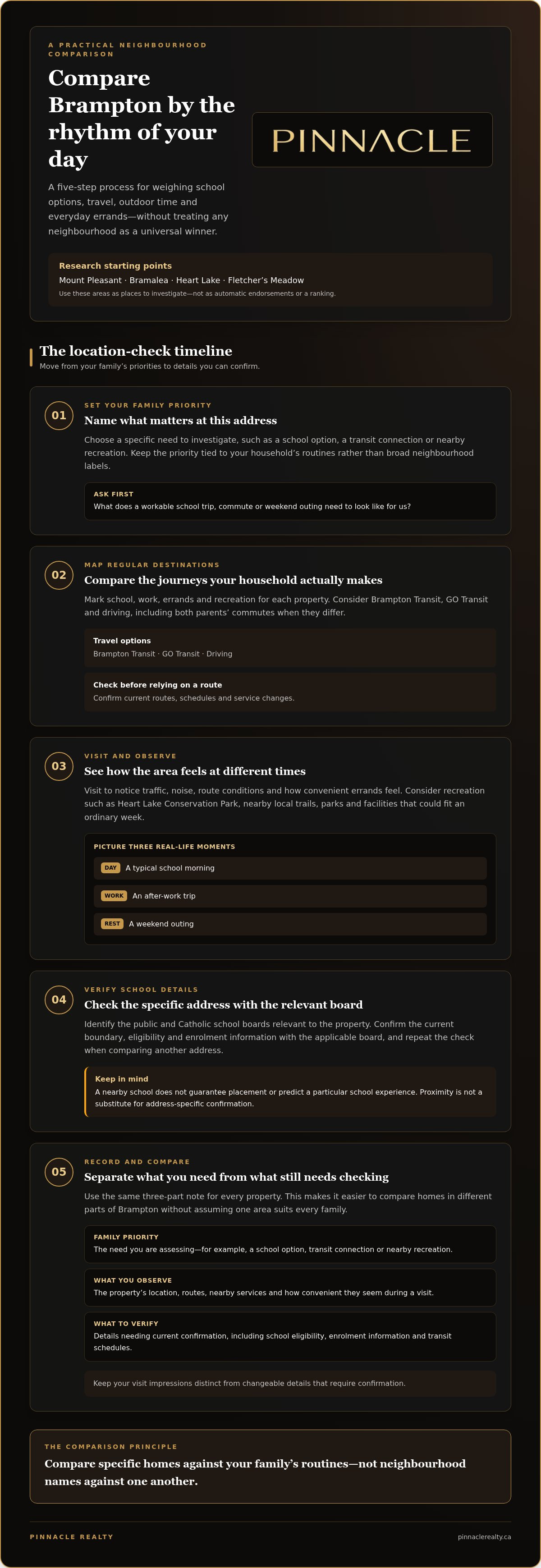
A neighbourhood isn’t a universal ranking. It’s a set of daily trade-offs: how children may get to school, how adults reach work, where the family can spend time outdoors and how easily errands fit between other commitments. When looking at Brampton real estate for young families, compare specific locations against your routines instead of relying on broad labels or a single neighbourhood recommendation.
Mount Pleasant, Bramalea, Heart Lake and Fletcher’s Meadow can all be starting points for research, not automatic endorsements. For each area, look at homes that meet your needs and map the practical details around them. A useful comparison can be brief:
- Family priority: Name the need, such as a particular school option, a transit connection or nearby recreation.
- What you observe: Record the property’s location, routes, nearby services and how convenient they seem during a visit.
- What to verify: Note details that need current confirmation, including school eligibility, enrolment information and transit schedules.
This keeps your impressions separate from details that can change. It also lets you compare homes in different parts of the city without assuming one area is better for every family.
How to check school options and boundaries in Brampton
First identify the public and Catholic school boards relevant to each address you’re considering. Then verify the current school boundary, eligibility and enrolment information with the applicable board. A nearby school may be worth considering, but proximity alone doesn’t guarantee placement or predict a particular school experience. Check the specific address, and repeat the process when comparing homes in different catchments.
How transit, parks, and errands shape a family’s location choice
Map your household’s regular destinations, then compare how Brampton Transit, GO Transit and driving fit each location. Check current routes, schedules and service changes before relying on a travel plan. For recreation, look into Heart Lake Conservation Park and nearby local trails, along with parks and facilities that could fit an ordinary week. Visit areas at different times to notice traffic, noise, route conditions and how convenient errands feel.
Make the comparison concrete by considering a typical school morning, an after-work trip and a weekend outing. If parents have different commutes, assess both rather than focusing on just one route. Include groceries, childcare and other regular stops. A route that looks simple on a map may feel different during busy periods, so experience it in person where practical.
Keep your notes in one place and mark each item as observed or still requiring confirmation. This makes a complex choice easier to manage. If you want professional support weighing property options and questions as you compare addresses, Pinnacle Realty’s buyer representation can help organize your family’s move.
Detached home, townhouse, or condo: compare Brampton options for family life
Property type affects more than the number of rooms. It can shape outdoor access, storage, upkeep and how close you are to everyday destinations. When comparing Brampton real estate for young families, assess the actual homes on offer rather than relying on assumptions about detached, townhouse or condo living.
A good family fit balances usable space, daily routines and the responsibilities that come with the property.
| Family priorities | Potential advantages | Trade-offs to consider |
|---|---|---|
| Room to adapt and private outdoor space | A detached home may offer flexible interior areas and a yard, depending on the property. | More space or a yard may bring additional upkeep; features vary from home to home. |
| Practical living space with outdoor access | A townhouse may offer multiple levels and, in some cases, a private outdoor area. | Stairs, shared walls, parking and maintenance arrangements can affect daily use. |
| Location, manageable upkeep or shared facilities | A condo may place a family near services and offer shared spaces, where available. | Private storage and outdoor access may be limited; rules, fees and amenities vary by building. |
When might a detached home suit a young family?
A detached home may appeal if private outdoor space or rooms that can change purpose are high priorities. A spare bedroom could eventually serve as a study or playroom if its size and location work for your household. Weigh that flexibility against the time and effort needed to maintain the home and yard. Assess the specific property, not the category alone.
During a viewing, picture routines that can make a layout feel convenient or cumbersome: bringing in groceries, getting children ready, storing outdoor gear and moving between floors. Check whether the entrance has practical space for coats and shoes, and whether the rooms support both quiet time and family activities. A larger footprint doesn’t automatically mean more useful living space.
When might a townhouse or condo make sense?
A townhouse or condo may suit families who value location, a particular layout or less private exterior space to maintain. Compare the unit’s storage, outdoor access, parking and distance to regular destinations. Shared amenities can be useful when they match your routine, but their availability and terms differ by property. Read current listing details and applicable documents before drawing conclusions about rules, fees or responsibilities.
For townhouses, review the ownership structure and property documents to understand maintenance and shared areas. For condos, review the relevant documents for building rules, fees, amenities and other details that affect how the home can be used. These specifics vary, so don’t assume that two properties of the same type operate alike.
Use the table as a starting point, then compare actual listings against the needs you ranked earlier. Consider which trade-offs would be easy to live with on an ordinary weekday and which might become frustrating as your family’s needs change. The strongest choice isn’t necessarily the largest or most feature-rich. It’s the home whose space, upkeep and location work together.
Use this Brampton family-home checklist before you make an offer
A promising home deserves more than a quick second look. Before making an offer, bring together your priorities, address-specific research and property questions so you can assess the home on the same basis as other options. When comparing Brampton real estate for young families, a consistent process helps separate what you’ve observed from what still needs confirmation.
What should families verify about a shortlisted address?
Use the exact address for checks that depend on location. School boundaries and enrolment details can change, as can transit schedules and routes. Confirm current information with the relevant school board and transit providers, and note when you checked it. A map or listing can guide your research, but it shouldn’t replace address-specific verification.
- Revisit your priorities. Review your must-haves and flexible preferences. Make sure they still reflect your family’s routines, likely space needs and acceptable trade-offs.
- Verify the address details. Check applicable school boundaries, eligibility and enrolment information, transit routes, nearby services and travel times. Mark each item as confirmed or still outstanding.
- Test the routes. Where practical, visit during a realistic commute, school drop-off or activity time. Notice traffic, noise, parking and how convenient regular errands feel from the property.
- Review the home. Record what you can observe, including the layout, storage, stairs, outdoor access and visible maintenance needs. Separately review listing details and relevant property or condominium documents with appropriate professional guidance.
- Compare your options. Use the same priorities and questions for every shortlisted home. Current Brampton property listings can help you identify options to compare, but availability and listing details can change.
How to compare shortlisted homes without losing sight of priorities
Create a simple scorecard with one row per home and columns for must-haves, trade-offs, routine-related observations and unanswered questions. Assess each property against your own ranked priorities, not another family’s preferences. Keep personal observations, such as a tight entrance or a convenient route, separate from details that require current records or professional review.
Look beyond the first impression. Compare regular travel demands, outdoor and interior upkeep, storage, and how the home might work as household needs change. A feature that seems manageable during a viewing may have a different impact when you use it every day. Record follow-up questions so you can resolve them before making a decision instead of relying on memory or assumptions.
Buyer representation can help organize property questions, compare options and navigate offer negotiations as your shortlist becomes a purchase decision. For professional buyer representation through this significant family move, Pinnacle Realty can help you approach the next step with clarity.
Make your Brampton move with a clear buyer-representation plan
Once you’ve compared home types, addresses and daily routines, turn your notes into a focused buying plan. A clear brief keeps the search centred on what matters to your family. Professional buyer representation can help structure property comparisons, follow-up questions and offer negotiations. It supports an important decision without promising a particular home, price or outcome.
What does buyer representation contribute to a family home search?
A buyer representative can help organize your priorities against the properties you’re considering, identify questions that need further attention and guide you through the purchase process. When evaluating an offer, professional negotiation can help you understand the choices in front of you and communicate your position. The goal is informed decision-making, grounded in your family’s needs and circumstances.
This support can be useful when two homes meet different parts of your criteria. One may work better for your regular routes, while another may offer a layout that suits your household. A structured comparison keeps the discussion specific: what works, what needs clarification and which trade-offs you’re prepared to make. Your priorities shape the search, but they can’t guarantee a particular result.
How to turn your shortlist into a confident next step
Before speaking with a buyer representative, bring a concise summary of your family’s priorities and the areas you’re considering. Include your shortlisted homes and unanswered questions about the property, applicable documents, school information or regular travel routes. This gives the conversation a practical starting point and focuses attention on the decisions still ahead.
Identify where you’re flexible, too. Perhaps location matters more than a particular finish, or you’d consider a different property type if the layout and commute work better. Naming these trade-offs makes it easier to assess suitable options without losing sight of your non-negotiables. You can then decide how you’d like to proceed at a pace that fits your planning.
- Clarify: Summarize must-haves, preferences and the compromises your family would consider.
- Review: Bring the addresses and questions that remain unresolved.
- Decide: Discuss how to compare options and plan a purchase.
For families exploring Brampton real estate for young families, professional representation connects the practical details of a search with the negotiation decisions that follow. Pinnacle Realty provides residential buyer agency and professional negotiation for buyers across the GTA. Explore Pinnacle Realty’s Brampton real estate services to plan your move.
Make your next move with confidence
Your family’s needs will keep evolving, so a thoughtful home search leaves room for decisions rather than pressure to settle quickly. Use your priorities as a guide, and let new questions shape the next conversation as you move from exploring options toward a purchase. That’s a measured way to approach Brampton real estate for young families.
Buyer representation can help bring structure to that transition, from weighing shortlisted properties to navigating offer negotiations. Pinnacle Realty is a Brampton-based brokerage serving residential buyers across the Greater Toronto Area, with buyer agency services and professional negotiation to support your search.
Ready to plan your next step? Discuss your Brampton home search with Pinnacle Realty and start with a clear picture of what your family needs.
Frequently Asked Questions
Which Brampton neighbourhoods should young families consider?
Mount Pleasant, Bramalea, Heart Lake and Fletcher’s Meadow can all be useful starting points for research, but the right fit depends on your family’s destinations and preferences. Compare how each address connects to your workplace, childcare, recreation and relatives you visit regularly. Don’t use a neighbourhood name as a shortcut for evaluating a particular property. Housing options, services and travel convenience can differ within the same area.
Is Brampton a good place to raise a family?
Brampton may suit families looking for a range of housing options, parks and community amenities, but whether it feels right depends on your day-to-day needs. Consider where you’ll spend time after school, how household members will commute and whether nearby services fit your routines. Explore specific areas in person and assess practical details, including access to recreation and the places your family visits most often.
How do I find the right school for my child in Brampton?
Start by identifying the public or Catholic school board that serves the property address, then review its current school locator, eligibility rules and enrolment information. In Brampton, families may need to consult the Peel District School Board or the Dufferin-Peel Catholic District School Board, depending on the address and school system. Contact the relevant board for current guidance. A school’s distance from a home alone doesn’t establish eligibility or available placement.
Should a young family buy a detached home or a townhouse in Brampton?
Choose based on how the particular property supports your household, rather than assuming detached homes always offer a better family fit. A detached home may provide a private yard, while a townhouse may offer a layout or location that better supports your regular routine. Compare usable rooms, stairs, storage, outdoor space and maintenance responsibilities. If you’re considering a townhouse, review its listing details and applicable documents to understand shared areas and responsibilities.
Are condos in Brampton suitable for young families?
A condo can work for a family if its layout, storage, outdoor access and location suit your needs. Consider where strollers, bikes and seasonal belongings will go, and whether the building’s shared facilities fit your household’s habits. Review the current condominium documents for rules, fees, amenities and other building-specific details. A visit at different times can also help you assess noise and how shared spaces function during your usual routines.
What should I check before making an offer on a Brampton home?
Before deciding, review the listing details, ask questions about features you couldn’t assess during a viewing and gather relevant property documents for appropriate professional review. Confirm address-specific school information and current transit routes, and revisit the area at a time that reflects your normal schedule. Keep unresolved items written down. This creates a clearer record of what you know, what needs follow-up and what may affect your decision.
Can a real estate agent help my family compare Brampton homes?
Yes. A buyer representative can help organize property comparisons, identify questions to follow up on and support you through offer negotiations. Share your family’s priorities, preferred areas and flexibility so the discussion reflects your needs rather than a generic checklist. Pinnacle Realty provides residential buyer agency services for families planning a Brampton purchase. Professional representation can help you make considered choices, but it can’t guarantee a particular home or transaction outcome.


