

The purchase price is only part of your budget. Your closing costs Brampton estimate can vary depending on whether you’re buying a resale home or a pre-construction property. Unanticipated adjustments or charges can put pressure on your plans just before possession, so it pays to review costs early.
It’s natural to focus first on the down payment, then ask how much more to set aside. In Brampton, buyers pay Ontario’s provincial land transfer tax, but there’s no additional municipal land transfer tax. Eligible first-time buyers may qualify for a provincial rebate of up to C$4,000, subject to current rules. That distinction can affect your budget, but the rebate won’t cover every legal, inspection, title or property-specific cost.
This guide explains which one-time expenses to consider before making an offer, how they differ from ongoing ownership costs, and what to compare when buying resale or pre-construction. Use the budget framework to organize estimates, then confirm transaction-specific amounts and eligibility with your real estate lawyer and other qualified professionals. Start with the property you’re considering, then check each estimate against the agreement and current requirements.
Key Takeaways
- Build your closing-cost estimate around the property type, purchase agreement, financing and your circumstances.
- Check land transfer tax and rebate eligibility against current Ontario rules. Don’t count a potential rebate as guaranteed savings.
- For pre-construction, review the agreement for possible adjustments and charges instead of assuming every new-build fee applies.
- Organize your budget into confirmed amounts, provisional estimates and expenses outside the closing statement.
- Use this guide to map out closing costs Brampton buyers may face, then confirm transaction-specific figures with your real estate lawyer and other qualified professionals.
What closing costs should Brampton homebuyers plan for?
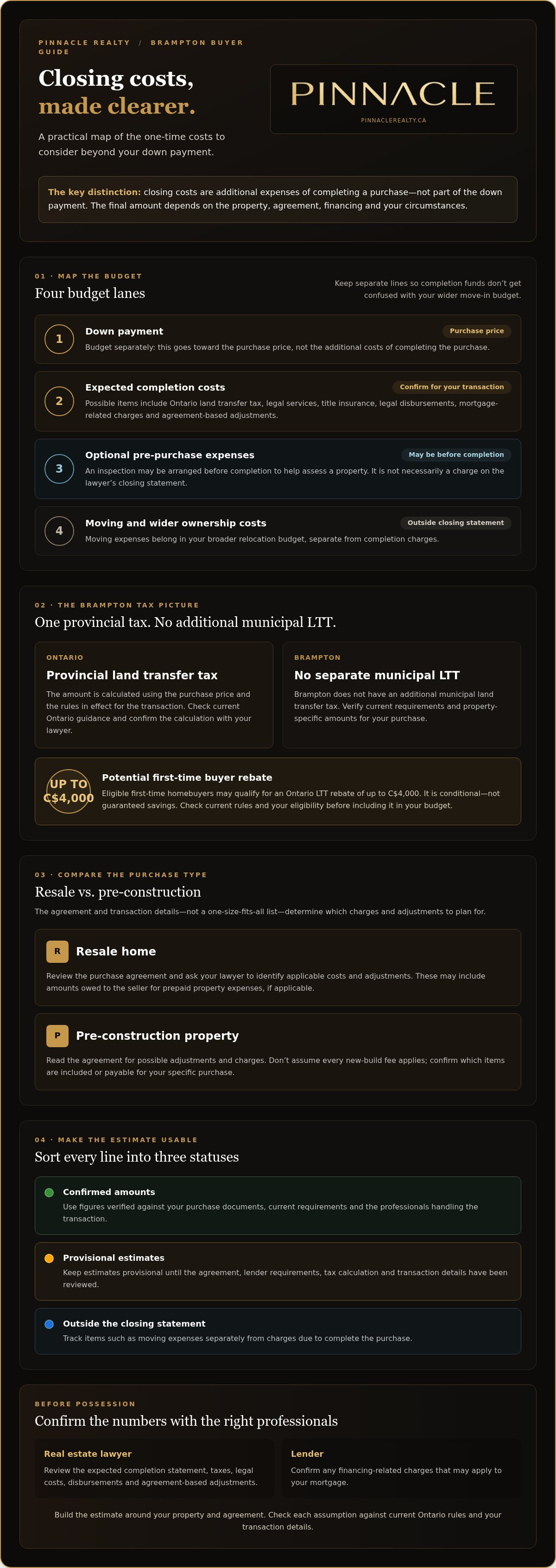
Closing costs are transaction-related amounts a buyer may need to pay around the date a property purchase is completed. They’re separate from the down payment, which goes toward the purchase price. Put simply: closing costs are the additional expenses of completing a home purchase, not part of the down payment itself.
There’s no single total that applies to every buyer. Costs can vary with the property, purchase agreement, financing and personal circumstances. A resale home and a pre-construction purchase, for example, may involve different charges or adjustments. The agreement and transaction details determine what to include.
Which expenses are typically included in a home purchase?
Potential completion costs include Ontario land transfer tax, legal services, title insurance and legal disbursements, which are expenses a lawyer pays on a client’s behalf. Mortgage-related charges depend on the financing and lender requirements. Your lawyer can also identify adjustments set out in the agreement, such as amounts owed to the seller for prepaid property expenses, if applicable.
Not every buyer pays every item. An inspection, for example, may be arranged before completion to help assess a property. Moving expenses belong in your broader relocation budget, rather than among charges on the lawyer’s closing statement. For a general introduction to understanding real estate transactions, readers can explore the broader context of property ownership and transfer.
What makes a Brampton closing budget different?
Ontario’s rules provide the framework, but the property and agreement determine the final figures. Brampton buyers should verify which taxes and charges apply to their specific purchase. Brampton doesn’t have a municipal land transfer tax, unlike Toronto, but confirm current requirements and any other property-specific amounts with your lawyer.
Keep your estimate provisional until the professionals involved have reviewed the transaction details. Ask your real estate lawyer to explain the expected completion statement, including taxes, legal costs, disbursements and adjustments. Ask your lender about any financing-related charges that may apply to your mortgage. A buyer representative can help you understand the property search and offer process, while legal and financing figures need confirmation from the relevant professionals.
A practical first step is to make separate budget lines for the down payment, expected completion charges, optional pre-purchase expenses and moving costs. This makes it easier to distinguish what must be ready for completion from expenses in your wider move-in plan. For closing costs Brampton buyers should not rely on a broad estimate alone. Check each assumption against the agreement, lender requirements and current Ontario rules.
How Ontario land transfer tax and buyer rebates affect Brampton closing costs
Ontario land transfer tax (LTT) is a provincial tax payable on qualifying real estate transfers. It can be a substantial part of closing costs Brampton buyers need to plan for. The amount is calculated using the purchase price and the rules in effect for the transaction. Brampton doesn’t have a separate municipal land transfer tax, but check whether local rules differ if you’re considering a property in another municipality.
For a current calculation, use the Government of Ontario’s Ontario Land Transfer Tax guidance. The provincial page explains the applicable calculation and rebate information. Treat an online estimate as a planning figure, then ask your real estate lawyer to confirm the amount for your purchase before completion.
How can buyers estimate Ontario land transfer tax?
Start with the purchase price and use the current provincial calculator or follow Ontario’s published calculation rules. Don’t rely on an old estimate or assume a rebate will apply automatically. The final amount depends on the transaction details and any rebate for which you qualify. Your lawyer can check the calculation against the purchase documents.
Who may qualify for a first-time buyer rebate?
Eligible first-time homebuyers may receive an Ontario LTT rebate of up to C$4,000. The benefit is conditional, not an automatic discount. Eligibility can depend on citizenship or permanent-resident status, age, occupancy of the home as a principal residence and ownership history. Review the current provincial requirements carefully and ask your lawyer how they apply to each purchaser named in the transaction.
Confirm rebate eligibility against current Ontario rules before including a potential saving in your closing budget. A proposal or estimate from an older source isn’t a substitute for checking the official guidance in effect at the time of purchase.
| What to verify | Why it matters |
|---|---|
| Purchase price and current LTT calculation | These determine the starting tax estimate under provincial rules. |
| Each buyer’s rebate eligibility | Ownership history and other requirements may affect whether a rebate is available. |
| Property municipality | Municipal land transfer taxes, where applicable, depend on location. |
| Final amount with your lawyer | The completion calculation should reflect the agreement and current requirements. |
For a Brampton purchase, a buyer representative can help you understand the property search and offer process, while your lawyer confirms tax calculations and legal requirements. To discuss your buying goals, explore Pinnacle Realty’s buyer services.
Resale vs. pre-construction: how Brampton closing costs can differ
The type of purchase affects what you need to review before completion. A resale transaction may include adjustments for expenses the seller has already paid. A pre-construction agreement may set out additional charges related to the development. Neither option is automatically less expensive. The documents, timing and buyer’s circumstances determine the actual amounts.
Land transfer tax may apply to either type of purchase. For the provincial calculation, refer to the Government of Ontario’s Calculating Ontario Land Transfer Tax guidance, then ask your lawyer how it applies to your transaction.
What adjustments might appear when buying a resale home?
In a resale purchase, the seller may have prepaid expenses that extend beyond the closing date. If applicable, property taxes or agreed-upon prepaid services can be prorated so each party is responsible for their share of the relevant period. The transaction documents set out the amounts and dates, which are reconciled through the lawyer’s statement of adjustments.
Review the statement with your lawyer. Confirm the period covered, how each amount was calculated and which party is responsible. Don’t assume a familiar adjustment will apply or that its amount will match an earlier estimate. The property records and agreement determine the details.
What should pre-construction buyers review in the agreement?
New-build contracts may include development-specific charges, utility connection costs and other adjustments. The agreement may also cover items such as development levies or warranty-related charges. These aren’t universal fees. Whether they apply, how they’re calculated and whether limits are specified depend on the contract.
Ask your real estate lawyer to explain the wording, including caps, definitions, payment timing and how adjustments could change by final closing. If there’s an occupancy period before final closing, confirm which payments are due during that period and how they differ from the amounts payable at final closing. The contract governs, so don’t treat occupancy-related payments as interchangeable with final closing costs.
For a clearer comparison, sort the agreement’s charges into three groups: amounts due before occupancy, amounts due at final closing and adjustments that still need confirmation. This helps you compare like with like instead of relying on a headline estimate. Pinnacle Realty provides buyer representation and pre-construction services. Learn more about buyer and pre-construction services. Confirm legal and tax questions with the appropriate professionals.
How to build a realistic Brampton closing-cost budget before making an offer
A useful budget is more than a single estimate. It shows what’s confirmed, what still needs checking and which moving expenses fall outside the lawyer’s completion statement. Build it before committing to an offer, then update it as the transaction details take shape.
- Identify the property type. Note whether you’re considering a resale home or pre-construction property. The agreement and timing can affect which costs or adjustments may apply.
- Collect the documents. Gather the purchase agreement when available, the lender’s estimate, your lawyer’s preliminary estimate and relevant property information. For a pre-construction purchase, include the full agreement and any schedules describing charges or adjustments.
- Request transaction-specific estimates. Ask your lawyer and lender to explain their figures. Find out which amounts are included, excluded, conditional or subject to final adjustment.
- Record assumptions and confirm them. Note the source and date beside each estimate, then ask the responsible professional about anything unclear. Refresh the figures if your financing, offer terms or closing date changes.
Organize the numbers into three groups: confirmed amounts, provisional estimates and expenses outside the closing statement. The last group can include an optional inspection or moving costs. Keeping these categories separate helps prevent a broad “closing costs” estimate from obscuring the cash you’ll need for the wider move.
Set aside a contingency buffer that reflects your comfort with uncertainty, especially while estimates or agreement details remain unresolved. No single buffer suits every purchase. The aim is to avoid treating a provisional figure as final and to leave room for confirmed adjustments before completion.
Who should confirm each part of the budget?
Your real estate lawyer can clarify legal completion items, adjustments and title-related requirements. Ask your lender to explain financing conditions and any mortgage-related charges. A buyer representative can help you understand the offer process and property context, but does not replace legal or lending advice.
For a practical review, ask: “What’s included in this estimate? What could change? Who can confirm the final amount, and by when?” Keep the answers with your budget so outstanding questions are visible before you make an offer.
For support with the property search and offer process, explore Pinnacle Realty’s buyer representation. A clear plan for closing costs Brampton buyers may face starts with organized documents, current estimates and the right professional confirming each figure.
Plan your Brampton purchase with clear advice and confirmed numbers
A closing-cost estimate is a planning tool, not a final quote. The signed agreement, property details and current rules determine what you’ll owe. Before waiving conditions or finalizing your plans, make sure the figures that could affect your decision have been checked by the right professionals.
What should buyers confirm before waiving conditions or finalizing plans?
Ask for an updated lawyer’s estimate based on the agreement and proposed closing date. Confirm financing details and any mortgage-related charges with your lender, and check applicable rebates against current requirements with your lawyer or the appropriate tax authority. For a resale home, clarify adjustments. For pre-construction, review agreement-specific charges and payment timing.
Pause on any figure labelled conditional, estimated or subject to adjustment. Ask which assumptions it relies on, what could change it and who can confirm the final amount. General online examples can help you identify questions to ask, but they aren’t a quote for your purchase.
- Does the estimate reflect the current agreement and closing date?
- Are rebates or other savings confirmed, or only assumed?
- Which amounts could change before completion, and who will update them?
Keep the answers with your budget. If your financing, offer terms or closing date changes, ask whether the estimates need to be revised. This helps prevent an earlier planning figure from being mistaken for the amount due.
How can local buyer representation help you move forward?
A local buyer representative can help you assess property options, understand the offer process and consider how a property fits your priorities. That support is separate from legal, lending or tax advice. Your lawyer should confirm legal completion items and agreement terms, your lender should explain financing, and a qualified tax professional or relevant authority can address tax questions.
As you refine your search, review current property listings and consider which homes merit a closer look. Pinnacle Realty is a Brampton-based brokerage offering buyer agency services. For support with your Brampton buying goals and the property search and offer process, connect with Pinnacle Realty. You don’t need to have every detail resolved before starting a conversation. Bring your priorities and the questions you’re working through.
A thoughtful plan for closing costs Brampton buyers may face starts with clear assumptions and confirmed figures. With the right professionals reviewing their areas of expertise, you can approach the next step with greater clarity.
Move forward with a confident Brampton buying plan
A strong purchase plan starts with a realistic view of the full budget. Closing costs Brampton buyers face depend on the property, agreement and personal circumstances. Use estimates as a starting point, then confirm final figures with your lawyer and lender. Check current land transfer tax and rebate rules, and review pre-construction charges or resale adjustments in the documents before you commit.
The right guidance can also bring clarity to the property search and offer process. Pinnacle Realty is a Brampton-based brokerage with residential buyer agency experience across the GTA, including condominium and pre-construction property sales. Its buyer representation can help you assess options and understand local market context, while legal, lending and tax questions should go to the relevant qualified professionals.
Ready to explore your next move? Discuss your Brampton home-buying plans with Pinnacle Realty. With thoughtful preparation and confirmed numbers, you can approach this important transition with greater confidence.
Frequently Asked Questions
How much are closing costs when buying a home in Brampton?
There isn’t one fixed total for closing costs Brampton buyers will pay. The amount depends on factors such as the purchase price, property type, agreement, financing and eligibility for rebates. Potential expenses include provincial land transfer tax, legal services, title insurance and transaction adjustments. Pre-construction agreements may set out additional charges. Treat general estimates as a starting point, then ask your lawyer and lender to confirm figures for your specific purchase.
Do Brampton buyers pay land transfer tax?
Yes. Buyers of qualifying properties in Brampton pay Ontario land transfer tax, calculated under the provincial rules in effect for the transaction. The purchase price affects the calculation, and an eligible first-time homebuyer rebate may reduce the amount payable. Ask your real estate lawyer to confirm the calculation and any rebate applied to your purchase. Don’t assume an online estimate reflects your final amount.
Is there a municipal land transfer tax in Brampton?
No. Brampton does not charge a separate municipal land transfer tax, so buyers pay the provincial land transfer tax that applies to their transaction. This differs from Toronto, which has its own municipal land transfer tax. If you’re comparing properties in different municipalities, confirm which taxes apply at each location and have your lawyer verify the calculation for the property you’re purchasing.
Can first-time homebuyers get a land transfer tax rebate in Ontario?
Yes. Eligible first-time homebuyers may qualify for an Ontario land transfer tax rebate of up to C$4,000. Eligibility is conditional and can depend on factors such as age, citizenship or permanent-resident status, occupying the home as a principal residence and ownership history. Check the current Ontario requirements before including a rebate in your budget, and ask your lawyer to confirm whether each buyer qualifies.
What closing costs are different for a pre-construction home?
Pre-construction purchases may involve agreement-specific charges that aren’t typical of a resale transaction, such as development-related levies, utility connection costs or other adjustments. Which items apply depends on the contract, so review its definitions, caps and payment timing with your lawyer. If there’s an occupancy period before final closing, confirm which payments are due during occupancy and which are payable at final closing.
When do I need to pay closing costs on a Brampton home?
Many legal completion costs and adjustments are due around the closing date, when the purchase is finalized and ownership transfers. Some expenses, such as an optional home inspection or moving costs, may be paid earlier or separately. Pre-construction contracts can also set out payments at different stages, including before final closing. Ask your lawyer for the expected payment timeline based on your agreement and closing statement.
Does a mortgage pre-approval include all home closing costs?
No. A mortgage pre-approval generally relates to financing, but it shouldn’t be treated as a complete estimate of your purchase expenses. It may not account for legal services, land transfer tax, title insurance, adjustments, agreement-specific charges or moving costs. Ask your lender to explain mortgage-related costs, then request a property-specific estimate from your lawyer. Keep confirmed figures separate from provisional estimates as your offer details develop.


